
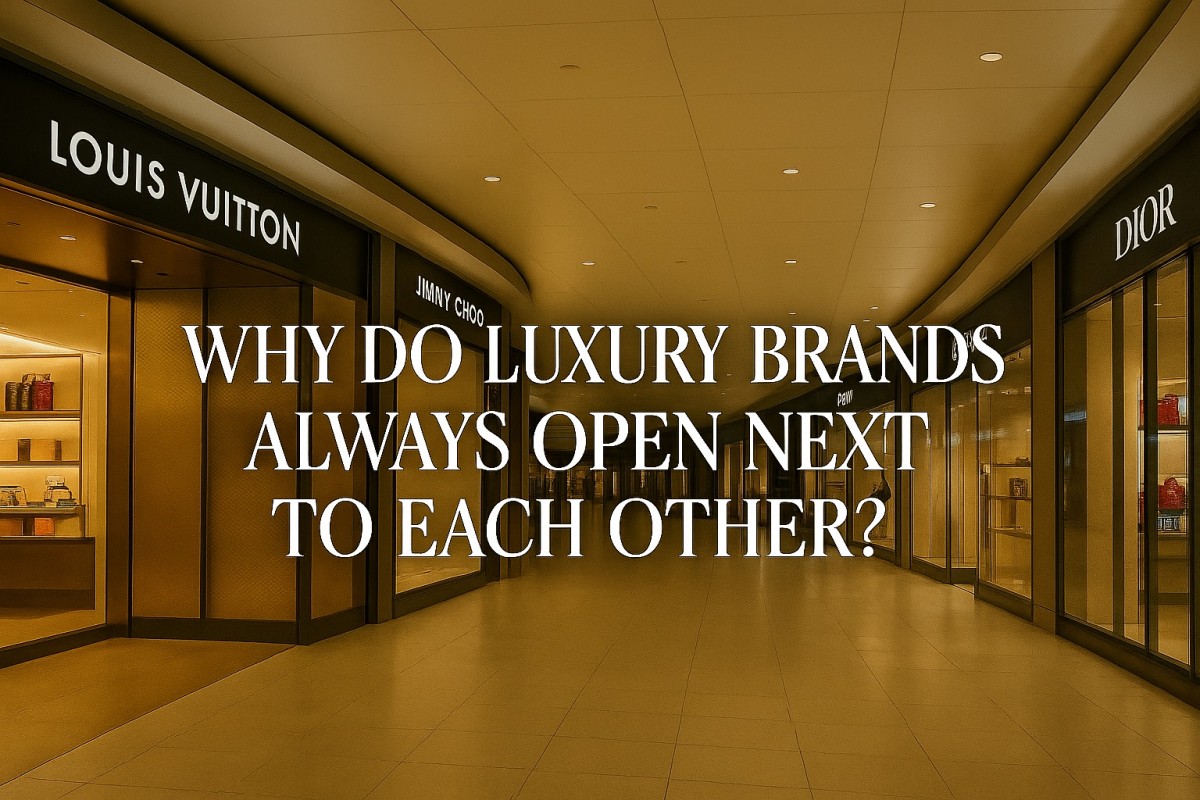
We see it everywhere: Old Bond Street in London, Via Montenapoleone in Milan, Canton Road in Hong Kong. The most ambitious names in luxury gravitate towards one another, as if pulled into the same orbit. And, of course, this is also true across the world’s leading international airports, where every luxury avenue feels like a mirrored version of the next.
But this is not just about aesthetics or prestige. It is a strategic choice. And, in some ways, a paradox.
Game theory calls it a Nash Equilibrium: each player makes the best possible move assuming others will do the same. If every other brand is positioned in the most visible, high performing area, not being there means giving up relevance and opportunity. So each one chooses to stay within the cluster. Not because it is safer, but because it is rational.
And yet, what starts as a strategic response can easily turn into a structural habit. This form of concentration creates value through visibility, aggregated traffic, and perceived exclusivity. It allows luxury brands to benefit from each other’s presence, attracting qualified customers in one concentrated space. It reduces uncertainty. It signals power. It creates reassurance for both the customer and the investor.
This form of concentration creates value through visibility, aggregated traffic, and perceived exclusivity…but it also compresses space for differentiation
But this model also compresses space for differentiation. Clustering luxury in one place ensures exposure, yet makes every store a variation of the same context. The windows change, but the backdrop remains identical. This repetition may offer consistency, but it rarely produces memorability. And this is where the distinction becomes evident, not between categories of product, but between categories of brand.
Some brands have the ability to operate outside this mechanism. They are not tied to the gravitational pull of others because they generate their own. They do not wait to see what the market validates. They move first, define context, and draw traffic through identity.
They invest in locations others have not yet considered, because their presence alone gives meaning to the space. These are the leading brands. They are not immune to risk, but they have enough brand capital to manage it.
Others rely on a more reactive approach. They take comfort in proximity, in replication, in being seen alongside the established names. They consider location strategically, yes, but their strategy depends on existing validation. These are the followers, who rarely break patterns, and by the time they arrive, the rules are already written.
There is nothing inherently wrong with either approach, but their consequences are very different – a leading brand shapes the landscape, a follower adapts to it. One builds presence to reinforce its positioning, while the other uses presence as a substitute for positioning.
In the travel retail environment, this dynamic is particularly clear. Airports are highly structured ecosystems, with limited retail space and very concentrated flows. Opening in the wrong location means missing an entire segment of high spending customers in transit. But opening in the same location as everyone else means offering a standardised experience, where the only difference is the name above the door.
This is where the true challenge lies. Not in choosing between centrality and visibility, those are givens; the challenge is deciding whether to reinforce a pattern that already exists, or to shape one that others will eventually follow.
The challenge is deciding whether to reinforce a pattern that already exists, or to shape one that others will eventually follow.
Sometimes, the best way to stand out is not to step away from the cluster, but to reframe its purpose – to use the space not just as a point of sale, but as a place of storytelling, of curation, of brand tension. The best brands make the location meaningful because of how they occupy it, not simply because of where it is.
So the question is not whether it makes sense to open next to your competitors. The real question is: if the cluster disappeared tomorrow, would your presence still mean something?