
Temporary retail has changed considerably over the past few years.
Across domestic markets, brands increasingly use pop-ups not simply to create visibility around a launch, but to reach customers in specific locations, test new markets, introduce particular product propositions and understand whether a temporary opportunity deserves a more permanent presence.
That makes airports particularly interesting.
Travel Retail has embraced the pop-up format enthusiastically. Some of the executions we see today are sophisticated, beautifully designed and capable of creating genuine engagement with passengers.
Dior Beauty’s recent La Collection Privée pop-up at Rome Fiumicino is a good example of how a highly specialised proposition can be given its own environment within an airport. Other brands are using temporary spaces for product launches, exclusive collections, personalisation and immersive experiences.
But most of these projects are still primarily discussed as marketing activations.
There is nothing wrong with that. Airports offer brands access to large numbers of international consumers concentrated in one environment, and temporary spaces can be extremely effective at generating awareness, trial and engagement.
I simply wonder whether we are using only part of their potential.
One of the structural challenges of airport retail is the difference between the speed at which consumers and brands evolve and the speed at which the physical retail environment can respond.
Permanent stores require investment, approvals, construction and long-term commercial agreements. That is understandable. Airports cannot continuously change their brand mix every time a new name becomes relevant.
But brands can become internationally desirable very quickly today. Categories evolve. Customer preferences change. A proposition that looked relatively niche three years ago may suddenly be highly relevant to the international passenger.
Committing permanent space to every emerging opportunity would obviously make no sense.
Temporary retail offers another possibility.
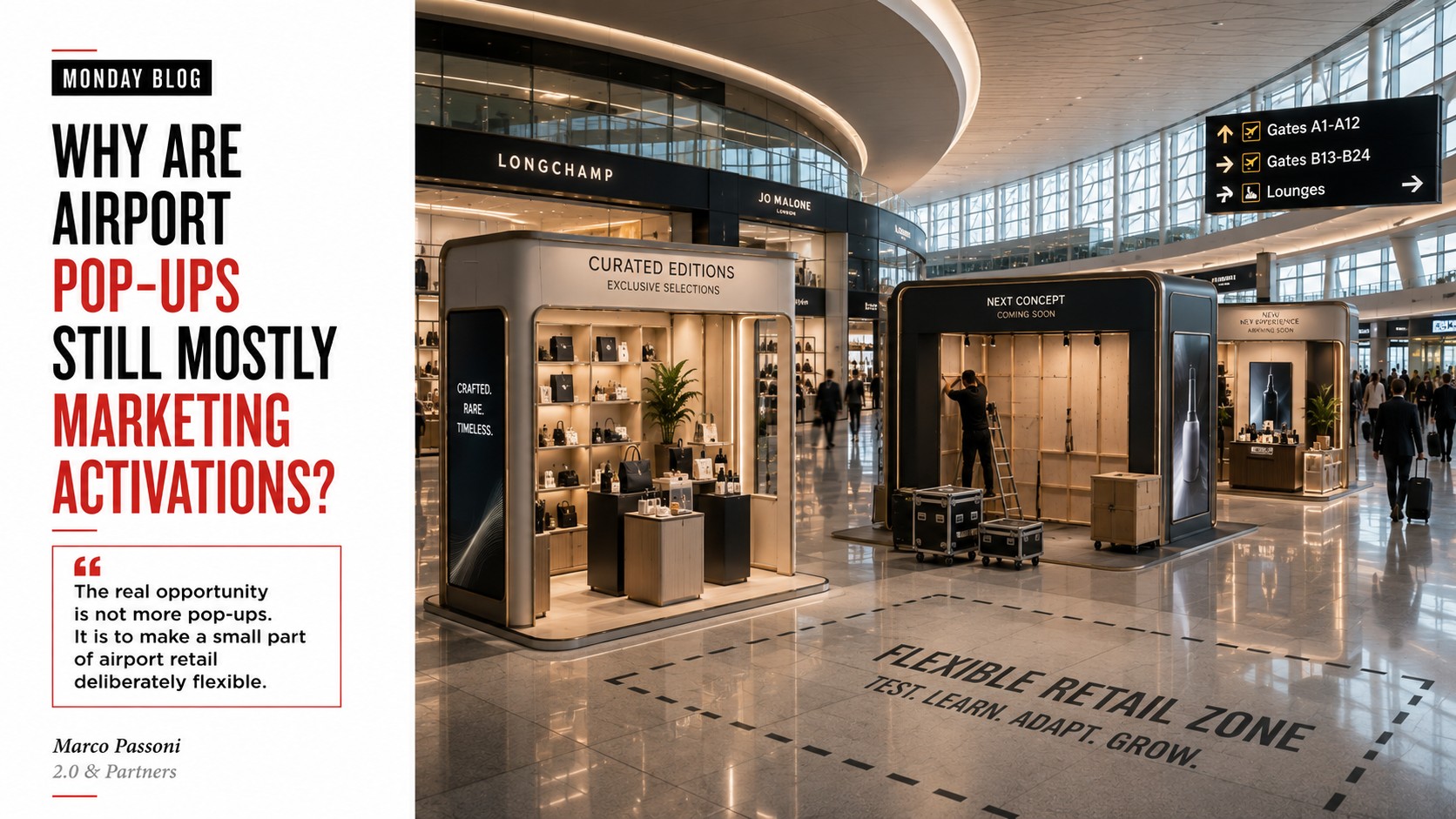
The real opportunity is not more pop-ups. It is to make a small part of airport retail deliberately flexible and use it as part of the commercial strategy, not only the marketing calendar.
A brand performing strongly in domestic markets could be tested before a permanent location is considered. A new category could be introduced without restructuring an existing retail area. An operator could test a different assortment or a cross-category concept. Airports could respond more quickly to changing passenger profiles or to brands whose long-term Travel Retail potential is not yet proven.
There are already examples of the format being used this way.
At Heathrow Terminal 4, Louis Vuitton opened a 20 sq m pop-up in 2018 that operated for five months before the permanent boutique opened later that year. In that case, temporary and permanent retail were part of the same commercial journey rather than two completely separate activities.
San Francisco International Airport takes the principle further. Its Pop-Up Retail Programme provides temporary, move-in-ready locations for small businesses, with successful participants able to progress towards longer-term airport leases. Different market, different type of brand, but an interesting principle: temporary retail can become a commercial pipeline.
That also changes what we should measure.
A marketing activation naturally looks at reach, traffic, engagement, sampling and visibility.
A commercial test should go further.
Who entered? Who bought? Which passenger profiles responded? Which products converted? Was the business incremental? Did the temporary space attract customers who would otherwise not have engaged with the brand?
The Moroccanoil pop-up at Schiphol is useful because the airport published commercial results. Turnover increased by 172% compared with the same period the previous year, while sales at the brand’s existing permanent points of sale at Schiphol also rose by 18%. Whatever the wider marketing impact, the exercise produced measurable commercial information.
A pop-up should not only tell us whether passengers noticed a brand. It can also tell us whether that brand, category or concept deserves a bigger role in the airport.
Of course, none of this means every activation needs to become a retail experiment.
Sometimes the objective really is communication, launch or brand experience, and the pop-up is perfectly suited to that purpose.
Nor does temporary mean easier or cheaper. Airport security, logistics, staffing, construction restrictions and operational requirements remain. And particularly in luxury, customers will not accept lower execution standards simply because a store will only be there for a few months.
If airports want genuine flexibility, therefore, the infrastructure has to support it. Some spaces need to be designed from the beginning to accommodate changing concepts without effectively rebuilding the unit every time.
There also has to be a clear commercial process behind them: test, measure, learn and then decide whether to scale, change or exit.
Permanent retail will remain the foundation of airport commercial environments. It provides continuity, recognisable brands and the economic certainty needed to justify substantial investment.
Temporary retail can provide something different: optionality.
Travel Retail talks constantly about newness and discovery. Yet much of the commercial offer inevitably reflects decisions taken several years earlier.
A small layer of genuinely flexible retail space would not solve that tension completely.
But it could allow airports, operators and brands to respond to change faster and, importantly, learn before making much larger commitments.
Perhaps that is the next evolution of the airport pop-up: not abandoning its role as a marketing activation, but recognising that it can also be a very useful commercial tool.
Marco Passoni has spent more than three decades in the travel retail industry, holding senior leadership roles across distribution, retail and business development. His career included 12 years as CEO of a leading international Duty Free distribution company and a further eight years managing a retail business operating fashion mono brand stores across several international airports.
Today, as Senior Executive Vice President and founding partner of 2.0 & Partners, he leads the development of innovative services and new business opportunities for brands, operators and airports across the global travel retail market. A former elite sailor and World Champion, Marco continues to spend much of his time airside, observing the industry first hand and helping partners and clients navigate the distinctive challenges and opportunities of this constantly evolving market.