
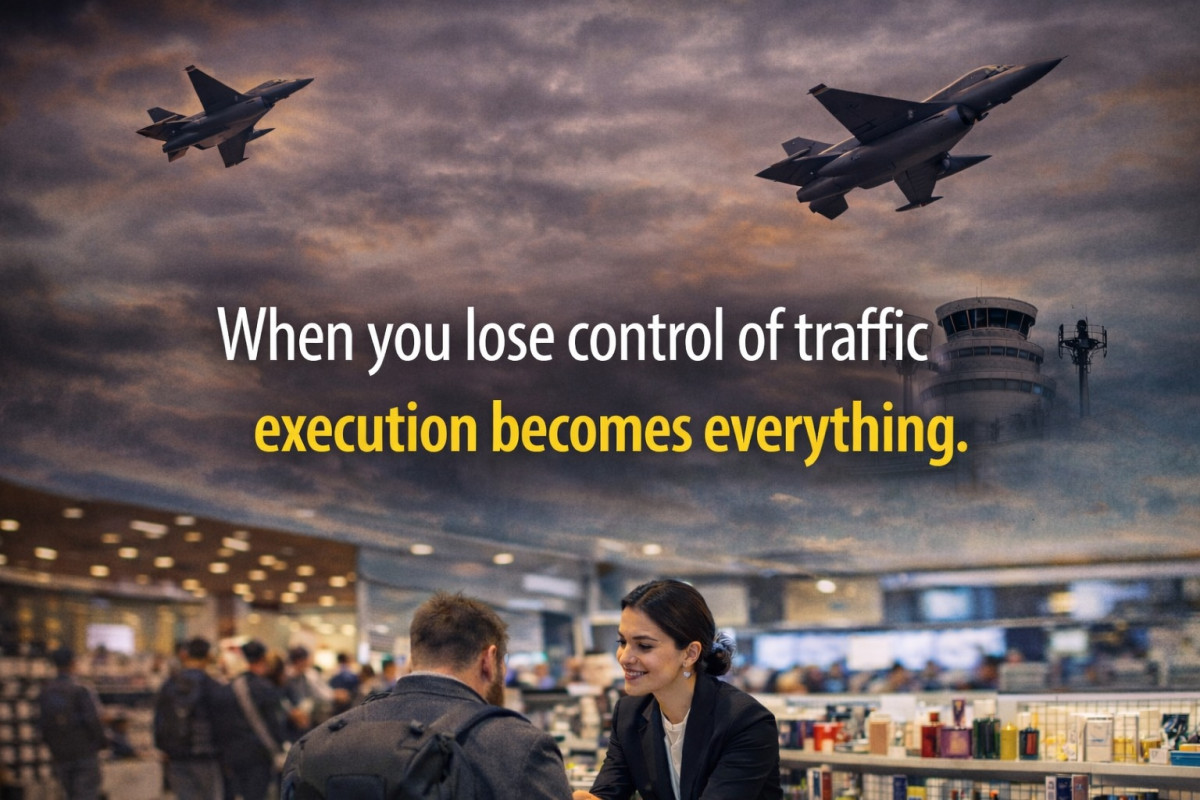
Travel retail is entering a phase where performance is becoming increasingly disconnected from execution.
After years of disruption and an uneven recovery post Covid, the industry had started to move again towards something that looked, if not stable, at least readable. Traffic was coming back. Patterns were re emerging. Planning, while imperfect, was becoming possible again.
That assumption is now being challenged.
The recent geopolitical tensions in the Middle East, including the escalation involving Iran, are once again reshaping air traffic in real time. Routes are being diverted, passenger flows are shifting overnight, and entire traffic compositions are changing without warning.
Routes are being diverted, passenger flows are shifting overnight, and entire traffic compositions are changing without warning
This is not a slow trend. It is a sudden loss of visibility. For years, the underlying logic was clear enough. Traffic drives opportunity, execution drives performance. The better you run the store, the more you convert what comes through the door.
Today, that link is weakening. Footfall is no longer something you can reliably anticipate. Passenger mix can change within days. Dwell time stretches or compresses without a clear reason. And yet, expectations on performance often remain unchanged, as if the inputs were still under control.
This is where the disconnect starts. When sales decline, the instinct is to push harder. More focus on targets, on conversion, on numbers that are increasingly influenced by factors no one on the ground can actually manage. But if the inputs are unstable, insisting on the outputs is not discipline. It is distortion. Because there is only one element that remains fully within control: what happens in the interaction between the frontline and the customer.
When sales decline, the instinct is to push harder. But if the inputs are unstable, insisting on the outputs is not discipline. It is distortion.
It is not the volume of passengers. Not who they are. Not how much they are willing to spend. It is only the quality of the moment. And this is where the role of the frontline fundamentally changes.
It is no longer about executing a predefined sales approach. It is about reading the situation in real time, adapting instantly, and creating relevance in a context that keeps shifting. The same store, with the same team, can face completely different customers, expectations and behaviours from one day to the next.
There is also a dynamic that is often underestimated, but critical.
When traffic drops, commission drops. When commission drops, motivation follows. And when motivation declines, execution weakens. At that point, even the reduced number of customers that are there are not converted effectively.
What starts as an external disruption quickly becomes an internal erosion. This is where value is lost. Not in the crisis itself, but in how the frontline is left to absorb it. Breaking this cycle does not come from pushing harder on results. It comes from refocusing on execution. Understanding what is actually happening on the shop floor, not what is assumed to be happening. Equipping teams to adapt to different situations, different customer profiles, different levels of pressure. Supporting them where it matters, in the interaction itself.
Breaking this cycle does not come from pushing harder on results. It comes from refocusing on execution.
In an environment you cannot control, consistency of execution becomes the only real competitive advantage. And consistency does not happen by chance. It needs to be measured, trained and coached. Empowering frontline teams, therefore, is not a soft initiative. It is a structural one.
Because when everything around the business becomes volatile, the only stable element left is the quality of human interaction.
This is not about resilience. It is about staying relevant when the rules of the game keep changing.