
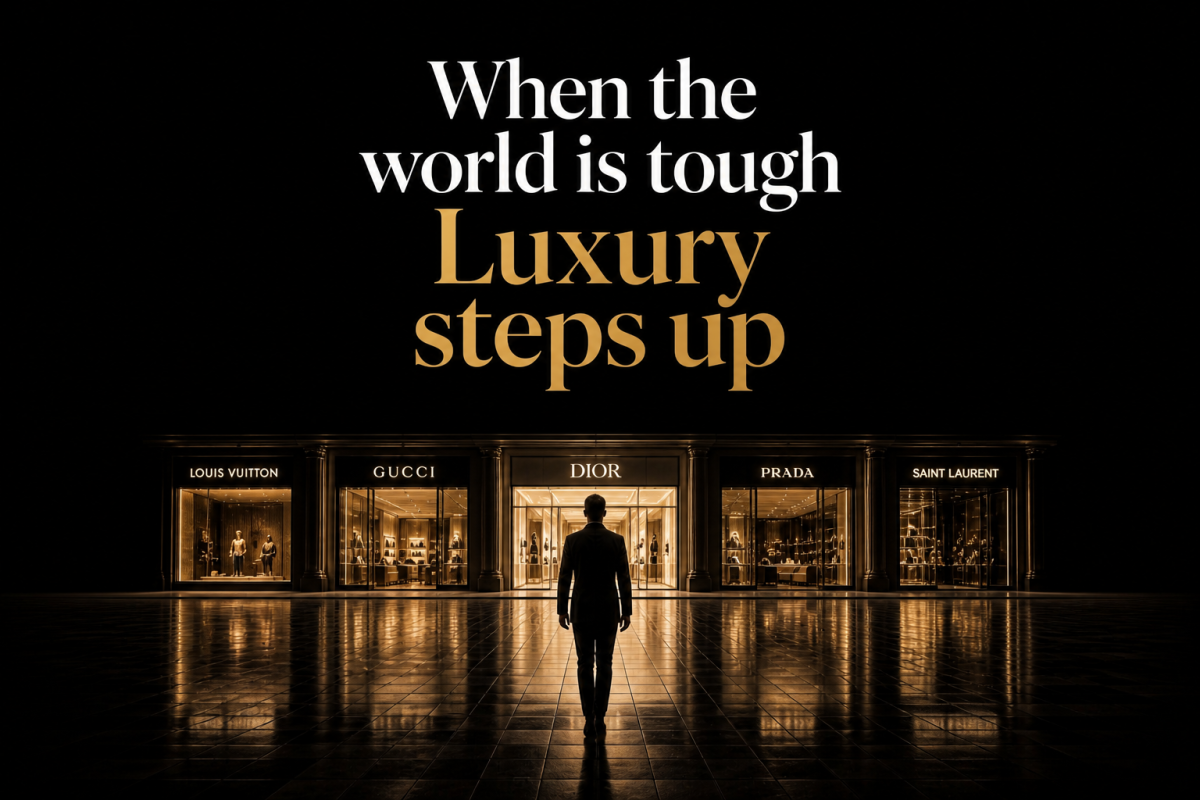
Luxury does not operate in isolation from the world around it – and the world, at the moment, is not calm. Geopolitical instability, economic pressure and a growing sense of societal fragmentation are shaping how people feel and, in turn, how they consume. In moments like this, expectations of luxury do not diminish. They intensify.
Because when reality becomes heavier, people look for something that lifts them out of it.
This is where luxury is meant to lead. Not through product. Through feeling. The recent Future 100 2026 report from VML reinforces this shift. Consumers are actively seeking experiences that deliver peace, joy and emotional release. Not distraction for its own sake, but something more meaningful. Something that feels considered. And yet, much of the industry continues to respond with volume. More launches. More product. More noise.
There is a growing disconnect here. Because in a world already saturated with messaging, simply adding to it is not leadership. It is contribution to the problem.
The brands that are succeeding are the ones resisting that instinct. Chanel has entered 2026 with a renewed clarity in its brand universe; not louder, but more precise. More aligned with what its audience is actually seeking. Dior, in parallel, has leaned into discovery, creating environments and moments that allow shoppers to step out of their reality, even briefly.
In a world already saturated with messaging, simply adding to it is not leadership. It is contribution to the problem
These are not transactional plays. They are emotional ones. And that distinction matters. At Loewe, the FW26 showcase from Jack McCollough and Lazaro Hernandez made the point explicitly: fashion and creativity are expressions of joy. Not obligation. Not output. Joy.
It is a position that feels both obvious and, at the same time, increasingly rare. Because too often, luxury is behaving as though its primary responsibility is to sell more, faster. That is not what the moment demands.
Nowhere is this more visible than in travel retail. Airports are environments already defined by pressure; time constraints, movement, uncertainty. Layering transactional retail into that context, without offering anything more, misses the point entirely.
If luxury is to justify its position in this space, it must offer relief from that pressure. Not add to it. There are examples that understand this. The Louis Vuitton café in Heathrow Terminal 2 is not about product. It is about pause. The Dior spa in Doha operates on the same principle: creating a moment that exists outside the journey, not within it.
Airports are environments already defined by pressure; time constraints, movement, uncertainty. Layering transactional retail into that context, without offering anything more, misses the point entirely.
These are not retail executions. They are emotional interventions. But they remain the exception. And that is the issue. This is not a call for imitation. Travel retail does not need more concepts replicated without thought. It needs brands to return to first principles.
Luxury has never been defined by product alone. It is defined by the lifestyle it represents, and the feeling it creates. The product is simply the entry point. What the modern consumer expects is the world around it. That requires clarity of identity. Confidence in storytelling. And a willingness to prioritise long-term connection over short-term transaction.
There are brands that are beginning to understand this. Rimowa’s Original Backpack campaign, with its sense of play and quiet absurdity, is a reminder that even in serious times, lightness has value. Perhaps especially then.
But these examples are still too isolated.
Luxury positions itself as a leader. It commands attention. It commands margin. It commands expectation. The question is whether it is willing to meet that expectation.
Because if luxury cannot offer something better than the world outside, it risks becoming just another part of it. And that is not what it was built for.