
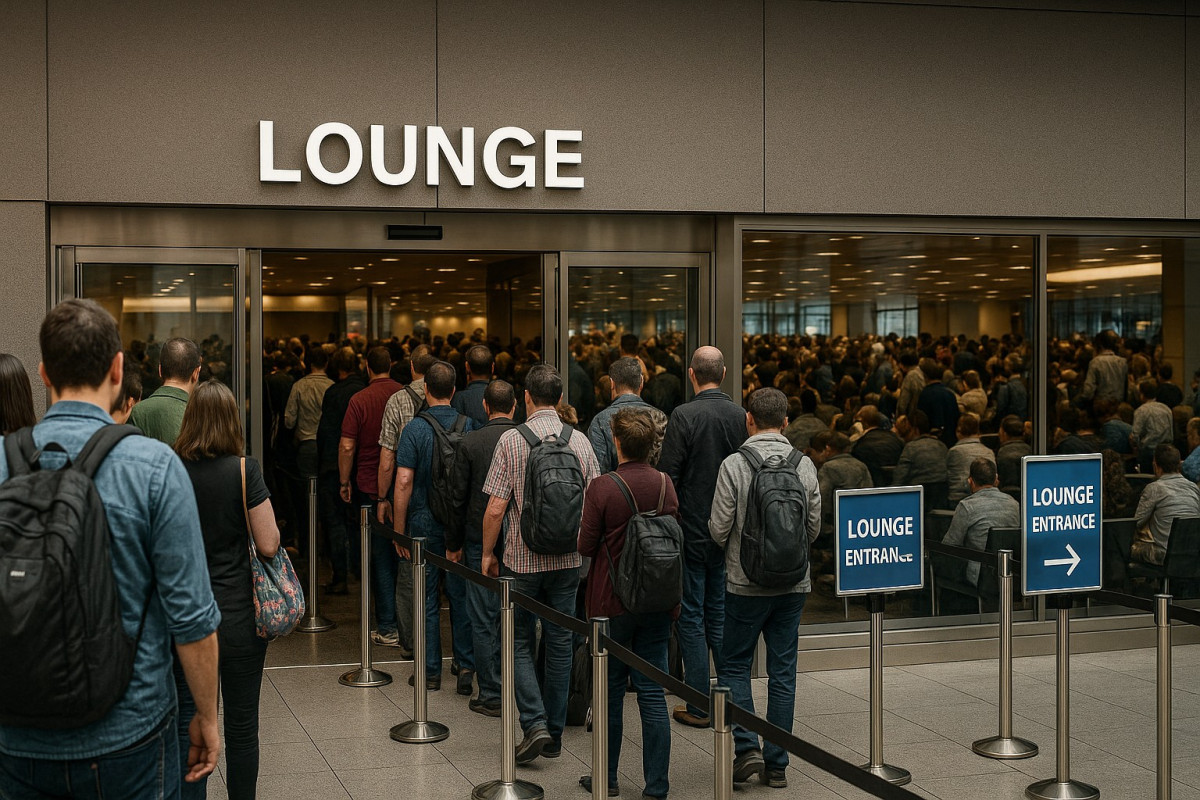
If we look at the airport journey through the eyes of a frequent traveller, there is one area where the gap between expectation and reality has become increasingly obvious. Lounges were designed to offer a controlled and efficient environment before departure. Today, in many airports, that promise is becoming harder to sustain. And the reasons are not ideological. They are numerical.
The latest industry figures show a steady and significant shift: 57% of frequent travellers now use lounges, 42% have visited at least one in the last twelve months and 62% say they would be willing to pay more for a quieter and more predictable experience. These are not marginal percentages. They indicate structural pressure on a product that was never designed to absorb such volume.
Passenger traffic itself has grown. In several hubs, the rebound after the pandemic has surpassed original forecasts. Yet lounge capacity, measured simply in square metres and seats available per hour, has not followed with the same rhythm. In practical terms this means that every square metre is asked to serve more people than before. The effect on perceived quality is immediate and measurable.
Passenger traffic itself has grown. Yet lounge capacity has not followed with the same rhythm. In practical terms this means…the effect on perceived quality is immediate and measurable.
This is not a question of privilege or exclusion. It is a question of operational logic. When demand rises and supply remains static, the experience changes. Not because travellers are different, but because the environment around them is no longer able to support the original service model.
The behaviour and needs of travellers have also evolved. Many work on the move and require stable connectivity. Others need rest after long itineraries. Others simply want a space where they can navigate the pre departure window without unnecessary stress. None of these needs are exceptional. They are basic conditions for a modern travel experience.
The challenge is that the current lounge model often tries to accommodate all profiles within a configuration that has not adapted. If the design does not separate working areas from quiet zones, both groups lose value. If the operational standards do not account for peak times, queues appear. If the staffing model is built around yesterday’s flows, consistency drops. These are operational gaps, not demographic issues.
The challenge is that the current lounge model often tries to accommodate all profiles within a configuration that has not adapted.
What is required is a clearer and more analytical approach. Access rules should follow actual capacity, not outdated assumptions. Capacity planning should be tied to live traffic patterns, not to annual averages. Space should be zoned with intention, based on how travellers actually use the environment. And service standards should be defined through measurable KPIs, not generic statements.
None of this is about building walls or reducing accessibility. It is about aligning the product with reality so that the lounge continues to serve its purpose for everyone who enters: providing calm, comfort and an environment designed to reduce pressure, not add to it.
There is an important point often ignored in the industry discussion. When the traveller loses trust in the value of a service, regaining that trust requires far more effort than maintaining it in the first place. Lounges are one of the few airport touchpoints where brands and airports can genuinely influence how the journey is perceived. They are a strategic asset, not a symbolic one.
When the traveller loses trust in the value of a service, regaining that trust requires far more effort than maintaining it in the first place.
If we want the lounge experience to remain relevant, the solution will not come from slogans or cosmetic renovations. It will come from data, planning and the willingness to redesign the product with the needs of today’s travellers in mind. The numbers already indicate the direction. Now it is a matter of acting on them.