
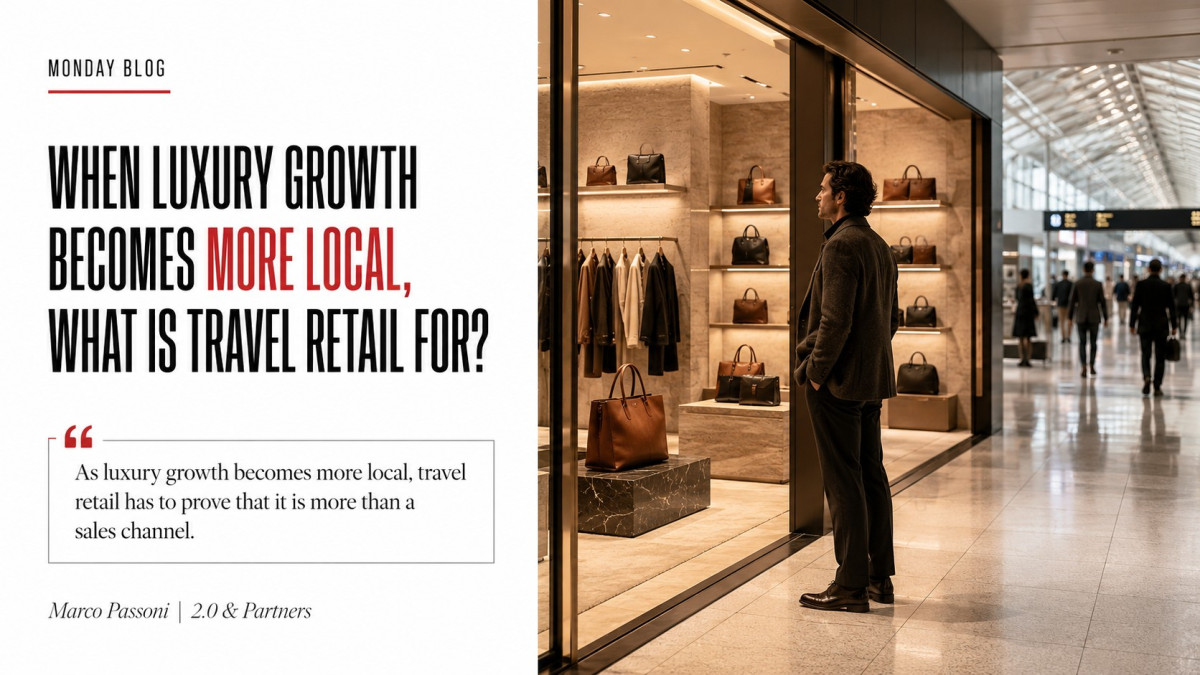
For many years, the relationship between luxury and travel retail was relatively straightforward. International tourism was growing, passenger flows were expanding, and Chinese travellers played a decisive role in the global luxury market. Airports offered brands access to customers moving between countries with a strong propensity to spend, and the commercial logic was compelling.
That logic has not disappeared. But it is no longer sufficient on its own.
The first quarter 2026 results published by Hermès provide an interesting perspective. The company generated revenue of €4.07 billion, growing by 5.6% at constant exchange rates despite a complex geopolitical environment. The most relevant element is not simply the resilience of the brand, but the geographic distribution of that growth. The Americas grew by 17.2%, Japan by 9.6%, and Europe excluding France by 9.7%. Asia Pacific excluding Japan grew by a more modest 2.2%, while the area classified as Other, which primarily includes the Middle East, declined by 5.9%.
Hermès also reported that store sales increased by 7%, despite a slowdown in tourist flows linked to the situation in the Middle East. Wholesale activity was significantly affected by lower sales to concession stores, particularly in the Middle East and in airports.
These numbers should not be overinterpreted. Hermès is a unique company with a distinctive business model, extraordinary desirability and an unusually loyal customer base. It would be simplistic to treat its performance as a universal proxy for the entire luxury market. But the underlying message is difficult to ignore.
Luxury growth is becoming more geographically diversified, more dependent on local demand and less easily explained by a single traveller nationality or source market. Hermès explicitly attributed its performance in Europe excluding France to local demand, its performance in Japan to strong footfall and the loyalty of local clients, and its growth in Asia excluding Japan to the loyalty of local clients and the strength of its value strategy.
If luxury brands increasingly build growth through deeper relationships with local customers, what is the distinctive role of the airport channel?
For too long, parts of the industry have relied on the assumption that international passenger flows would naturally translate into commercial relevance. The passenger was travelling, the brand was present, the store was visible, and the airport environment created an opportunity to purchase. In some locations and for some categories, this remains true. But traffic and visibility alone can no longer provide a sufficiently convincing answer.
Travel retail is structurally exposed to volatility. Routes change. Passenger mixes evolve. Geopolitical tensions reshape traffic patterns. Currency movements alter the perception of value. Some nationalities travel less, while others become more relevant. A location that benefits strongly from a particular flow can lose part of its commercial momentum very quickly when that flow changes.
The Hermès figures provide a reminder of this vulnerability. The slowdown in tourism connected with the situation in the Middle East affected France, the Middle East itself and wholesale activity, with a specific impact on concession stores and airports. At the same time, markets supported by strong local demand continued to perform well.
This does not mean that airport retail is becoming less important. It means that its role needs to become more clearly defined.
The channel should not be judged only as a sales channel. It should also be understood as a brand channel: a platform for image, client acquisition and positioning.
This is particularly relevant for luxury brands. An airport store may generate revenue, but its value should not be measured exclusively through the sales produced within its perimeter. It can introduce the brand to a new international customer. It can reinforce recognition in a strategic market. It can create opportunities for gifting, discovery or a first purchase. It can offer visibility in a highly selective environment and strengthen the perception of global relevance.
But none of this happens automatically simply because the store exists. A luxury boutique in an airport cannot be treated as a smaller version of a downtown store with a more transient audience. Nor can it rely passively on the assumption that passenger flows will compensate for a generic offer. The channel has to provide a reason to engage that is specific to the journey.
That reason may come from exclusivity, convenience, a relevant assortment, gifting opportunities, price clarity, cultural sensitivity, discovery or a seamless connection with the customer relationship already built elsewhere. The precise answer will vary by airport, passenger mix and brand. What matters is that the answer is deliberate.
There is also a wider implication for airports and operators. The strength of a luxury offer cannot be assessed only through the presence of recognisable names or the number of square metres allocated to the category. A terminal may host an impressive line up of brands and still fail to create a compelling commercial environment if the proposition is disconnected from the passengers actually travelling through it.
The question is no longer simply whether the right brands are present. It is whether the right brands are relevant in that particular location, for that particular passenger mix and at that particular moment in the journey.
This requires a more sophisticated approach to planning. Passenger volumes remain important, but they are only the starting point. Nationality, route structure, destination, frequency of travel, local purchasing power, tourism patterns, product preferences and the balance between local and international customers all shape the real commercial opportunity.
It also requires a more honest assessment of the purpose of each store. Some airport boutiques will be strong commercial locations capable of delivering significant sales. Others may play a more strategic role in terms of image, customer acquisition or market visibility. Some may justify a directly operated store. Others may be better suited to a more flexible format. There is no universal formula.
For luxury brands, the airport channel should be part of a wider global architecture. It should connect with the customer before, during and after the journey. It should reinforce the positioning of the brand rather than dilute it. It should create incremental value rather than simply redistribute sales that might otherwise have happened elsewhere.
For airports, the challenge is to move beyond the logic of filling space with prestigious names. For operators, the priority is to provide brands with a model that is transparent, flexible and capable of adapting as traffic patterns evolve. Historic assumptions about tourist flows and category performance are no longer enough.
The global luxury market is not becoming less attractive. But it is becoming more complex. Growth is more dispersed. Customer relationships are more important. Local demand is playing a stronger role. International tourism remains relevant, but it can no longer be treated as a stable and predictable engine.
Travel retail therefore needs to be more ambitious about the value it creates. Its strength lies in its ability to occupy a unique position between markets, cultures and moments of consumption. It can introduce, reinforce, surprise and connect. It can transform the airport store from a simple point of sale into a platform for image, client acquisition and positioning.
When luxury growth becomes more local, the airport channel cannot simply wait for the customer to pass by. It has to demonstrate why it still matters.