
I read ACI EUROPE’s new Tender Code with great interest. Its attention to the information supplied to bidders and the credibility of financial proposals addresses questions that matter in our negotiations. I welcome any opportunity to discuss how airport tenders can produce agreements that work commercially over the full concession period.
Through our LIS, Location, Intelligence & Selection activity at 2.0 & Partners, we assess airport opportunities from the brand’s perspective. The work involves establishing whether a particular location can support the business a brand intends to operate, and on what terms. That assessment has to stand up before a bid is submitted, when we can still challenge the assumptions and establish which commitments the brand can support.
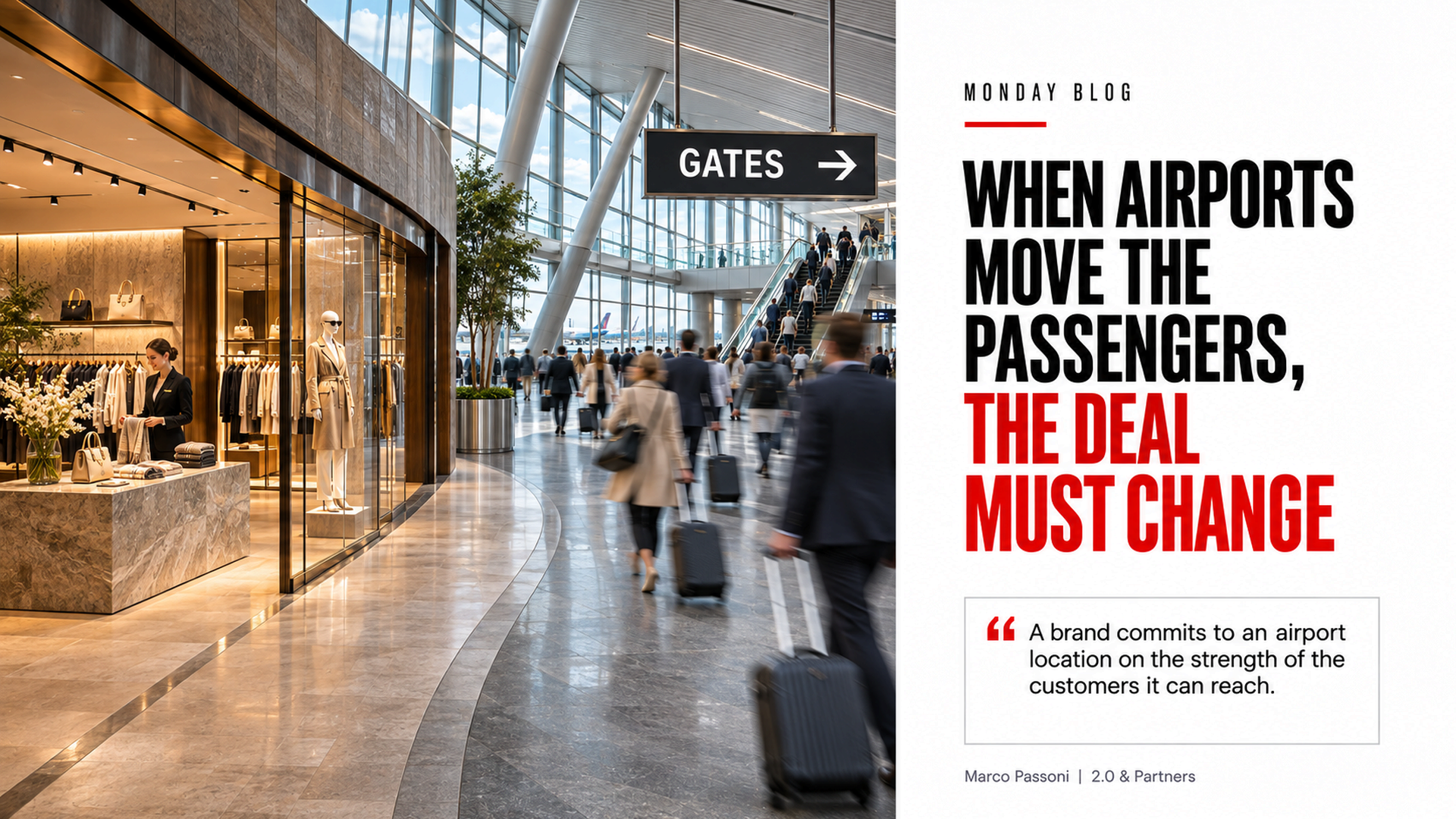
A brand commits to an airport location on the strength of the customers it can reach.
The unit’s size, frontage and visibility matter, as do its operating constraints. But the opportunity depends heavily on the passengers who can realistically access it. Their nationalities, destinations and travel patterns help determine whether that location offers a credible audience for the brand.
For luxury brands, the surrounding brand mix and immediate adjacencies are crucial to the assessment. A strong luxury cluster can attract customers and strengthen the location. We also need to examine whether the overall retail offer, particularly within the relevant category, is proportionate to the demand available. An airport can have more selling space and competing offers than its accessible customer base can sustain. Adding another store in that situation risks dividing existing spend across more outlets, reducing the sales each can achieve.
Turning that audience into a sales forecast requires judgement. How many relevant passengers pass the store, how many are likely to enter and buy, and at what average transaction value? Benchmarks need to reflect the category, location and operating model. Applying the performance of a successful boutique elsewhere to an airport unit with a different customer base can produce a persuasive forecast with very little commercial substance.
The next question is what those sales can support. The margin available after product costs and expected markdowns has to cover the airport’s charges and the actual cost of operating there. Staffing across the required opening hours, airport deliveries and security procedures all affect the calculation. The brand also needs to recover its investment and earn a return. A rent to sales ratio viewed in isolation tells us too little.
The operating model changes that calculation. A brand operating its own store carries responsibilities and costs that differ from a wholesale relationship with a retailer. When an operator is involved, its margin requirements and allocation of investment also affect the brand’s return. The same location and sales forecast can therefore produce quite different conclusions about whether an opportunity is worth pursuing.
This is why the financial terms have to be assessed together. A royalty that appears reasonable may become difficult to sustain alongside an ambitious minimum annual guarantee, or MAG. Escalation clauses can increase that pressure over time. The basis on which the minimum is calculated and reconciled also matters, particularly for a business with pronounced seasonality. Comparing headline percentages will not reveal the full commitment.
Duration needs the same scrutiny. A store requiring substantial investment needs sufficient time to recover it, with allowance for the opening period and any refurbishment obligations. A longer term has limited value if the economics are already strained and the assumptions become less credible each year. We need to understand how the business performs across the concession, including a realistic downside scenario.
Brands have responsibilities here. They should present achievable sales assumptions and demonstrate that the proposed assortment and operating plan can deliver them. If a bid depends on understaffing the store or on margins the business cannot realistically achieve, the problem exists before the award. The Code’s attention to the economic credibility of proposals is particularly relevant. Winning the location cannot be the only measure of a successful negotiation.
Once the agreement is in place, the assumptions supporting it still matter. An airport can report passenger growth while a store faces a weaker opportunity. Additional traffic may use another terminal or pass through a different departure area. A change in the customer mix can reduce the potential for a particular brand even when the number of passengers near the store remains broadly stable.
A specific issue arises when the airport’s own decisions cause that change. Moving an airline between terminals, revising gate allocations or redirecting passenger routes can alter the customer base accessible to an existing location. Reorganising a commercial area can affect access too. Where these decisions are within the airport’s control and have a substantial effect, the store may retain its address while losing an important part of the opportunity it was offered.
When airport decisions materially change that opportunity, the commercial terms need to be renegotiated.
Airports have legitimate operational priorities and must be able to develop their terminals. Those priorities can justify a decision without removing its consequences for a tenant. The brand has committed against an opportunity described through historical information and forecasts. If the airport materially changes that opportunity, it should be prepared to reconsider the conditions attached to it.
This is different from a demand shock caused by external events beyond the airport’s control. Those risks also need to be addressed, but responsibility cannot be assessed in the same way. Equally, weak sales alone do not establish that the airport caused the problem. A brand still has to account for its own stock availability, service and execution.
The reference point should be agreed during the tender. It needs to cover the relevant passenger flows and available profile data, alongside known or reasonably foreseeable operational changes. Historical figures and forecasts must be distinguished, with gaps made clear. Regular exchange of traffic and trading information then allows both parties to identify a change and examine its effects before their positions become entrenched.
The Code recommends structured flexibility through mechanisms established in advance. In practice, the agreement should define what constitutes a material change, how long it must persist and how its impact will be assessed. It should also establish who takes the decision and within what timeframe. This does not create an automatic right in every existing concession. The review process needs to be agreed within the applicable contractual and procurement framework.
The outcome should reflect the effect on the business. A turnover royalty already moves with sales, while a binding MAG may leave much of the payment unchanged. The investment still to be recovered and the remaining term also deserve examination. If an airport decision improves access to relevant customers, the parties should be equally willing to assess that improvement. The commercial logic must work in both directions.
The economics ultimately reach the shop floor. A store needs room to invest in its assortment and maintain capable staff, training and service. Financial commitments that leave too little for those requirements undermine the offer the airport selected. That is why a sustainable agreement matters to the brand’s commercial interests and to the passenger experience.
This is the perspective I would have brought to the discussion, based on our work negotiating airport locations for brands. My starting point is the business the location can realistically support. The financial commitments should follow that assessment and remain open to review when the airport’s own decisions materially change its foundations.
Marco Passoni has spent more than three decades in the travel retail industry, holding senior leadership roles across distribution, retail and business development. His career included 12 years as CEO of a leading international Duty Free distribution company and a further eight years managing a retail business operating mono-brand fashion boutiques across several international airports.
Today, as Senior Executive Vice President and founding partner of 2.0 & Partners, he develops new business opportunities and services for brands, operators and airports across the global travel retail market. Through 2.0 & Partners, he works with some of the world’s most recognised luxury and premium brands, as well as leading international airports, helping them assess opportunities, strengthen their travel retail presence and navigate the distinctive commercial dynamics of the airport environment. A former elite sailor and World Champion, Marco continues to spend much of his time airside, observing the industry first hand and helping partners and clients respond to the challenges and opportunities of an evolving market.