
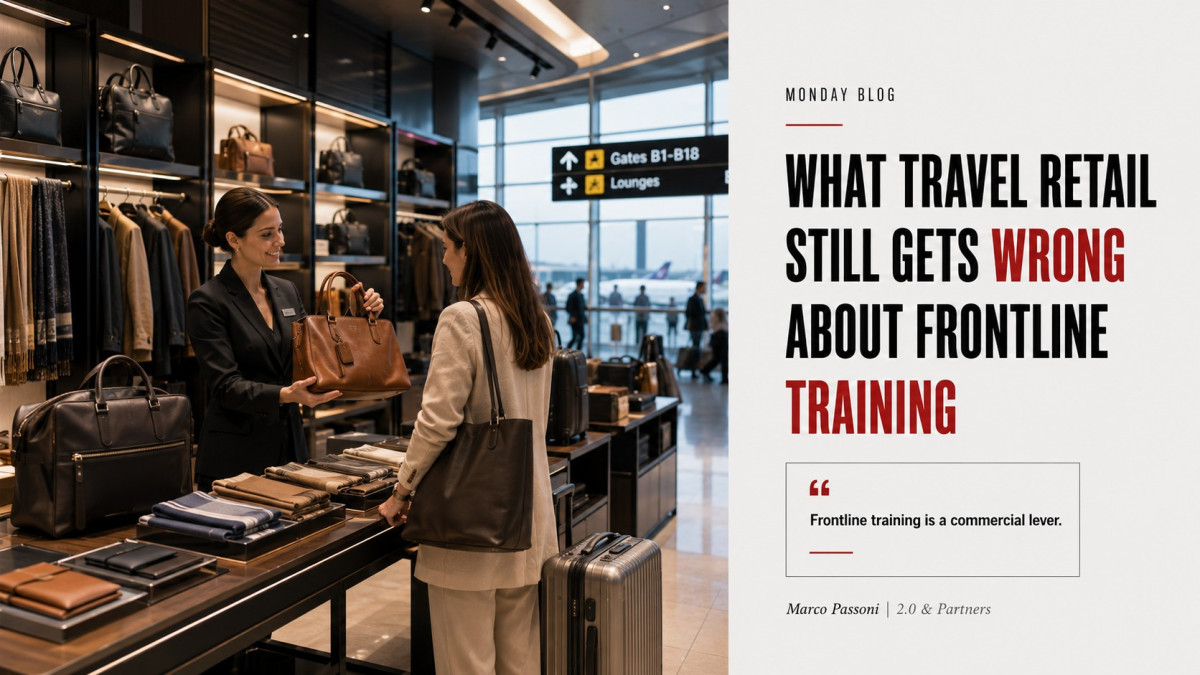
Travel retail has changed significantly over the past few years. Passenger flows have recovered, the customer mix has evolved, expectations are higher, digital behaviours are more complex, and airport stores are increasingly asked to perform not only as sales points, but also as brand environments.
Yet one area has often remained surprisingly static: frontline training.
In many cases, training is still treated as an HR activity rather than a commercial lever. It is often designed around product knowledge, service standards, brand guidelines and operational procedures. All necessary elements, of course, but not always sufficient to deal with the real complexity of the airport environment.
Because selling in an airport is not the same as selling downtown.
The customer is often distracted, time constrained, tired, stressed, travelling with family, moving between security, boarding gates, lounges and other priorities. In many cases, shopping was not the original reason for being there. The store has only a limited window of opportunity to interrupt the journey in a way that feels relevant, respectful and convincing.
This is where frontline performance becomes critical.
The difference between a passenger who walks past the store and a customer who enters it is not always the product. The difference between a customer who browses and one who buys is not always the price. Very often, it is the quality of the first approach, the ability to read the situation, the cultural sensitivity of the interaction, the confidence of the team, and the capacity to turn a brief moment of attention into a meaningful commercial opportunity.
This is why generic training is no longer enough.
A frontline team in travel retail needs more than brand information. It needs to understand passenger behaviour, airport dynamics, cultural profiles, conversion barriers, time pressure, basket building opportunities, and the very specific psychology of customers who are travelling rather than shopping.
It also needs to understand when not to push.
This point is often underestimated. Better training does not mean more aggressive selling. It means better judgement. It means knowing when to approach, how to approach, what to ask, when to step back, and how to adapt the conversation to the customer in front of you. In a travel retail environment, elegance and commercial effectiveness should never be treated as opposites.
There is also another issue. Training is too often disconnected from measurement.
Companies invest in training programmes, but they do not always connect them clearly to what is happening on the shop floor. Where are customers being lost? Is the issue traffic capture, conversion, average transaction value, units per transaction, cross selling, cultural understanding, or service consistency? Without this kind of diagnosis, training risks becoming a well intentioned exercise rather than a targeted response to a real business problem.
This is particularly important for airports, operators and brands. Each of them looks at the business from a different angle, but all of them are affected by the same reality: if the frontline does not convert the opportunity, everyone loses value.
The airport loses potential commercial revenue. The operator loses sales productivity. The brand loses not only transactions, but also a moment of visibility, positioning and customer acquisition. The passenger, too, may lose the opportunity to experience something better than a purely functional journey through the terminal.
This is why frontline training in travel retail should be reframed.
It should not be seen as a periodic refreshment activity. It should not be limited to product launch briefings. It should not be treated as a soft service initiative detached from commercial performance. It should be built around the real conditions of the airport store and connected to measurable customer experience outcomes.
The point is not to train people because training is good.
The point is to help frontline teams perform better in one of the most difficult retail environments in the world.
And perhaps this is where travel retail still has work to do. The industry has become very sophisticated in analysing passengers, planning spaces, negotiating rents, designing stores and presenting brand concepts. But the final moment of truth is still often left to people who are expected to deliver more, with limited time, limited preparation and very little room for error.
Passenger growth creates the opportunity. Store design can support it. Brand desirability can attract it. But in many cases, the frontline is still the point where that opportunity is either converted or lost.
If travel retail wants to move from traffic recovery to real commercial growth, frontline training can no longer be treated as a support function.
It has to become part of the business strategy.