
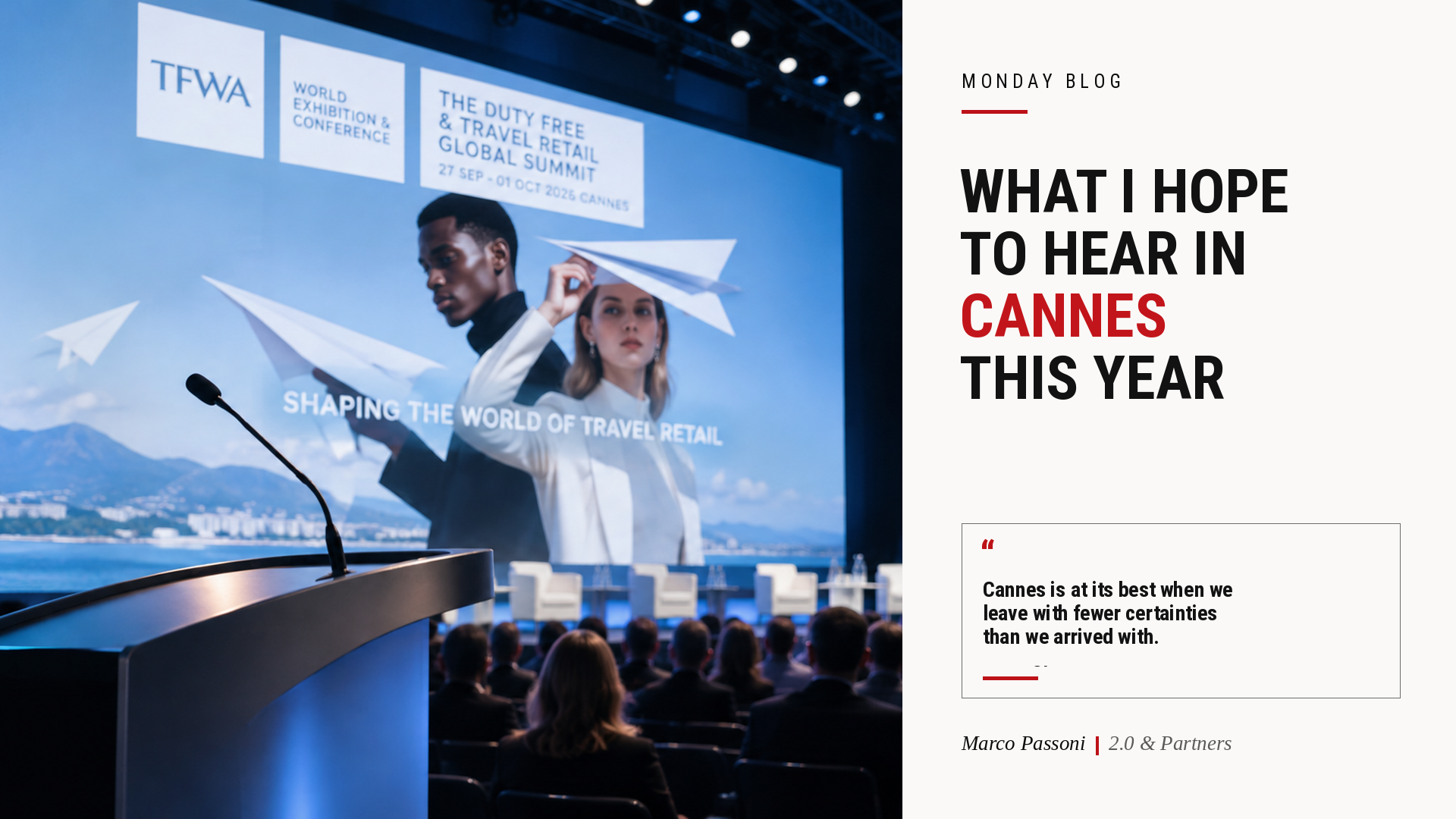
Cannes is almost here again.
For anyone who has worked in Travel Retail for a reasonable amount of time, the rhythm is familiar. Diaries fill up weeks in advance, launches are prepared, dinners are booked, announcements are timed for maximum visibility and LinkedIn gradually becomes a countdown to the Croisette.
I have been going to Cannes for more than three decades and I still believe it matters. There are very few moments in the year when such a large part of the Travel Retail ecosystem is physically in the same place. Brands, retailers, airports, operators, distributors, consultants and technology providers are all there, and that concentration of people, knowledge and decision-making remains genuinely valuable.
Precisely for that reason, I think we should expect more from Cannes than another week of meetings, launches, photographs and familiar conversations.
This year’s official programme looks promising. The World Conference on Monday 28 September will bring together David McWilliams on geopolitics and economics, Gilles Roucolle on the future of mobility and Charles Duhigg on human behaviour and decision-making, with Stephen Sackur moderating. The workshops that follow will look at customer growth, future travel demand, changing traveller behaviour in fashion and the role of AI in turning data into commercial growth.
There is plenty there that could be useful. What I hope we do not get is another sequence of presentations built around conclusions the industry has already repeated for years. The traveller is changing, digital matters, AI will affect retail, customer experience is important, younger generations behave differently and collaboration is necessary. None of that is wrong. It is simply no longer enough.
A conference earns its value when it gives the audience something they did not already believe when they entered the room.
Cannes is at its best when we leave with fewer certainties than we arrived with.
That could be a piece of data that contradicts an assumption, a case where something worked materially better than expected, a concept that failed despite looking convincing on paper, or an uncomfortable question that forces people to reconsider something the industry has been saying for too long.
That feels particularly relevant this year because several assumptions that supported Travel Retail for a long time are becoming less reliable. Price advantage is less automatic. Domestic retail has become much more sophisticated. Luxury growth is increasingly local. Passenger growth does not necessarily translate into commercial growth. Chinese outbound travel is evolving. Technology is making more things possible, but that does not automatically make retail more relevant.
So if we are going to spend several hours talking about the future, I would like to see less time devoted to describing change and more time spent showing what that change is actually doing to the business.
The Oliver Wyman workshop on customer growth is a good example. Its starting point is already interesting. Travel Retail is growing unevenly across geographies, categories and generations, while the historic price-led proposition is no longer enough to convert the next generation of travellers. That is exactly the sort of premise that deserves to be pushed further.
What I want to understand is what replaces that price-led proposition in measurable terms. Which behaviours are genuinely changing conversion? Which categories are gaining relevance and which are losing it? Where are airports failing to engage the traveller? What is the difference between attention and actual spending? Where does Travel Retail still outperform domestic retail and where is it falling behind?
The same applies to AI.
We do not need another demonstration showing that AI can personalise an offer, analyse behaviour or predict demand. We already know the technology can do those things. The useful discussion starts after that. Who owns the data? Who is capable of acting on it? What has actually improved conversion, loyalty or productivity? What do the economics look like? And where has technology simply added another layer without improving the customer journey?
Kearney’s session on the connected traveller is intended to look at how AI can create value across discovery, conversion and loyalty, and to compare Travel Retail with other retail channels. That comparison could be one of the more useful parts of the week because Travel Retail has spent too long benchmarking itself primarily against Travel Retail.
I would also like to hear more about things that did not work.
Our industry is extremely good at turning case studies into success stories. By the time they appear on a stage, the difficult parts have usually disappeared. We hear about the uplift, the engagement, the innovation and the lessons learned. We hear much less about the concepts that were abandoned, the activations that failed to convert, the technologies customers ignored or the commercial assumptions that turned out to be wrong.
Yet those examples are often more useful than another polished success story. If Cannes is supposed to help the industry improve, it should also be a place where failure can be discussed without embarrassment.
Then, inevitably, there will also be the various awards dinners and industry celebrations taking place around Cannes during the week.
Awards have their place. Genuine recognition matters, and there are people and companies in this industry doing exceptional work. But Travel Retail occasionally seems to have developed an extraordinary ability to create enough categories, subcategories and special recognitions to make losing statistically quite difficult.
Everyone wins something, everyone takes a photograph, everyone thanks everyone else, sponsors are happy, tables are full and LinkedIn performs beautifully the following morning.
It is all very pleasant. Whether it always helps us understand who is genuinely raising the bar is another question.
Perhaps awards, like conferences, should discriminate a little more. Excellence only means something when not everything qualifies as excellent.
The exhibition itself should be judged by a similar standard. Cannes is one of the rare occasions when brands can show the industry what they believe deserves a place in Travel Retail. I hope that means more than domestic products in travel packaging, more than another limited edition whose principal difference is the box and more than concepts primarily designed to photograph well.
I want to see products and propositions that have a genuine reason to exist in the channel. Something relevant to the traveller, something that understands the journey and something that gives the airport store a credible reason to be different from downtown.
That is also why some of the most useful moments in Cannes will probably happen outside the auditorium.
A coffee between meetings, a conversation in a corridor or an unexpected discussion with someone you had not planned to see can often be more useful than an hour on stage. Those conversations are less rehearsed. People are more willing to say that something is not working, that a strategy needs to change or that an assumption no longer makes sense.
The value of Cannes has never been only the number of people in the Palais. It is the quality of access to an industry that, for a few days, is unusually concentrated in one place.
If Cannes is going to remain one of the most important weeks in Travel Retail, its value should come from the quality of the questions we take home, not the quantity of meetings we manage to fit into the diary.
I will arrive, as usual, with a very full agenda. I will see clients, airports, brands, retailers, old friends and probably several people I only meet once a year in Cannes.
But that is not how I will judge whether the week was worthwhile.
If I come home with one assumption challenged, one genuinely useful piece of insight and a few better questions than the ones I arrived with, Cannes will have done its job.
Marco Passoni has spent more than three decades in the travel retail industry, holding senior leadership roles across distribution, retail and business development. His career included 12 years as CEO of a leading international Duty Free distribution company and a further eight years managing a retail business operating fashion mono brand stores across several international airports.
Today, as Senior Executive Vice President and founding partner of 2.0 & Partners, he leads the development of innovative services and new business opportunities for brands, operators and airports across the global travel retail market. A former elite sailor and World Champion, Marco continues to spend much of his time airside, observing the industry first hand and helping partners and clients navigate the distinctive challenges and opportunities of this constantly evolving market.