
Malaysia Airports has recently launched a Request for Information as part of a review of its duty-free concession model. What caught my attention was not the review itself, but the sequence the airport has chosen.
Rather than starting with a predetermined concession structure, Malaysia Airports says it is first defining the retail experience it wants to create and then identifying the model best suited to deliver it. The review specifically refers to greater differentiation, more product choice and an offer that better reflects changing travel and shopping patterns.
I think that sequence matters.
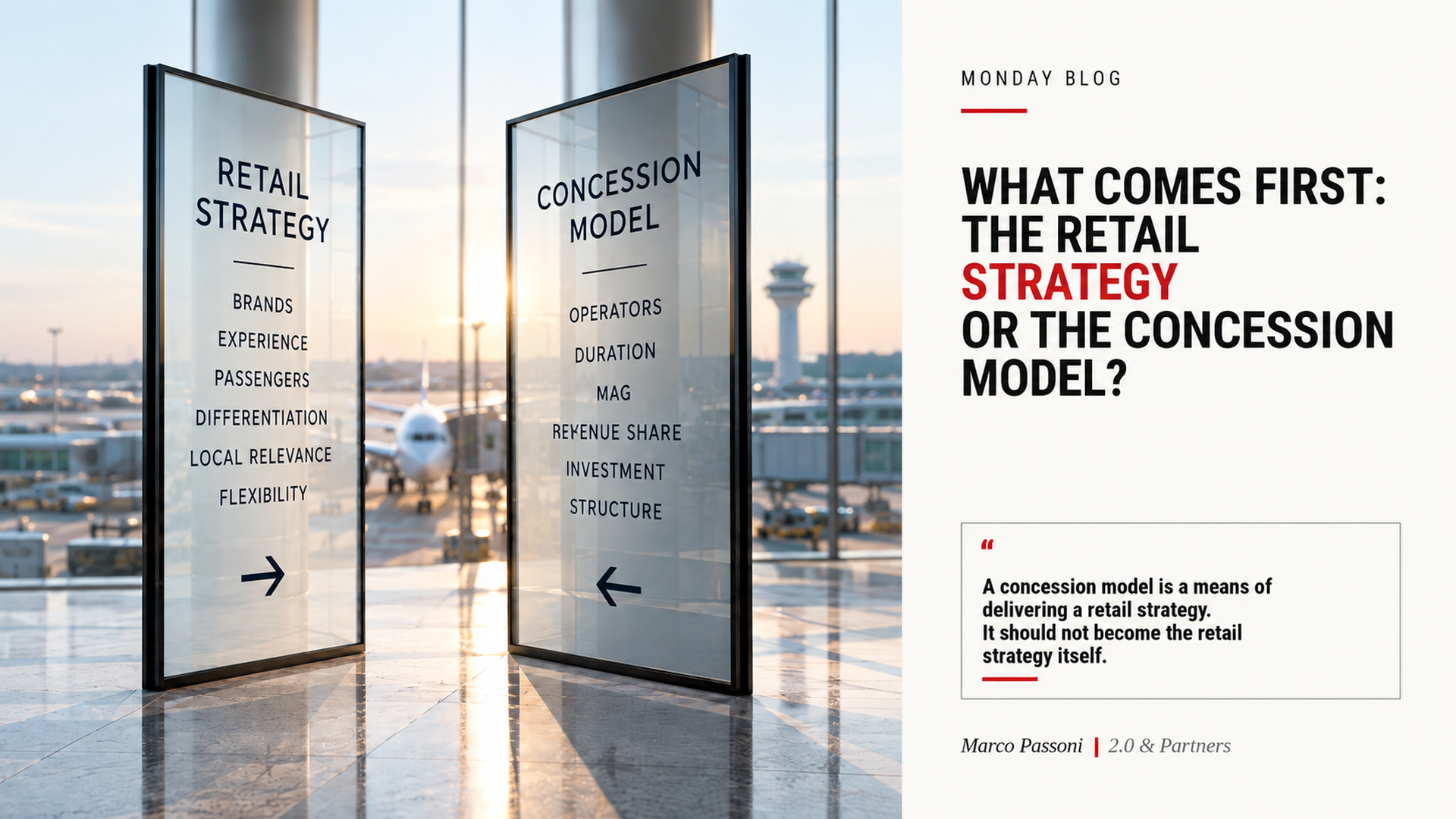
Airport commercial planning can easily start with the structure: one operator or several, master concession or category concessions, contract duration, Minimum Annual Guarantee, revenue share and investment commitments.
All of those decisions are fundamental. They determine risk, economics and operational accountability.
But they should come after a more basic question: what kind of commercial environment are we actually trying to build?
If an airport wants greater brand diversity, faster rotation, stronger local content, specialist category expertise or more direct control over the customer experience, the concession structure needs to make those things possible.
If the priority is operational simplicity, investment certainty and one accountable partner across a large commercial footprint, a more integrated model may be entirely appropriate.
There is no universally correct answer.
That is why I find the Malaysia Airports approach interesting. The RFI is only a market-sounding exercise at this stage, not a procurement process, but the principle is clear: define the ambition first, understand what the market can deliver and then determine the structure.
A concession model is a means of delivering a retail strategy. It should not become the retail strategy itself.
The distinction matters because structure inevitably shapes behaviour.
A long contract gives an operator the confidence to invest. It can support substantial fit-out, technology, staffing and operational infrastructure. It provides continuity and can simplify the relationship for the airport.
But the same long-term certainty can make change more difficult.
Brand relevance moves faster than airport contracts. Categories evolve. Passenger profiles change. New brands emerge, established brands gain or lose momentum and commercial priorities shift. A model based on what is proven today may still be operating seven, ten or twelve years from now.
That does not make long contracts wrong. In many cases, they are economically necessary.
Aena, for example, is currently tendering four fashion and accessories concessions across Madrid-Barajas, with contracts running until the end of 2033 and possible extensions beyond that. Operators and brands need sufficient time to justify investment and build a meaningful business.
The challenge is making sure that certainty does not remove the ability to evolve.
Riga Airport provides another interesting example. Its recent commercial tender was divided into separate lots, but allowed combined bids across categories. The eventual outcome gave Avolta a 12-year duty-free and F&B concession covering eight shops and 22 food & beverage outlets, while convenience retail and lounge services were awarded to specialist operators.
Different airport, different priorities, different answer.
What matters is whether the operating model follows the commercial strategy rather than forcing the commercial strategy to adapt to the operating model once the agreement has been signed.
This becomes particularly relevant when airports talk about differentiation.
Almost every airport wants an offer that feels distinctive. Most want greater local relevance, stronger customer experience and a brand mix capable of responding to changing passenger expectations.
But differentiation requires some freedom to differentiate.
If the concession structure strongly favours scale, standardisation and financial certainty, the commercial outcome will naturally reflect those priorities. It may still be a very good offer, but it can become harder to accommodate smaller specialists, emerging brands or concepts that require a different economic logic.
The same applies to competition.
Multiple operators can create competitive tension and bring specialist expertise, but they also add complexity. A highly integrated model can generate economies of scale, consistency and stronger investment capability, but concentration can reduce competitive pressure and make the airport more dependent on one partner.
Neither model is automatically better.
The question is what the airport is trying to achieve and which trade-offs it is prepared to accept.
I also think we sometimes underestimate the value of optionality.
Airport retail is capital intensive, so certainty matters. But commercial relevance also matters, and relevance requires some ability to change.
That could mean different contract lengths for different categories, performance mechanisms, flexible commercial spaces, clearer provisions for brand rotation or simply a deliberately mixed portfolio of long-term and more adaptable concessions.
There is no reason why every square metre of an airport should necessarily operate under the same commercial logic.
A core duty-free operation and a specialist fashion unit have very different investment requirements, operating dynamics and exposure to changing consumer tastes.
The best commercial model is not the one that maximises certainty on day one, but the one that still allows the airport to remain relevant several years later.
This is also where the financial architecture becomes important.
MAG, revenue share and investment commitments are essential elements of airport economics. Airports understandably need predictable income, while operators need a structure that allows them to generate an acceptable return.
But incentives matter.
An operator carrying a substantial fixed commitment will naturally protect the categories, brands and formats most likely to produce predictable returns. Experimentation becomes more difficult when every square metre has an aggressive productivity requirement attached to it.
That is not a criticism of the operator. It is simply the commercial consequence of the model.
So when an airport awards a concession, it should be very clear about what it is actually buying.
Rent certainty? Investment? Operational capability? Brand access? Category expertise? Customer experience? Innovation? Flexibility?
Usually, the answer is some combination of all of them.
The difficulty is that the structure of the contract will inevitably prioritise some more than others.
Which brings us back to the starting point.
Begin with the passenger and the commercial ambition. Decide what role retail should play, what kind of mix the airport wants, how much differentiation it needs, how much control it wants to retain and how quickly the offer may need to evolve.
Then design the concession model around those choices.
It sounds straightforward, but contracts can define an airport's commercial environment for a decade or more. Getting the sequence wrong can therefore be extremely difficult, and expensive, to correct later.
Malaysia Airports has not yet decided what its future duty-free concession model will be.
That is precisely why I think the process is worth watching.
The interesting question is not whether it eventually chooses one operator, several operators or some variation between the two.
It is whether the final structure genuinely reflects the retail strategy the airport decided it wanted in the first place.
Marco Passoni has spent more than three decades in the travel retail industry, holding senior leadership roles across distribution, retail and business development. His career included 12 years as CEO of a leading international Duty Free distribution company and a further eight years managing a retail business operating fashion mono brand stores across several international airports.
Today, as Senior Executive Vice President and founding partner of 2.0 & Partners, he leads the development of innovative services and new business opportunities for brands, operators and airports across the global travel retail market. A former elite sailor and World Champion, Marco continues to spend much of his time airside, observing the industry first hand and helping partners and clients navigate the distinctive challenges and opportunities of this constantly evolving market.