
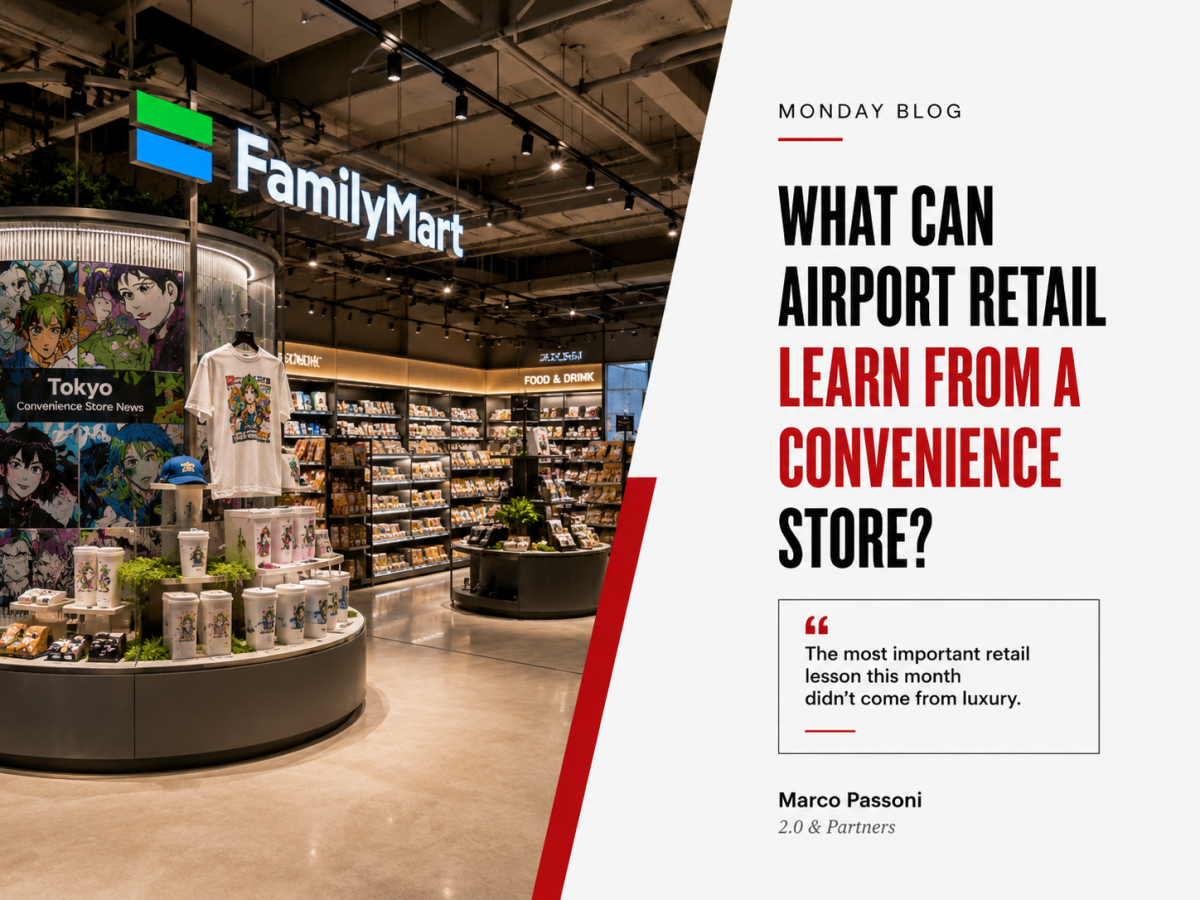
Retail innovation is usually associated with luxury flagships, premium department stores or digital platforms. It is therefore significant that one of the most interesting retail developments of recent weeks comes from FamilyMart, a business built around one of the most functional formats in the industry: the convenience store.
In July, the Japanese retailer opened Famima Park Azabudai in Tokyo, the first flagship of its new “Famima” initiative. Developed under the creative direction of NIGO, the store combines food, fashion, merchandise and services within an environment designed to feel closer to a destination than to a traditional neighbourhood outlet. It includes flagship-exclusive products, fitting rooms, digital styling tools, dedicated staff, a takeaway concept, a rooftop green space and areas organised more like individual shop-in-shops than standard convenience-store aisles.
The individual features are interesting, but the strategic decision behind them matters more. FamilyMart is taking a format historically defined by speed, proximity and utility and adding the elements normally used to create desirability: exclusivity, curation, creative collaboration, visual identity and a stronger sense of place.
This is not simply a redesign of a familiar store format. It reflects a broader change in consumer expectations. Convenience remains important, but it is increasingly treated as a minimum requirement rather than a sufficient reason to visit. Consumers can access products quickly through multiple physical and digital channels. A store therefore has to offer something more than availability if it wants to earn attention, time and discretionary spend.
Convenience is becoming an expectation, while destination value is becoming the differentiator.
This shift has direct relevance for airport retail. Airports have always offered a structural advantage that most retail destinations would value: large volumes of consumers moving through a controlled environment, often with time available before departure. For many years, that combination encouraged an operating assumption that passenger flow would naturally produce store traffic and that store traffic would eventually produce sales.
That assumption is now less reliable. A passenger can move through a terminal with little or no interaction with retail. The journey is increasingly managed through a phone, purchases can be made before travelling, price comparisons are immediate and a growing share of passenger time is directed towards lounges, food and beverage, entertainment or simply getting to the gate with minimal friction. The store may be visible and well located, but visibility alone does not create relevance.
This does not mean that airport retail has lost its competitive advantages. It means those advantages need to be activated more deliberately. Passenger traffic creates potential, not performance. The commercial result depends on whether the proposition gives travellers a sufficiently clear reason to interrupt their journey, cross the threshold and spend part of their limited dwell time inside the store.
The FamilyMart example is useful because it shows how a retailer can rethink a familiar format without abandoning its core business. The flagship still sells food, drinks and everyday products, but it has layered additional reasons to visit around that basic offer. The result is not a completely different business. It is a more distinctive expression of the same business, designed to attract customers who might otherwise have had no reason to make the trip.
Airport retailers and brands should consider the same question. Is the store merely present on the passenger route, or does it contain something that makes the visit worthwhile in its own right? The answer cannot depend only on architecture or brand recognition. Many airport stores are already beautifully designed and located in premium environments. The more difficult task is to ensure that the proposition is sufficiently specific to the airport, the destination and the traveller.
That specificity can take different forms. It may be a product or service that is genuinely exclusive to the channel. It may be a limited collection connected to the destination, a collaboration available only during a particular travel season, a level of personalisation that is practical within the passenger journey, or a service that combines discovery, purchase and collection in a way that cannot be replicated in the domestic market. It may also be strong human interaction, provided by teams who understand the particular pressures, cultural diversity and time constraints of airport customers.
The common requirement is that the store must offer more than the same assortment presented in a different location. A terminal is not automatically a destination simply because millions of people pass through it. In the same way, a store does not become relevant merely because it occupies space within that terminal.
This distinction is especially important at a time when airports, retailers and brands are investing heavily in new commercial environments. Larger spaces, more premium architecture and stronger brand portfolios can improve the overall proposition, but they do not by themselves guarantee engagement. A visually impressive store can still be commercially passive when the customer sees no compelling reason to enter.
The most effective airport retail concepts therefore need to be assessed not only by how they look, but by what behaviour they are designed to generate. Do they create curiosity from the passenger route? Do they communicate a clear benefit within a few seconds? Do they reward entry with something distinctive? Can the frontline team translate the concept into a relevant conversation? Does the experience provide a reason to buy now rather than later?
Passenger flow should be treated as a commercial opportunity, not as a substitute for a compelling retail proposition.
FamilyMart’s Tokyo flagship is not a model that airport retail should copy literally. Its value lies in the principle behind it. A retailer whose traditional strength was convenience has concluded that convenience alone does not create enough differentiation. It is using design, curation, exclusivity and experience to turn an everyday format into a place that customers may choose to visit intentionally.
For airport retail, the implication is clear. The next stage of growth will not come only from placing more stores in front of more passengers. It will come from creating propositions that earn a greater share of passenger attention and give people a credible reason to stop, enter and engage.
The strongest airport stores will continue to benefit from location, but they will not rely on location alone. They will use the airport context to offer something more relevant, more distinctive and more memorable than the customer could find elsewhere.
When a convenience store starts thinking like a destination, it provides a useful reminder to the entire retail industry: presence creates access, but only relevance creates choice.
Source: SoraNews24, “Family Mart opens new ‘Famima’ flagship store in Tokyo that’s like a tourist attraction”, 10 July 2026.