
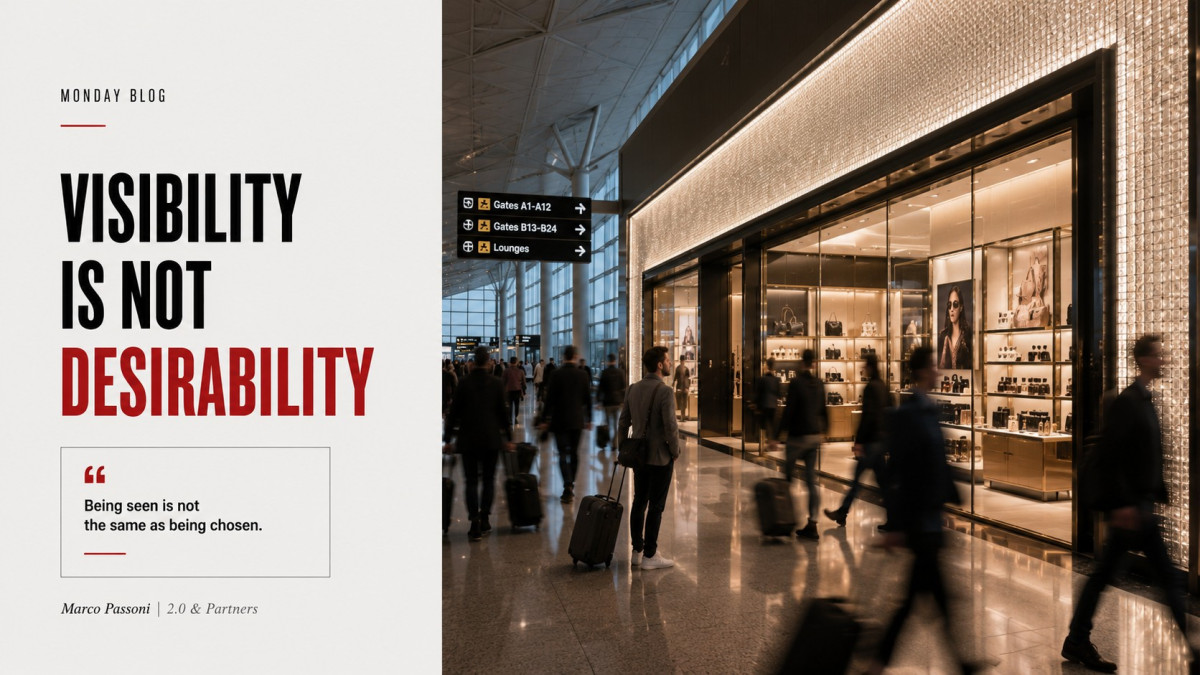
Travel retail has always been a business obsessed with visibility.
And for obvious reasons. Airports are high traffic environments. Locations are expensive. Storefronts compete for attention. Brands fight for the best position, the strongest façade, the most impactful lightbox, the most visible digital screen, the most recognisable presence along the passenger journey.
Visibility matters. Nobody should pretend otherwise.
But visibility is not the same as desirability.
This distinction is becoming increasingly important in a channel where passenger traffic may be growing, but customer behaviour is less predictable, less linear and often more selective than in the past. A passenger may see a store, recognise a brand, understand the category and still decide not to enter. The brand has been visible, but it has not necessarily become relevant.
That is a very different problem.
The industry still tends to celebrate presence. A new opening, a better location, a larger façade, a stronger position in the terminal, a renewed concept. All these elements are important, but they are only the beginning of the commercial equation. They put the brand in front of the passenger. They do not automatically give the passenger a reason to care.
And this is where the mistake often begins.
In airport retail, brands sometimes assume that visibility will do more work than it actually can. The logic is understandable. If the passenger flow is there, if the store is well positioned, if the brand is known, then the opportunity should translate into traffic, engagement and sales.
But the airport passenger is not a conventional shopper.
The passenger is moving through a journey that has not been designed primarily around shopping. There is security, boarding time, family, luggage, fatigue, stress, lounges, F&B, work calls, delays, gate changes and a constant need to manage time. Even when the passenger has spending power, shopping may not be the priority in that moment.
Visibility may interrupt the journey.
Desirability is what makes the interruption worthwhile.
This is why the question should not simply be whether the brand is seen. The more important question is what happens after it is seen. Does the store create curiosity? Does the offer feel relevant to the passenger’s mindset? Is there a reason to stop? Is there a reason to enter? Is the message clear enough to be understood in a few seconds? Does the environment communicate something more than distribution?
A visible store without a clear reason to engage can easily become part of the airport background.
This is particularly true for luxury and premium brands. In many airport locations, the problem is not awareness. The passenger may already know the brand. The logo is recognised. The positioning is understood. The issue is whether the airport expression of that brand creates enough interest, urgency or emotional relevance to justify a stop.
Recognition is not enough.
In some cases, the airport store risks becoming a smaller, faster and less complete version of the downtown brand experience. It has the name, the design codes, the product, the staff and the visibility. But it does not always create a travel specific reason to engage.
This is a missed opportunity.
Because travel retail is not just another point of sale. It is a different context of consumption. The passenger is in movement, between places, between purposes, sometimes between identities. There is a natural emotional dimension in travel, but it is not automatically captured by the store. It has to be translated into the offer, the storytelling, the service approach and the store experience.
That is where desirability is built.
It is built through the ability to make the brand feel relevant to the journey, not just present in the terminal. It is built through assortments that reflect who is travelling, why they are travelling and what they may be willing to discover. It is built through clear visual messages, meaningful exclusives, intelligent gifting logic, cultural sensitivity and a frontline team capable of reading the customer quickly.
It is also built through restraint.
Not every brand expression needs to be louder. Not every activation needs to be bigger. Not every screen needs to be brighter. In some airports, passengers are already overwhelmed by commercial noise. More visibility does not always create more attraction. Sometimes it simply adds to the clutter.
Desirability requires clarity.
This matters even more when looking at recent travel retail indicators. According to IATA, both domestic and international passenger traffic growth moderated in 2025, with domestic traffic up 2.4% year on year and international traffic expanding by 7.1%. The point is not that traffic has stopped growing. It is that growth is no longer enough, on its own, to explain commercial performance. The Duty Free World Council’s Full Year 2025 KPI Monitor, published in March 2026, pointed to international departures up 7%, while impulse purchases increased to 31% of duty free transactions. At the same time, 64% of travellers were actively seeking travel retail exclusives or unique items, compared with 57% the previous year.
These figures tell a useful story.
There is traffic. There is impulse. There is interest in uniqueness. But none of this means that any visible brand will automatically benefit. The opportunity is there, but it still has to be earned.
ACI Asia Pacific and Middle East has also highlighted that airport retail is increasingly driven by passenger mix and behaviour rather than traffic volumes alone, with 70% of purchases still impulse driven. This reinforces the same point: if the decision is often made in the moment, the quality of that moment becomes critical.
Visibility can create exposure.
Desirability creates the reason to act.
For airports, this should raise an important commercial question. Is the terminal simply allocating space to visible brands, or is it curating a retail environment where passengers feel there is something worth exploring? The two things are not the same. A terminal can be full of strong names and still feel commercially flat if those names do not translate into relevance for the passenger mix.
For operators, the question is equally important. Is the commercial model designed only to maximise frontage, density and category presence, or also to understand where attention is converted into engagement? Store performance cannot be read only through traffic and location. It has to be read through the quality of the customer response.
For brands, the challenge is perhaps the most delicate. Airport visibility can be valuable, but it can also become passive if the brand does not adapt intelligently to the channel. Travel retail should not dilute the brand. But nor should it simply replicate a generic version of the brand in a more transient environment.
The best airport stores understand this.
They do not rely on visibility alone. They create a specific reason to enter, a reason to interact and a reason to remember. They make the passenger feel that what is being offered in that location, at that moment, has some relevance to the journey.
This does not always require spectacular investment. Sometimes it requires better discipline. A sharper assortment. A clearer message. Better storytelling. More relevant exclusives. Stronger frontline briefing. A more intelligent connection between passenger profile, location and offer.
The future of travel retail will not be won only by the brands that are most visible.
It will be won by the brands that are most relevant when they are visible.
That is a very different standard.
And it is one the industry should take more seriously.