
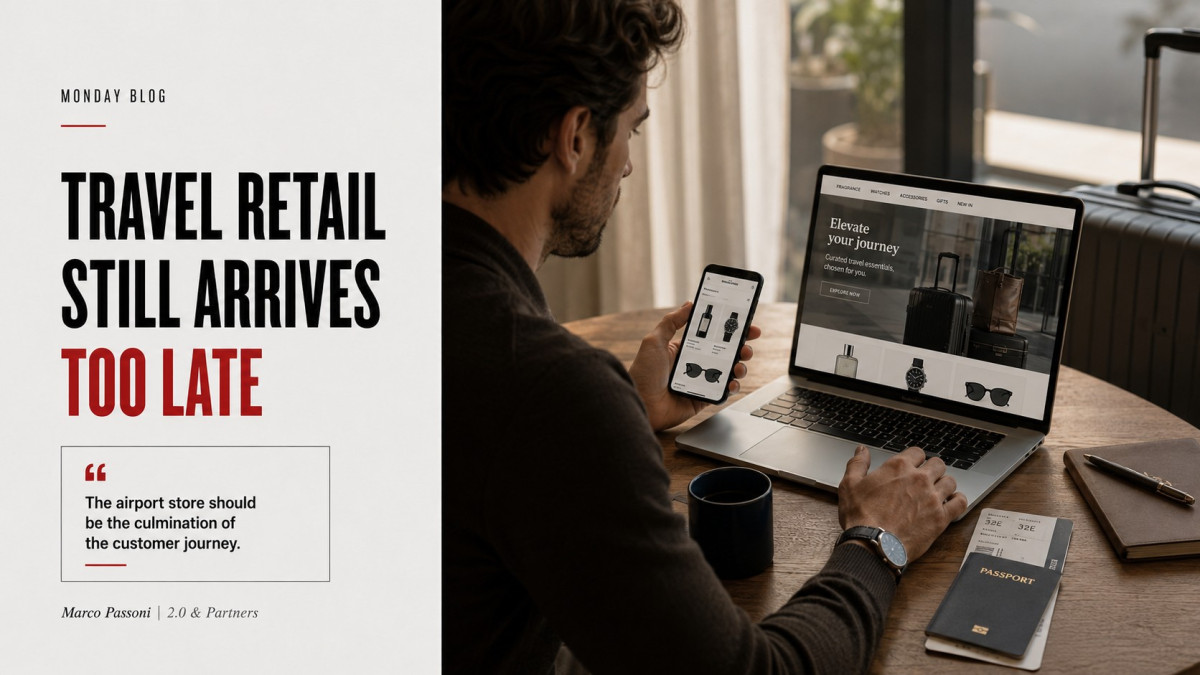
Travel retail continues to behave as if the commercial journey begins when the passenger enters the terminal. For a long time, this assumption was understandable. Airports were unique commercial environments, passengers had fewer alternatives, access to information was more limited, and the store was the natural point of discovery. Today, however, that model is increasingly disconnected from the way people actually shop.
The passenger now begins the decision process long before arriving at the airport. Products are researched online, prices are compared across markets and channels, reviews are read, alternatives are considered, and brand preferences are reinforced or weakened well before the journey begins. In many cases, entire categories may already have been excluded before the passenger reaches the security queue.
Yet much of travel retail still concentrates its energy almost entirely inside the terminal. The industry continues to invest in location, space, store design, assortment, promotions, visibility and activations. All of these elements matter. But they still operate mainly at the final stage of the journey, when the passenger is already travelling, already distracted and often already carrying a clear idea of what is worth buying and what is not.
The airport store should be the culmination of the customer journey, not the point where the journey begins.
The distinction matters because the airport store is no longer simply a place of discovery. It has increasingly become a place of confirmation. The passenger may already know the product, the local retail price, the online price, the available alternatives and the expected level of discount. The store therefore has to prove that the offer is relevant, that the product is available, that the price makes sense and that there is a credible reason to purchase at the airport rather than online or downtown.
This is where travel retail still has a problem. For many passengers, it remains surprisingly difficult to understand in advance what they will actually find at the airport. Product availability is often unclear. The difference between departure and arrival assortments is rarely transparent. Prices are difficult to compare. Genuine exclusives are not always easy to identify. Reservation and collection services remain fragmented, while the real commercial advantage of purchasing at the airport is often left unexplained.
These are not secondary details. They are basic questions that shape the purchasing decision. A passenger should not have to arrive at the airport to discover whether the product is available in the right terminal, whether the assortment is relevant, or whether the price is genuinely competitive. Yet this is still the reality in many cases.
The paradox is that travel retail operates in one of the richest data environments in retail. Airports know when the passenger is travelling. Airlines know the destination. Loyalty programmes know the customer profile. Operators know the assortment and the available stock. Brands know the product story. Digital platforms know what customers are searching for and what they are comparing. Despite this, the commercial journey often remains disconnected.
Before travelling, passengers receive countless operational messages. They receive check in reminders, gate information, security guidance, baggage updates, transport options, hotel confirmations and lounge offers. They are guided through every practical aspect of the journey. The retail offer, however, is still too often absent, generic or poorly integrated into the same process.
The problem is not that travel retail needs another app. The problem is that travel retail still lacks continuity.
There is often no clear connection between the moment when the passenger starts planning the journey and the moment when the passenger enters the store. There is no coherent path from discovery to consideration, from consideration to reservation, from reservation to collection and from collection to a future relationship with the customer. The store remains isolated from the wider journey. As a result, the entire commercial opportunity is compressed into a few minutes inside the terminal.
This is particularly limiting for categories where the decision process is naturally more considered. Luxury, fashion, watches, jewellery and premium gifting are not always spontaneous purchases. Even when the final decision is made in the airport, the interest may have been built earlier. The passenger may need reassurance, comparison, availability and a credible reason to act. Travel retail should not wait passively for that decision to happen. It should become part of the decision process before the passenger travels.
This does not mean turning the airport into another generic online marketplace. Travel retail has its own strengths: immediacy, discovery, exclusivity, emotional context, convenience, gifting, international exposure and the particular psychology of the journey. But these strengths should not remain invisible until the passenger walks through the terminal. They need to be activated earlier and presented in a way that is useful, relevant and connected to the purpose of the trip.
A more intelligent model would begin with a simple question: what does the passenger need to know before reaching the airport? A frequent traveller may value speed, certainty and collection. A leisure traveller may be interested in discovery, gifting and exclusives. A luxury customer may want reassurance that the right product is available in the right terminal before investing time in the store. A family may need convenience, while a passenger with a short connection may need clarity and precision.
The industry often talks about personalisation, but personalisation should not be reduced to targeted messages or promotional emails. It should make the commercial journey more useful. A passenger should not have to search across multiple airport websites, operator pages and brand channels to understand what is available. A passenger should not arrive in the terminal only to discover that the desired product is not there. A passenger should not have to guess whether the airport price offers a real advantage.
A better travel retail model would not eliminate spontaneity. It would create the conditions for spontaneity to work more effectively. Impulse and planning are not opposites. A passenger may discover a product before travelling, consider it during the journey, see it in the airport and decide to purchase it in the store. The final transaction may still feel spontaneous, but the commercial relationship started earlier.
This is also why store performance can be misread. A location may underperform not because the concept is wrong, the passenger mix is unfavourable or the visibility is weak. It may underperform because the customer journey started elsewhere and the airport was never properly connected to it. The passenger did not necessarily ignore the store. The store simply arrived too late.
There is also a wider strategic issue. Airports increasingly want to position themselves as more than infrastructure. They want to become destinations, commercial environments and expressions of place. Operators want to increase productivity. Brands want to protect their positioning, reach new customers and use travel retail as a platform for image, client acquisition and long term relevance. None of these ambitions can be fully delivered if the commercial relationship begins only after security.
The terminal remains important. The store remains essential. The physical experience continues to play a decisive role. But the airport store should no longer be treated as an isolated commercial box. It should be the visible end point of a journey that has already started.
This requires greater integration between airports, operators, airlines, loyalty platforms and brands. It requires clearer information on assortment, availability, price and exclusivity. It requires a more useful role for digital tools. Above all, it requires the industry to accept that the passenger journey and the customer journey are no longer the same thing.
The passenger journey may begin with a ticket. The customer journey may begin with a search, a comparison, a recommendation, a previous purchase or a moment of curiosity long before the airport. Travel retail cannot afford to join that conversation only at the end.
The next phase of the industry will not be defined only by better stores, stronger locations or more impressive activations. It will be defined by the ability to become relevant earlier. Travel retail should not wait for the passenger to arrive. It should already be part of the journey before the journey begins.