
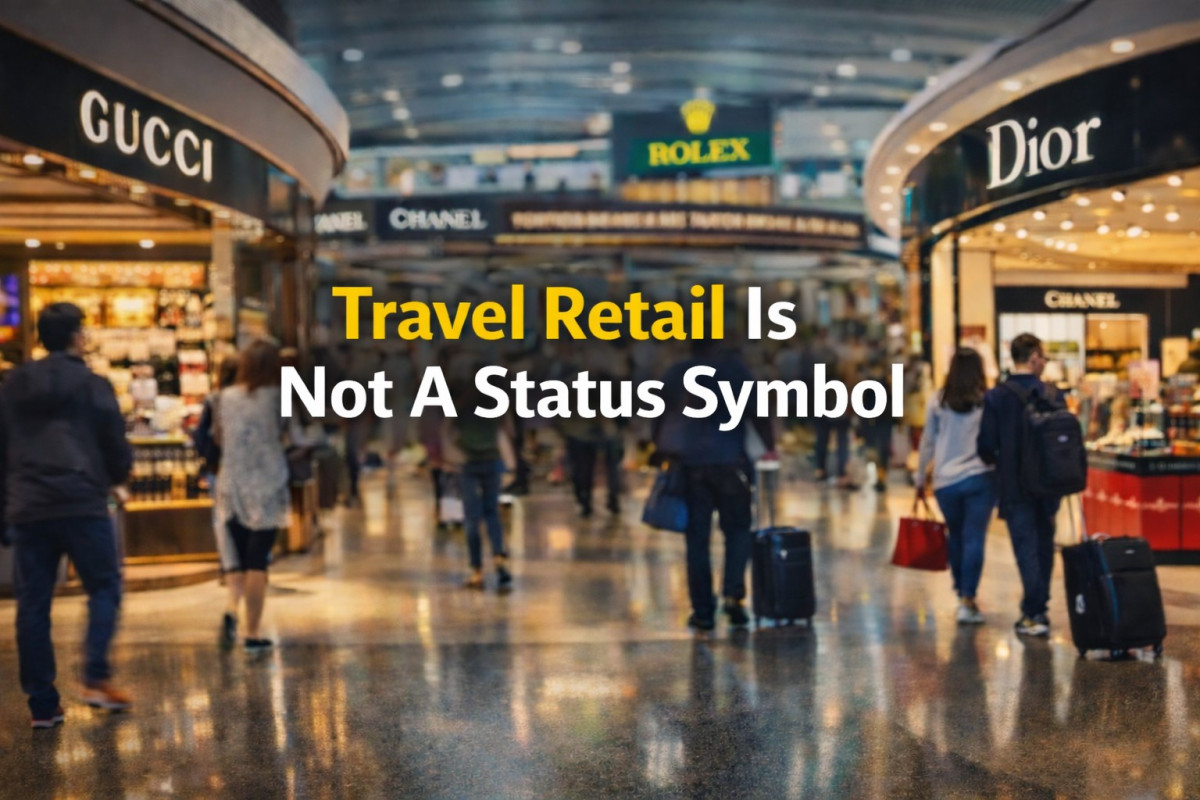
As I write this week’s blog, I find myself reflecting on a pattern that has become increasingly visible across airports worldwide.
Travel retail has matured enormously over the past decade. The quality of store design has improved, the number of luxury brands has grown, and the ambition of airports to elevate their commercial offer has never been higher. Yet, despite this progress, one recurring dynamic continues to hold the sector back: the tendency to treat location as a badge of status rather than a strategic decision.
Too often, the question behind a new airport opening is not “Why here?” but “Why not here?”.
At 2.0 & Partners, we speak with many brands considering expansion into travel retail. The location requests we hear are frequently identical. The same airports. The same terminals. The same concourses. Not because those environments are the best match for the brand or its customers, but because they are perceived as the places a brand should be: because competitors are already there. Because the location is considered prestigious. Because being present feels like a milestone.
But travel retail is not a status box to tick. And treating it as one is increasingly risky.
We can see the consequences clearly in many airports today, particularly in the luxury segment. Clusters of strong brands sit side by side, each with impressive stores and compelling products, yet none truly stands out. The result is not a stronger offer, but a quieter one. When every brand follows the same playbook, differentiation inevitably disappears.
Safety begins to replace strategy. Presence begins to replace purpose.
Travel retail is not a status box to tick. And treating it as one is increasingly risky
For emerging and smaller brands, the challenge is even greater. The temptation to follow established paths is completely understandable. Proven locations feel reassuring. Competitor presence feels validating. But entering an environment that you cannot truly own is rarely a long-term solution. Without a clear strategic fit between brand, location and traveller profile, visibility quickly becomes noise.
The real question every brand should ask before entering travel retail is simple. Why this location, and why now?
Are the right travellers actually passing through this space? Can the brand add something meaningful to their journey? Is there a clear role for the brand in that specific environment?
If the answer is unclear, the decision may be driven more by perception than by strategy.
Airports and landlords face a parallel challenge. It is often easier to select familiar names than to create space for new concepts and new stories. Yet repeating the same brand mix across terminals and across continents does little to excite travellers or differentiate destinations. In the long term, sameness benefits nobody.
It is often easier to select familiar names than to create space for new concepts and new stories.
Travel retail has never lacked ambition. What it sometimes lacks is the willingness to take calculated, strategic risks.
As the sector continues to evolve, success will depend less on being present in the most famous locations and more on being present in the right ones. The brands that will thrive are those that treat travel retail not as a trophy, but as a channel that requires clarity, purpose and genuine strategic fit.
Because in a world where every airport is improving, simply being there is no longer enough.