
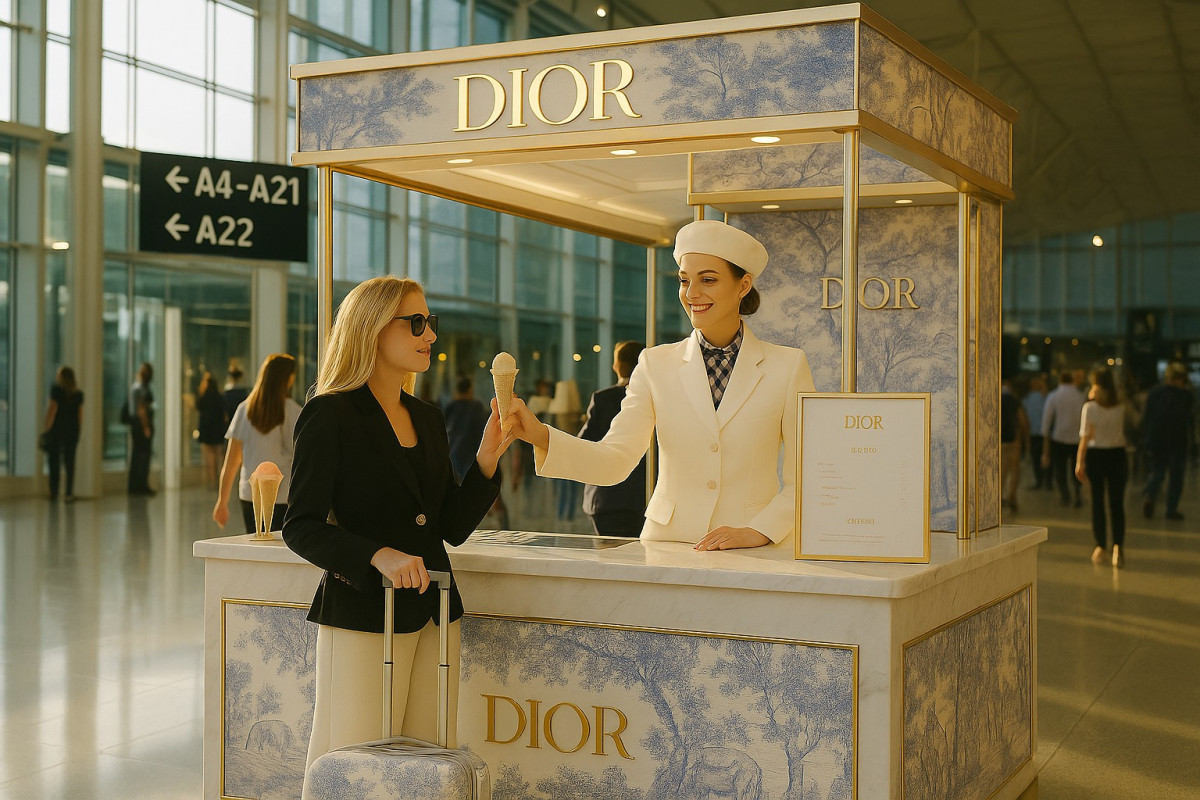
Luxury brands often talk about creating experiences, but too often those experiences remain trapped within the walls of their boutiques. They are sophisticated, curated, beautiful—and predictable. Then something apparently simple, even childish, enters the stage and changes everything. Ice cream. Or better, gelato. The most democratic expression of pleasure, suddenly transformed into a medium for storytelling.
Over the past few years, some of the most iconic houses have turned gelato into a tool for emotional connection. Dior opened its café in Saint-Tropez serving pastel-coloured scoops in branded cups. Gucci turned gelato into a lifestyle statement with Gucci Giardino 25. Louis Vuitton played with seasonal flavours as an extension of its collections. What was once a casual indulgence became a moment of aspiration. A cone became a brand signature. People queued, photographed, and shared. Experience in its purest form—short, sweet, instantly shareable.
Ice cream. Or better, gelato. The most democratic expression of pleasure, suddenly transformed into a medium for storytelling.
The genius of this formula lies in its simplicity. No purchase barriers, no intimidation, no need for explanation. It brings luxury down to human temperature. You don’t need to buy into the brand to belong to it for a moment. You just need to taste it. The customer smiles, takes a photo, and walks away with something that feels exclusive yet accessible. Emotion delivered in 30 seconds. A connection stronger than many expensive campaigns.
And yet, as I look at airports—the natural homes of global brands and the perfect theatre for these emotions—I rarely see anything comparable. Travel retail keeps promising experience, but most of the time what we find airside is sterile repetition. Large stores, bright lights, familiar names, and little else. The perfect stage, wasted. Travellers are there with time, curiosity, and an appetite for discovery, yet brands keep offering them only product, not feeling. The irony is that the simplest format—a branded gelato pop up—could achieve exactly what we keep calling “engagement”: curiosity, interaction, memory. A moment that sticks.
Travel retail keeps promising experience, but most of the time what we find airside is sterile repetition.
Gelato is not the message. It is the medium. It translates a brand’s world into something everyone can understand and enjoy. It makes identity edible. It makes storytelling physical. I wrote about gelato before, and I return to it now for the same reason: because it keeps proving that simplicity, when executed with clarity and intent, can be the most powerful expression of luxury.
The travel retail industry loves to overcomplicate things—more space, more concepts, more noise. But customers crave the opposite. They want emotions that feel natural, short, and real. They want moments, not messages. Gelato works because it gives them exactly that. A few seconds of connection. A smile that travels further than any campaign could.
Gelato is not the message. It is the medium. It translates a brand’s world into something everyone can understand and enjoy.
In the end, luxury is not about how much it costs to make someone feel good. It’s about how little it takes when you know how to do it. And maybe, just maybe, the next great idea in travel retail will not come from an architectural blueprint—but from a spoon.