
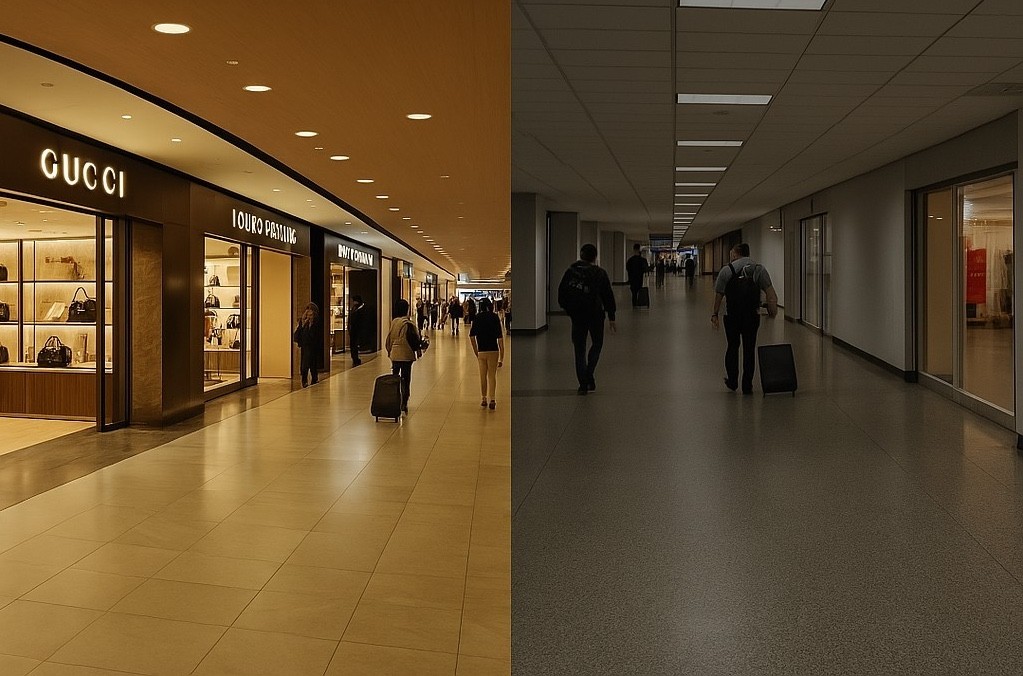
Over the past few years, I’ve watched more and more airports launch ambitious renovation projects with a clear goal: creating the perfect luxury line-up.
It’s an appealing vision — a retail precinct filled with the most prestigious names in fashion and accessories, lined up in an elegant, high-margin corridor meant to elevate the entire passenger experience.
The problem? Too often, this vision is undermined by executional flaws that should have been addressed at the drawing board.
I keep seeing the same mistakes repeated: store units that are too small or awkwardly shaped for luxury formats; façades that limit visibility or force brands into layouts that don’t respect their VM standards; adjacency plans that place luxury labels alongside brands with completely different positioning; circulation paths designed for practicality rather than storytelling. These might seem like minor details on paper — but in the luxury world, they’re dealbreakers.
Luxury brands don’t compromise on how they present themselves. If the space doesn’t meet their minimum requirements, they simply decline. Or worse: they accept with reluctance, and the result is a diluted version of the brand experience that reflects poorly on everyone involved.
Luxury brands don’t compromise on how they present themselves. If the space doesn’t meet their minimum requirements, they simply decline
What’s behind these repeated errors is often a deeper disconnect: airports and luxury brands are speaking different languages. Many airport stakeholders approach negotiations as they would with any other retailer — focusing on rental income, footfall, and sales-per-square-metre. But luxury operates on a different plane. Beyond performance metrics, brands need the how to be right: how they’re presented, how they’re curated, how they’re surrounded. In luxury, space is not just a location — it’s part of the brand identity.
What makes it even more frustrating is that, in many cases, the airport should be a perfect environment for luxury. The passenger profile is there: high-spending travellers, long dwell times, international visibility. The fundamentals are solid. But when the product is wrong — when real estate basics are overlooked or underestimated — all that potential goes to waste. The opportunity is lost not because the airport isn’t good enough, but because it didn’t speak the right language to the brands it hoped to attract.
In a recent redevelopment, a major European airport launched what it presented as a premium fashion area. The space was elegant on the surface, but store dimensions were restrictive, façades lacked height and visibility, and the brand adjacencies were inconsistent. Despite the passenger traffic perfectly matching the target profile of luxury brands, none of the top-tier maisons agreed to open.
The opportunity is lost not because the airport isn’t good enough, but because it didn’t speak the right language to the brands it hoped to attract
By contrast, there are airports that do understand the rules. When the retail environment is curated around luxury principles — proportion, visibility, adjacency, and positioning — the results are clearly visible. In those cases, luxury brands not only sign up, they thrive. And the entire passenger experience is elevated as a result.
Building a true luxury line-up is not about filling empty boxes with logos. It’s about curating an ecosystem. It requires understanding that luxury retail is a precise and unforgiving discipline — and that credibility in this world isn’t granted by ambition, but by execution.
Until more airports embrace this, we’ll keep seeing good intentions dressed up as premium destinations — and wondering why they fail to deliver.
Because the truth is: luxury doesn’t forgive shortcuts.
And polished tiles don’t equal prestige.
Happy Monday.