
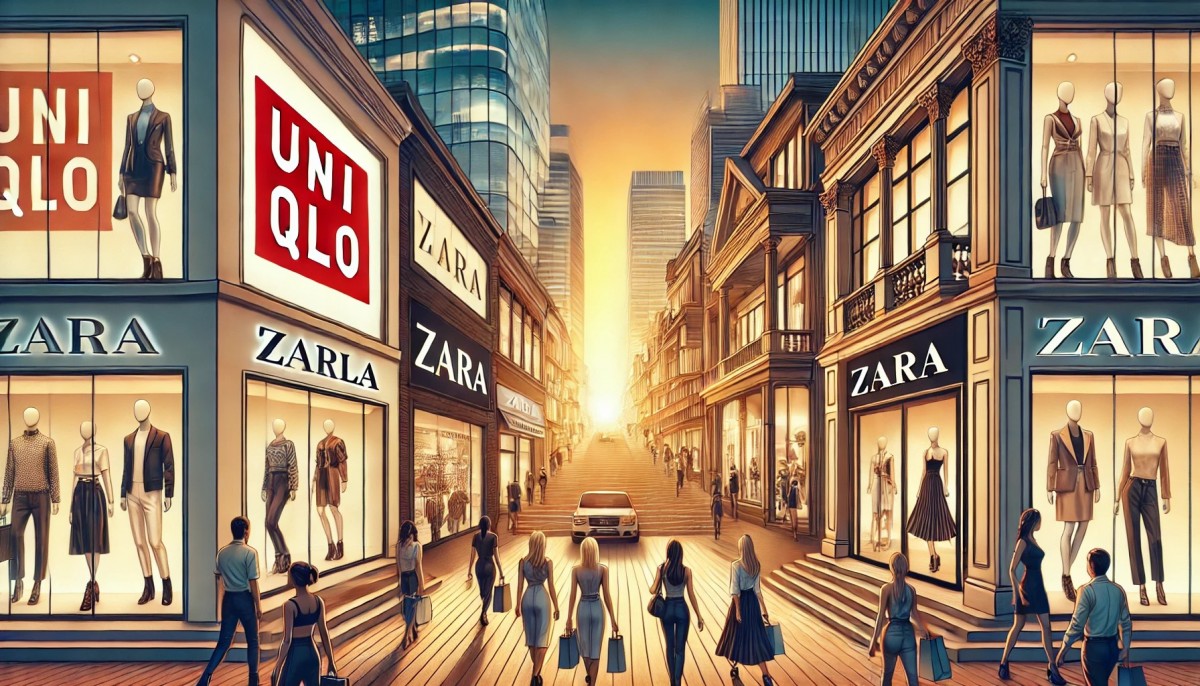
Much discussion at the end of last year focused on the recent slowdown in the luxury market. There are doubtless multiple factors here, as highlighted by a report from Bain & Co in collaboration with Altagamma, including the challenges of global economic pressures and the evolving demands of an increasingly selective and discerning consumer. However, for me, one particularly interesting dynamic is emerging in the modern market: the transformation and evolution of mid-range brands.
This phenomenon is reshaping the global fashion landscape and challenging the traditional value proposition of luxury brands.
In recent times, several brands which have historically been positioned at the lower end of the price pyramid have embarked on a journey of qualitative growth, transforming their offering and radically changing consumer perception. They are no longer seen merely as cheap alternatives to major luxury brands but are now regarded as independent and desirable choices, capable of delivering fashion content and intrinsic quality.
A prime example is UNIQLO, which over the past year has achieved outstanding financial performance, with a significant leap on the stock market. This success has propelled its founder, Tadashi Yanai, to 30th place on the list of the world’s richest individuals. UNIQLO has successfully created a blend of minimalist aesthetics, functionality, and material innovation, offering high-quality products at accessible prices. This strategy has broadened its audience and solidified a positioning that goes far beyond the concept of “low-cost fashion”.
In recent times, several brands which have historically been positioned at the lower end of the price pyramid have embarked on a journey of qualitative growth, transforming their offering and radically changing consumer perception
Similarly, Zara, the flagship brand of the Inditex group, reported robust growth with a +7.1% increase in global revenue in its latest quarter. The Spanish giant’s strategy has focused not only on speed and adaptability to trends but also on transforming its retail spaces. Zara’s new stores today resemble boutiques more than fast-fashion outlets, with refined layouts and a growing emphasis on the perceived quality of its garments.
What makes this transformation even more significant is the gradual departure from the image of “throwaway fashion” that has characterised mid-range brands for years.
Zara and UNIQLO, among others, are investing in better materials, more sustainable production processes, and increasingly sophisticated designs. This strategic choice responds to the demands of a consumer who seeks a balance between price, quality, and social responsibility. In this way, the mid-range is no longer perceived as a mere middle ground between luxury and low-cost but as a distinct category capable of delivering genuine value.
A new challenge
This raising of the qualitative bar poses a concrete challenge to luxury brands: convincing consumers to spend ten or twenty times more for a branded product is becoming increasingly difficult. The glory of the past and the value of the brand alone are no longer sufficient to justify premium prices, particularly when mid-range offerings deliver aesthetically pleasing and satisfactory quality products.
For some luxury brands, the response to this challenge has been clear: strengthening their identity, ensuring product exclusivity, and enhancing their heritage. Others, however, find themselves in a phase of redefining their value proposition, searching for new strategies to remain relevant in an increasingly crowded and competitive market.
This raising of the qualitative bar poses a concrete challenge to luxury brands: convincing consumers to spend ten or twenty times more for a branded product is becoming increasingly difficult
The transformation of mid-range fashion is not a temporary phenomenon but a structural change. Today’s consumers, particularly the younger generations, are unwilling to pay premium prices without tangible and perceptible value. Quality, authenticity, and the overall brand experience are key factors influencing purchasing decisions.
While the luxury market faces a slowdown, it is evident that the playing field is shifting towards a new balance, where brands such as UNIQLO and Zara are no longer mere followers but true innovators, capable of challenging the traditional hierarchy of the fashion system.
In this scenario, luxury brands must renew their commitment to creating authentic value, exploring new frontiers of creativity and quality to continue winning the hearts and wallets of consumers.
The game is on, but one thing is certain: luxury can no longer rest on the laurels of past success. Innovation is the only path to remaining competitive in an ever-evolving market.