
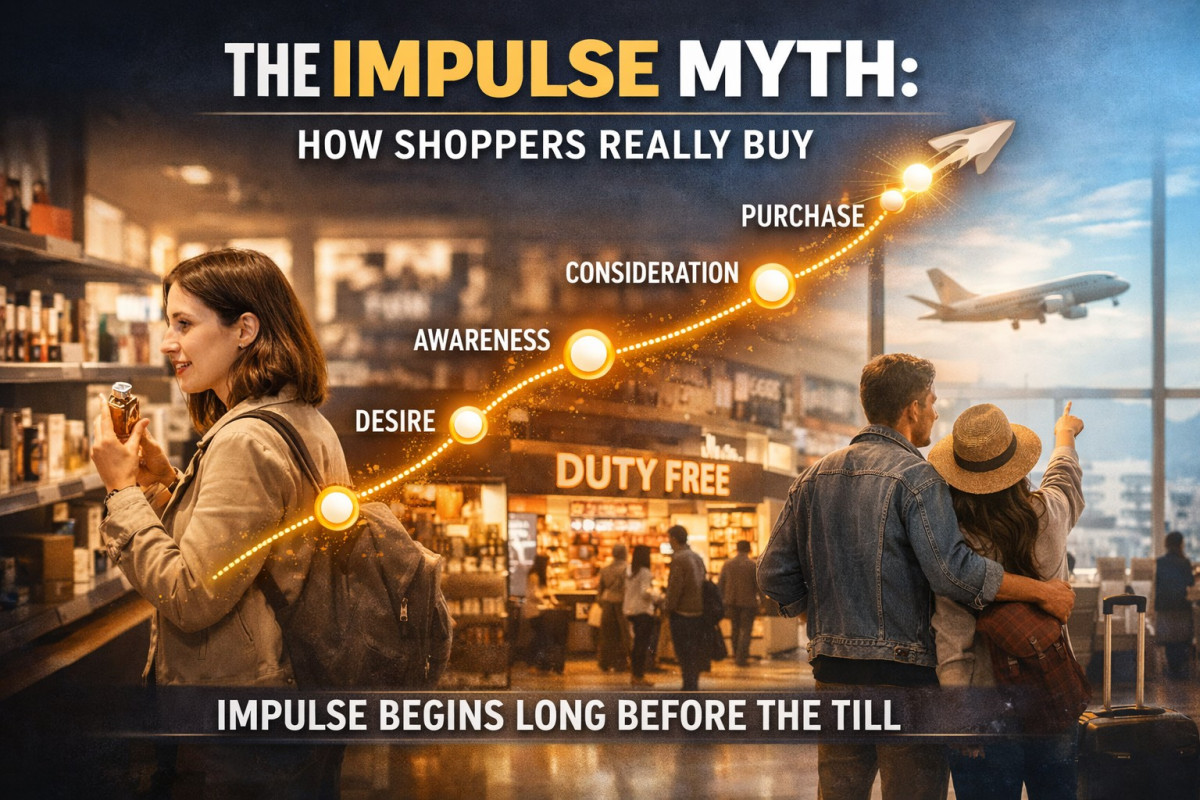
We talk a great deal about “impulse” shopping in travel retail. It is a convenient narrative. Place the right product near the till. Design a compelling grab-and-go offer. Capture the traveller in the moment and convert them before boarding is called.
But this version of impulse buying is far too simplistic.
Shoppers do not arrive at a purchase decision from nowhere. Very rarely does a product leap off the shelf and into a basket without context, familiarity or desire already in place. Yet the industry often behaves as though impulse is spontaneous, accidental, almost random.
Shoppers do not arrive at a purchase decision from nowhere…Yet the industry often behaves as though impulse is spontaneous, accidental, almost random.
Recent insight from GWI tells a very different story. What we call impulse shopping is far more often the release of latent desire; a want that already exists, waiting for the right moment to surface. The store does not create that desire; it merely gives it permission.
The data supports this. Around 50% of shoppers who describe themselves as “impulse buyers” say they already have a specific product in mind when they shop. Among “pre-planned” shoppers, the figure rises to 60%. The gap is far narrower than we like to admit. The real distinction is not whether they want the product, but when that desire becomes a purchase.
This changes how we should think about product, space and engagement.
No product exists in isolation. Nothing sits on a shelf waiting to inspire like a bolt of lightning. Every purchase sits within a wider ecosystem of awareness, relevance and emotional connection that begins long before a shopper steps into store.
Those so-called impulse moments are built upstream: through storytelling, visibility, credibility and engagement. But this groundwork must be handled carefully.
So-called impulse moments are built upstream: through storytelling, visibility, credibility and engagement. But this groundwork must be handled carefully.
WGSN data shows that almost half of American consumers now actively avoid brands they feel have over-advertised. At the same time, 66% of shoppers say they feel more positive about a brand after engaging with it live, in a real-world environment. Experience, it seems, carries more weight than repetition. Shoppers want something they can live, not simply be shown.
This is where travel retail holds a rare and powerful advantage.
Airports are uniquely primed for conversion. The self-treat mindset, the sense of occasion, the emotional lift of travel: all of these make them fertile ground for purchases that might otherwise be postponed.
But arguably, travel retail is even more valuable as a stage for live brand experience. A place where discovery happens. Where curiosity is sparked. Where a future purchase is seeded, even if it does not happen immediately.
Impulse shopping will always be part of travel retail’s DNA. But if we want those moments to keep delivering value, we must stop treating them as accidents.
They are earned. And the work starts long before the shopper ever reaches the till.