
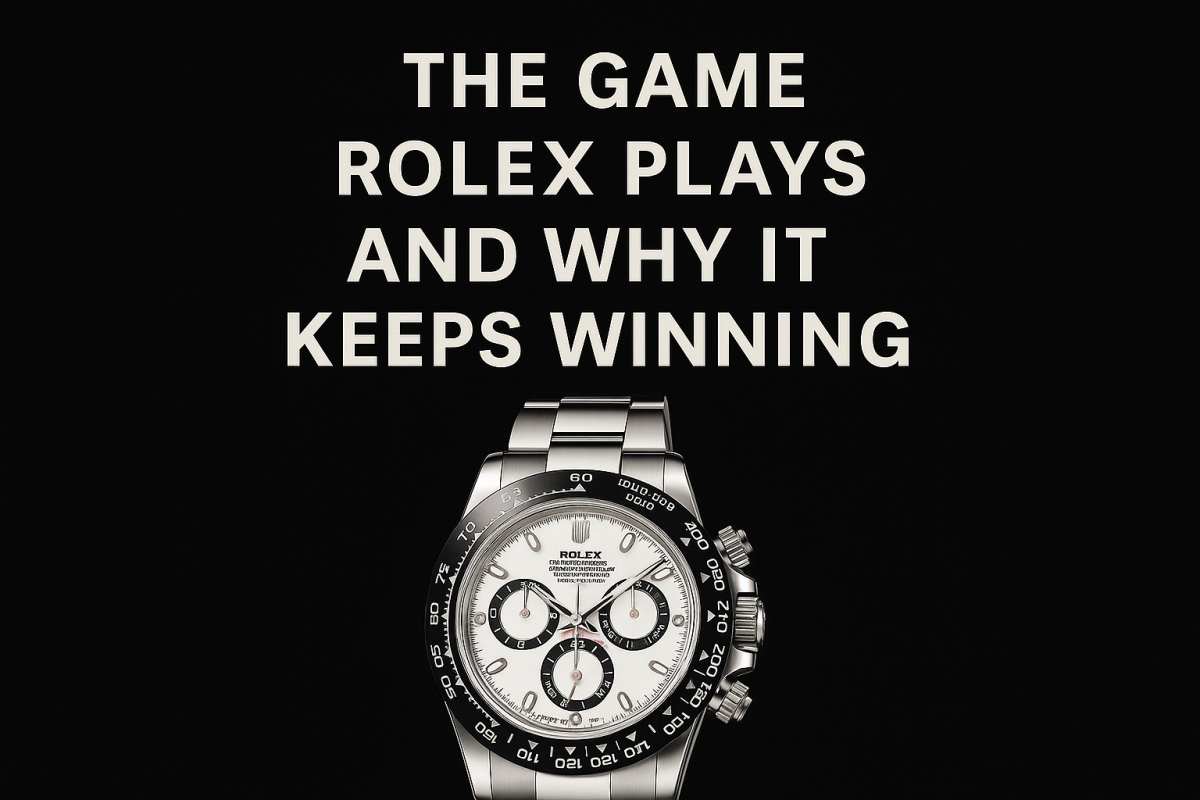
Rolex does not run. Rolex does not chase. Rolex sets the pace.
In an era where luxury exposes itself, accelerates, and multiplies, Rolex continues to win by playing a different game — slower, quieter, more selective. This is not a marketing trick. It is a business model. And it works because it reshapes the fundamentals of demand: it does not sell watches — it sells access, qualification, and aspiration.
Rolex continues to win by playing a different game — slower, quieter, more selective. This is not a marketing trick. It is a business model.
Today, owning a Rolex is not simply a matter of financial means. It is a matter of merit. To purchase a steel Daytona, the most coveted of all models, money is not enough. You need a personal relationship with an authorised dealer. A track record of purchases. Patience. And, ultimately, to be chosen.
The market knows this well. In the UK, it is widely accepted that being considered for a Daytona often requires having already spent between £80,000 and £150,000 on previous Rolex purchases. A Datejust first, perhaps a Submariner next, maybe a Day-Date… and eventually, if all goes well, you may be “offered” a Daytona. Possibly not the exact reference you wanted. Maybe not in your preferred colour. But that is beside the point — what matters is being granted one.
What stands out is not just the rigidity of the process, but how effective it is. Every waiting list, every refusal, every checkpoint strengthens the buyer’s emotional investment. Desire builds precisely because Rolex does not speak, does not promise, and never explains. And when, after years of waiting, a client finally receives their piece, the moment does not feel like a transaction — it feels like an achievement. A rite of passage. The unlocking of a new level in a hierarchy of prestige.
Rolex has gamified luxury. But not through digital badges, rewards or subscriptions. Through scarcity. Through silence. Through absolute control of distribution.
Rolex has gamified luxury. But not through digital badges, rewards or subscriptions. Through scarcity.
This is not the result of production limitations — it is a choice. Rolex manufactures roughly 1.2 million watches per year and generates over $10 billion in revenue. It could double production and still fall short of demand. But that is not the point. Rolex is not trying to satisfy the market — it is trying to manage the myth. And in the mythology of luxury, scarcity is not a flaw. It is the asset.
That is why waitlists remain long. A Daytona can take up to five years. A coloured-dial Oyster Perpetual is often unobtainable for over a year. Highly sought-after models are on display in boutiques but not for sale. And nobody complains. Because everyone understands that those showcases are not promises — they are invitations to want.
Recently, Rolex officially entered the certified pre-owned market, partnering with selected retailers such as Bucherer. The logic remains the same. A brand-new Daytona might retail for just over £11,000. On the secondary market, its value can double — immediately. Resale value is not a threat to the brand, but an extension of its commercial strength: the second-hand market becomes another arena where the myth is monetised and reinforced.
In 2025, Rolex began construction of a new production facility in Bulle, in the Swiss canton of Fribourg. And again, the logic is clear: grow, but with discipline. The planned increase in output is modest — around 25% — and will take years. No aggressive scaling. No volume chasing. Only surgical control of supply, keeping tension high between visibility and availability.
Meanwhile, the brand continues to appeal to new generations without pandering. For Gen Z, a Rolex is not only a status symbol, but a tangible investment. The financial narrative merges with the emotional one. Ownership becomes identity — and capital.
The financial narrative merges with the emotional one. Ownership becomes identity — and capital.
And this is how Rolex keeps winning. Not by selling watches, but by crafting a path of belonging. Not by following trends, but by defining its own rhythm. Not by explaining, but by implying.
This is not a commercial strategy. It is a cultural strategy.
And like all deep-rooted cultures, it does not need to shout. It just needs to exist.
Demand may surge, markets may evolve, the world may accelerate – but time, for Rolex, is always under control.