
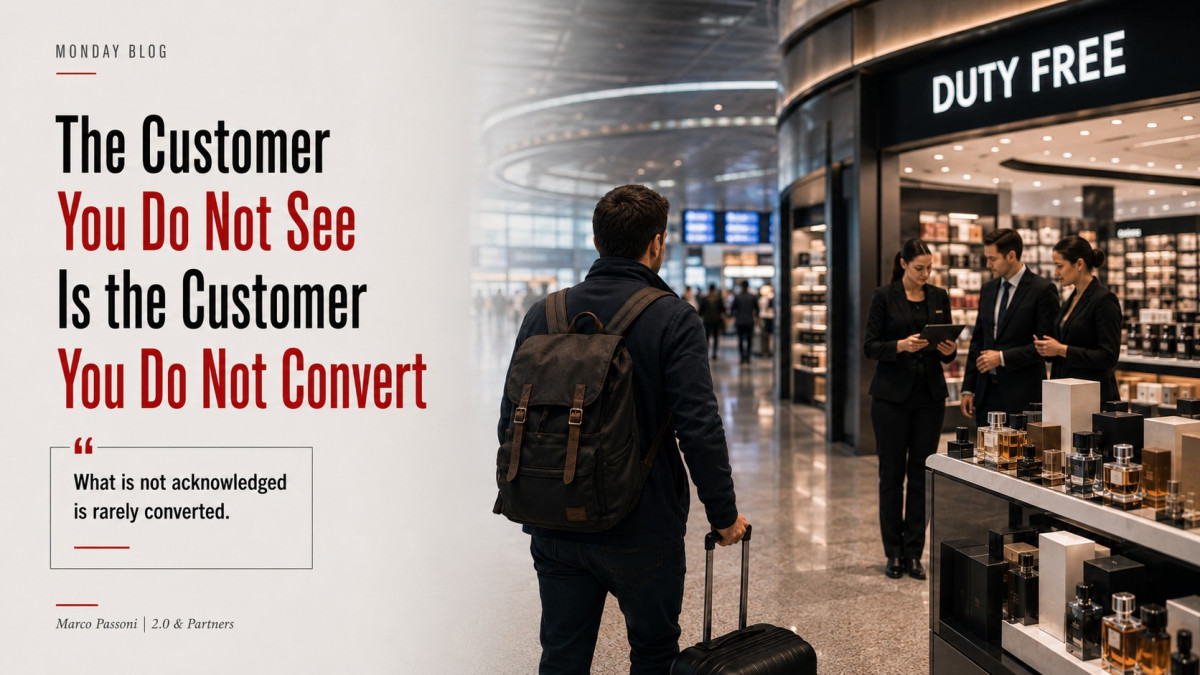
In travel retail, we spend a lot of time discussing passenger flows, spend per passenger, conversion rates, category mix, space productivity, rent levels and commercial terms.
All of this matters.
But sometimes, before getting lost in more sophisticated analysis, we should start from a much simpler question.
What actually happens when a passenger walks into a store?
Not in theory.
Not in the brand manual.
Not in the training deck.
Not in the monthly report.
But in the real world, on the shop floor, during a normal trading day, when the team is under pressure, when the store is busy, when the manager is distracted, when the passenger is unsure, tired, rushed or simply browsing.
Because very often the answer is uncomfortable.
A customer enters the store and nobody really sees him.
Maybe there is a team member at the entrance, but the welcome is mechanical. Maybe there are people on the floor, but they are grouped together. Maybe someone is behind the till, creating an invisible but very real barrier. Maybe the team is focused on tablets, stock movements, internal conversations or simply waiting for the customer to make the first move.
The passenger walks in, looks around, touches a product, moves through the space and leaves.
No eye contact.
No ownership.
No meaningful interaction.
No goodbye.
Then, at the end of the month, we look at the numbers and try to explain why conversion is weak.
We may blame traffic composition. We may blame pricing. We may blame lack of time. We may blame product availability, promotional intensity, nationality mix or the wider macro environment.
And sometimes these explanations are valid.
But not always.
Sometimes the issue is much more basic.
The customer was never properly acknowledged.
The customer you do not see is the customer you do not convert.
This is not a minor detail. In travel retail, the first human signal has a disproportionate impact.
Airports are not relaxed retail environments. Passengers are often distracted, in a hurry, overloaded with information or uncertain about how much time they have before boarding. Many of them do not enter a store with a clear purchase intention. They need a reason to stay. They need permission to browse. They need to feel that the space is open, alive and worth engaging with.
A proper welcome does exactly that.
It is not just politeness. It is the first commercial act.
It tells the passenger that someone has noticed them. It reduces hesitation. It opens the door to interaction. It creates the first bridge between movement and purchase.
But this only works when it is genuine, structured and intentional.
A welcome is not three people saying “hello” at the same time because they suddenly noticed someone entering. It is not a forced smile. It is not a script delivered without context. It is not a box ticking exercise designed to satisfy a training requirement.
It is part of a service flow.
Who welcomes?
Who observes?
Who approaches?
Who takes ownership?
Who hands over?
Who reconnects if the customer disengages?
Who closes the interaction, even when no purchase is made?
These are basic questions, but in many stores they are not clearly answered.
And when they are not answered, the customer journey becomes random.
Some passengers receive too much attention, often in a reactive and intimidating way. Others receive none. Some are approached twice by different people with no coordination. Others pass through the entire store without a single meaningful contact. The team may be physically present, but commercially absent.
This is where leadership on the floor becomes essential.
Not leadership as a job title, but leadership as visible direction. Someone setting the tone. Someone reading the room. Someone ensuring that the team is not just present, but alert. Someone making sure that the customer journey is not left to individual instinct or personal mood.
Because frontline performance does not improve by telling people once what good service should look like.
It improves when behaviours are observed, measured, trained and reinforced.
The team may be physically present, but commercially absent.
This is particularly important in travel retail, where complexity is much higher than in domestic retail. The team deals with different languages, cultures, expectations, time constraints and purchasing motivations, often within the same hour. A customer from Asia, the Middle East, Europe or the US may read the same approach in completely different ways.
Too little attention may be perceived as indifference.
Too much attention may be perceived as pressure.
A scripted welcome may sound artificial.
A passive approach may kill the sale before it starts.
This is why the basics are not basic at all.
They are the foundation of conversion.
And they cannot be managed through assumptions.
A store may look premium and still behave poorly. A team may appear busy and still miss opportunities. A training programme may have been delivered, but the behaviour may not have landed. A mystery visit may produce a score, but the real value is understanding what that score says about the operating reality of the store.
The question is not only whether standards exist.
The question is whether they are lived.
On the floor.
With real passengers.
In real conditions.
Across different stores, teams, terminals, operators and cultures.
That is where travel retail performance is won or lost.
Not only in the lease negotiation.
Not only in the assortment review.
Not only in the marketing campaign.
But in the few seconds between a passenger entering a store and deciding, consciously or unconsciously, whether to stay, engage and eventually buy.
The customer you do not see is the customer you do not convert.
And what is not observed cannot be improved.
Don’t guess it, track it.