
For years, one of the most common conversations in retail has been about the threat of e-commerce.
Travel Retail was no exception. Would passengers browse online instead of shopping at the airport? Would price transparency destroy the duty-free advantage? Would digital commerce eventually make physical airport stores less relevant?
All of those questions remain valid. But I increasingly think they may distract us from a more immediate competitive challenge.
The passenger walking through an airport today is comparing that retail environment not only with what is available on a screen, but with the quality of retail they experience every day in London, Paris, Milan, Shanghai, Seoul, Dubai or New York.
And downtown retail has changed considerably.
The latest Oliver Wyman research on Asia-Pacific Travel Retail provides some useful evidence. Between 2019 and 2025, the sector captured only around 70% of the growth in passenger traffic and overall tourism spending, which the consultancy estimates represents approximately $5 billion in missed revenue opportunity.
Part of that is explained by the changing behaviour of Chinese luxury consumers. The share of Chinese luxury spending taking place overseas has fallen from 55% in 2019 to 25% in 2026. At the same time, domestic retail in China has improved considerably, both online and offline, and more than 75% of Chinese luxury spenders now maintain regular relationships with sales associates in their home market.
That last point matters.
Luxury retail is not simply about access to a product. Increasingly, it is about access to a relationship.
A good sales associate knows the customer, understands previous purchases, alerts them to new products, arranges appointments and can continue the conversation long after they have left the store.
An airport store starts from a very different position. In most cases, it has a few minutes to establish relevance with a customer it may never see again.
Meanwhile, the physical high street is not standing still.
Cushman & Wakefield recorded 96 new luxury store openings across Europe's leading luxury streets in 2025, up 13% on the previous year. More interestingly, 70% of those openings came from 57 brands outside LVMH, Kering and Richemont. The domestic luxury landscape is therefore not only investing in physical retail; it is also becoming broader and more diverse.
JLL describes a similar evolution in prime urban retail. Brands are committing substantial capital to stores that increasingly combine retail with hospitality, food, culture and experience. Louis Vuitton's planned Beverly Hills development, for example, combines a flagship with exhibition space, a café and rooftop restaurant. Armani's Madison Avenue development combines retail, home, restaurant and residential uses.
This is the environment against which airport retail is competing.
Not a static high street populated by conventional shops, but increasingly sophisticated destinations where brands have more space, deeper assortments and significantly more freedom to express themselves.
There is also the question of price.
Duty free historically benefited from a very simple consumer perception: buying at the airport meant buying cheaper.
That assumption is increasingly difficult to sustain.
Oliver Wyman points out that travellers can now compare duty-paid and duty-free prices almost instantly, with AI making that process even easier. At the same time, browsing time in airport stores has been declining as passengers choose lounges, restaurants or their own devices instead.
If the customer no longer automatically assumes the airport is cheaper, and the domestic store offers deeper assortment, stronger service and an existing relationship with the brand, simply reproducing the same brands in a smaller airport environment becomes a difficult proposition.
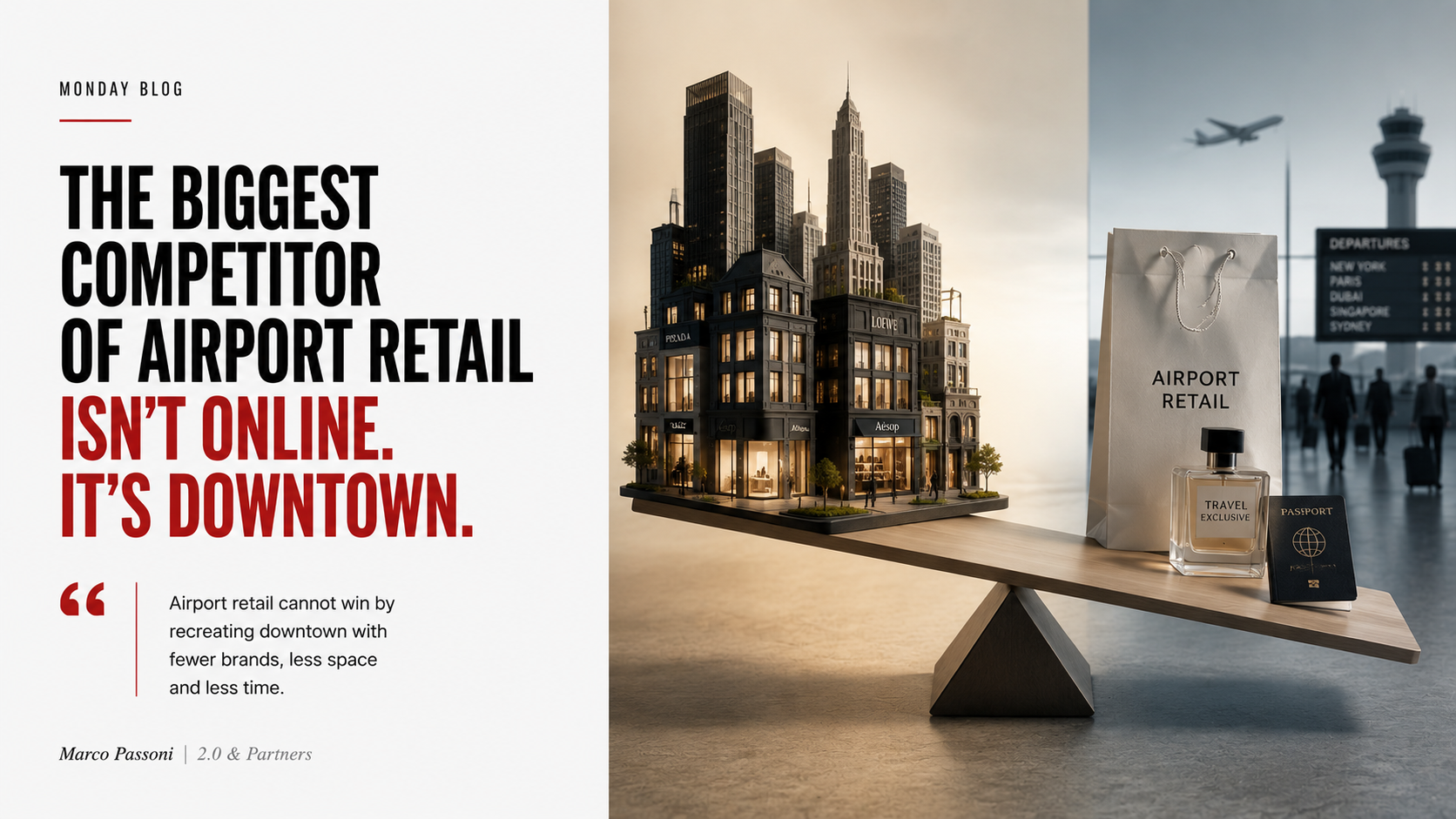
Airport retail cannot win by recreating downtown with fewer brands, less space and less time. It has to give the traveller a reason to shop that downtown cannot.
I think this has important implications for airport commercial planning.
The answer is not necessarily more spectacular stores.
Nor is it simply more technology, more screens or more experiential installations.
It starts with understanding what is genuinely different about the travel moment.
The airport has advantages that downtown does not.
It concentrates an enormous number of international customers in one location. It creates natural gifting occasions. It puts customers in a different mindset, often with time available and an upcoming destination or return home influencing what they buy. It can offer products, editions, services and combinations that are genuinely specific to travel.
It also has convenience.
That may sound less glamorous than experience, but convenience remains an extremely powerful retail proposition when it is properly executed.
A traveller who discovers something relevant, can buy it quickly, carry it easily and perhaps access an offer unavailable at home has a genuine reason to shop.
The problem is when airport retail relies on location alone.
Passenger traffic creates opportunity, but it does not create demand.
The fact that millions of affluent customers are physically required to walk past a store is an extraordinary commercial advantage. But it can also create complacency if we assume that visibility will compensate for a proposition that would struggle to compete elsewhere.
That becomes particularly relevant when thinking about the airport brand mix.
Domestic luxury retail is bringing new names into prime locations. Cushman & Wakefield's data shows that expansion is far from being confined to the traditional global groups. Yet airport luxury environments often remain concentrated around a narrower and more established universe of brands.
There are understandable reasons for that. Airports require proven productivity, operators need commercial certainty and brands need sufficient scale to justify the complexity of the channel.
But there is still a risk.
If the customer discovers the brands that excite them downtown while the airport continues to offer primarily the brands they already know, the role of Travel Retail gradually shifts from discovery to repetition.
And repetition is not necessarily a strong reason to stop.
The airport brand mix should not be defined by what the premium traveller used to value; it should keep pace with what that traveller is actually buying, discovering and experiencing elsewhere.
None of this suggests that airport retail should imitate the high street more aggressively.
I would argue exactly the opposite.
The more sophisticated downtown retail becomes, the less sense there is in trying to reproduce it.
Airport retail needs to become clearer about its own reason for existing.
That may mean stronger travel exclusives rather than superficial exclusivity. More relevant brand rotation. Better use of passenger data. Faster introduction of emerging categories. Assortments genuinely adapted to nationality and destination. Service designed around limited time. And locations planned around how passengers actually move, rather than simply where commercial space happens to exist.
Online retail will continue to influence how passengers shop.
But perhaps the more uncomfortable competitive benchmark is the physical store the passenger visited before arriving at the airport.
Because that store may already know their name, understand their preferences, carry a wider assortment and give them a better reason to buy.
The airport cannot compete with all of that on the same terms.
It should not try.
It needs to offer something different, and make that difference valuable enough to convert traffic into customers.
Marco Passoni has spent more than three decades in the travel retail industry, holding senior leadership roles across distribution, retail and business development. His career included 12 years as CEO of a leading international Duty Free distribution company and a further eight years managing a retail business operating fashion mono brand stores across several international airports.
Today, as Senior Executive Vice President and founding partner of 2.0 & Partners, he leads the development of innovative services and new business opportunities for brands, operators and airports across the global travel retail market. A former elite sailor and World Champion, Marco continues to spend much of his time airside, observing the industry first hand and helping partners and clients navigate the distinctive challenges and opportunities of this constantly evolving market.