
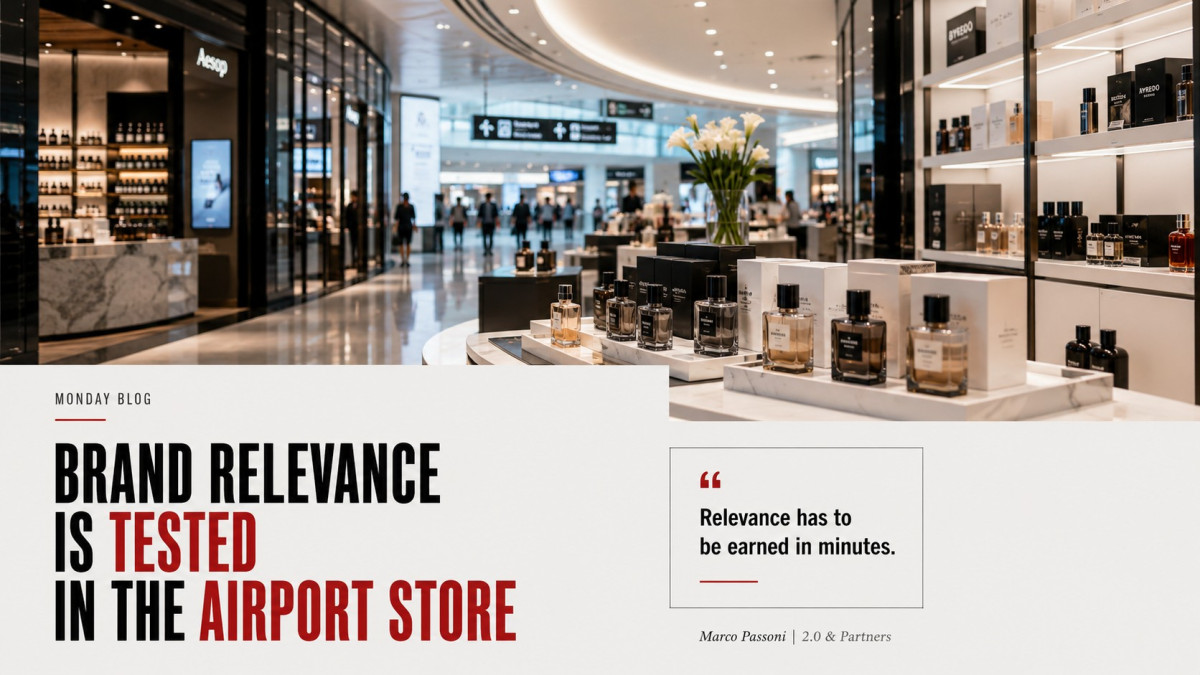
For many years, travel retail has been protected by a comforting assumption. If the passenger was there, the opportunity was there. If the location was strong, the store would perform. If the brand had visibility, sales would follow.
That logic was never entirely wrong. Airport retail has always been a powerful channel because it concentrates international consumers, premium brands, impulse behaviour and moments of personal reward in one highly commercial environment.
But it is becoming increasingly dangerous to confuse presence with relevance.
The airport store is no longer just a point of sale. It is becoming a test of brand relevance. And it is one of the toughest tests a brand can face.
In a domestic flagship store, the customer may have chosen to visit the brand. In an airport, the brand is often interrupting a journey. The customer may be tired, distracted, rushed, price aware, travelling with family, managing boarding time, or simply not in the mood to be approached. The store may be beautifully designed, but the window of attention is narrow. Recognition is not the same as engagement.
In airport retail, relevance has to be earned in minutes.
This is where the channel becomes interesting, but also unforgiving. A passenger does not necessarily enter because the brand is famous. A passenger does not necessarily engage because the store is visible. A passenger does not necessarily buy because the environment is premium. Each step must be won.
The first test is whether the brand is able to stop the passenger mentally. In a terminal full of movement, screens, queues, announcements and competing retail propositions, attention is fragmented before the customer reaches the storefront. The store has only a few seconds to communicate why it deserves a pause.
The second test is whether the brand can make entry feel worthwhile. Many airport stores still behave as if passing traffic will naturally convert into store traffic. But traffic in the corridor and traffic inside the store are two very different things. The real commercial question is not how many passengers pass the unit. It is how many feel there is a reason to step inside.
That reason may come from assortment, category clarity, destination relevance, visual presentation, perceived value, exclusivity, convenience or service. Often, it is a combination of these elements. But when they are weak, unclear or generic, the store becomes part of the background. It may be present, but it is not really competing.
This distinction matters because airport retail has changed. The passenger is not simply a captured consumer. The passenger is better informed, more selective and more able to compare prices before, during and after the journey. The old duty free reflex is weaker. The idea that a purchase is automatically justified because it happens at the airport is less convincing than it used to be.
This does not mean the opportunity has disappeared. It means the opportunity has become more conditional.
A beautiful store may attract attention. A relevant experience converts it.
Relevance in this environment is not abstract. It is practical. It is the ability to make a passenger understand the offer quickly. It is the ability to connect a product to a travel moment. It is the ability to recognise whether a customer wants speed, reassurance, discovery, advice or simply to be left alone.
This is especially important for luxury and premium brands. In a city store, a brand can often rely on time, ritual and depth. In the airport, the same brand must condense its world into a much shorter interaction. The space is smaller. The rhythm is faster. The sales associate has less time to build the story and less margin for a poor first approach.
That is why the airport store has become such a demanding environment for frontline teams. They are not simply there to process transactions. They are asked to translate brand value under pressure. They must understand who is in front of them, adapt the interaction, protect the premium perception, manage practical constraints and still create enough confidence for the customer to buy.
When this works, the airport can be extraordinary. It can introduce the brand to new customers. It can reinforce loyalty with existing ones. It can create a profitable transaction in a moment of travel related emotion. It can turn a few minutes of dwell time into a meaningful brand encounter.
When it does not work, the weakness becomes visible very quickly.
A store can look good and still feel irrelevant. A brand can have the right location and still fail to convert. A team can be polite and still miss the commercial opportunity. A product can be desirable and still remain unsold because nobody made it easy, clear or compelling enough for the passenger to act.
This is where travel retail should become more honest with itself. Too often, performance is explained through external variables alone: traffic, spend per passenger, nationality mix, flight schedule, terminal constraints, space allocation, promotional pressure. All these elements matter. Some are outside the control of the brand. But they do not explain everything.
There is also the question of execution. How clearly is the offer presented? How well is the passenger engaged? How consistently are service standards delivered? How effectively does the team move from greeting to discovery, from discovery to recommendation, from recommendation to conversion? How many opportunities are lost not because the passenger had no potential, but because the store failed to create enough reason to buy?
These are not secondary questions. They are now central questions.
The future of airport retail will not be defined only by who secures the best locations. It will also be defined by who understands what those locations actually demand. Visibility is valuable, but visibility without relevance is expensive decoration. Traffic is valuable, but traffic without capture is unrealised potential. Brand awareness is valuable, but awareness without engagement does not pay the rent.
That is why the role of the airport store needs to be reconsidered. It is not merely a distribution point, a showcase or an additional sales channel. It is a live environment where the strength of a brand proposition is tested by real customers, in real time, under real constraints.
For airport landlords and operators, this has implications. The question is not only which brands occupy the space, but whether those brands can activate the space properly. A strong name on the fascia is not enough if the store does not generate energy, conversion and customer satisfaction.
For brands, the implication is even clearer. Airport retail cannot be treated as a simplified version of domestic retail. It is not a smaller store with higher traffic. It is a different environment, with different behavioural rules and different pressure points. The passenger is not necessarily looking for the brand. The brand must make itself relevant within the journey.
This requires more than investment in fit out. It requires sharper understanding of customer profiles, better preparation of frontline teams, more disciplined reading of store performance and a willingness to look beyond top line sales. Sales matter, of course. But sales are the result. The real diagnosis sits in what happens before the sale: who passes, who enters, who engages, who hesitates, who leaves and why.
The most important question for a brand in airport retail may no longer be: are we present in the right airports?
It may be: once we are there, are we relevant enough to matter?
That is a harder question. But it is also the question that will separate passive presence from real performance.
The next phase of travel retail will not be won by brands that simply occupy airport space. It will be won by brands that understand the pressure of the airport environment, respect the complexity of the passenger, and know how to turn a brief encounter into a credible reason to engage.
Because in airport retail, the store is no longer just where the transaction happens.
It is where the brand proves whether it still means something.