
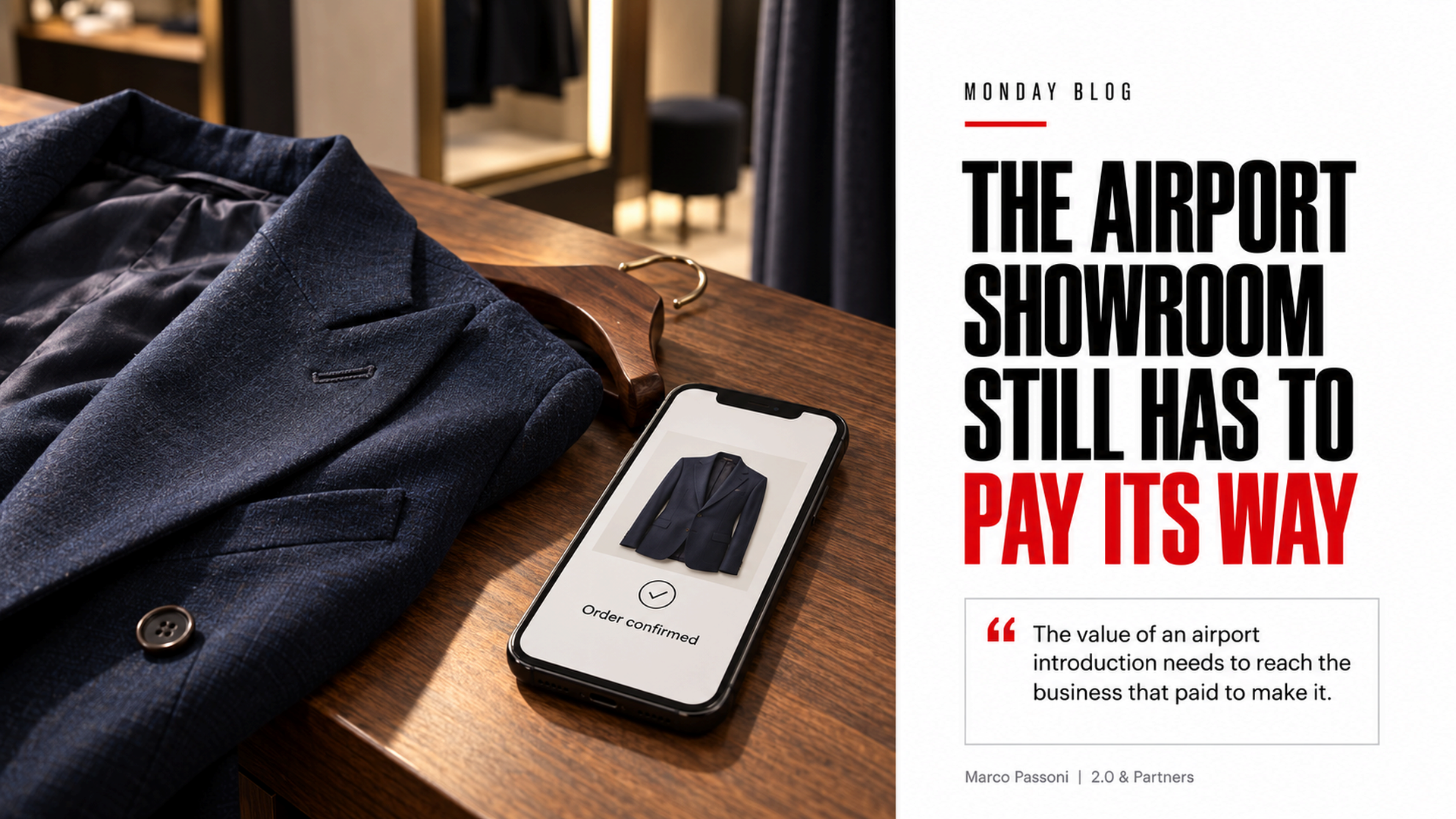
Consider a passenger who tries on a jacket before a flight. The sales assistant explains the fit and helps the customer choose the right size. The customer likes it, but decides to think about it. A few days later, the passenger buys it from the brand’s website. The airport store may have made an important contribution to that decision. Its sales report will show no transaction.
In the recent Global Travel Retail Pulse from Oliver Wyman and TFWA, 27% of respondents reported buying at a later stage following an airport discovery. These are survey responses, rather than tracked transactions. The chart does not identify where those later purchases took place. We cannot treat the figure as a measure of sales lost to another channel, but it gives us a reason to examine what happens after a passenger leaves the store.
I can see why brands value that opportunity. An airport can introduce a product to someone who might never have entered the same brand’s boutique at home. A good conversation with a knowledgeable member of staff can make a purchase feel more credible. Some decisions need time, particularly when the amount involved is substantial. The boarding deadline will not always be the right deadline for the customer.
The difficulty comes when we move from recognising that contribution to paying for it. Airport retail requires investment before it opens and carries substantial costs while it trades. Those costs remain due whether the passenger buys immediately, buys elsewhere or never buys at all. Describing the store as a place of discovery does very little for the business unless that role produces a return it can recognise.
The operating model makes a difference. A brand running its own airport boutique may be able to assess its contribution across the wider business. A subsequent purchase from its website could still be a worthwhile outcome, provided there is evidence of the store’s contribution. Even then, the local team can find itself judged on a store result that gives it little credit for work completed elsewhere in the organisation.
When a separate retailer runs the store, the commercial consequences can be much sharper. Its team has provided the service and its business has funded the operation. A later purchase directly from the brand may produce no income for that retailer.
The value of an airport introduction needs to reach the business that paid to make it.
A general assurance about brand building is unlikely to be enough over several years of trading.
I would be careful, however, about using the showroom argument to explain away disappointing sales. A passenger who leaves because the price is uncompetitive, the right size is missing or the service is poor has encountered a weakness in the offer. A possible purchase somewhere else should not allow us to stop examining why we failed to complete it. A credible price advantage remains part of the reason to buy at the airport.
Equally, pressuring every interested visitor to purchase before boarding would be a poor response. A passenger may need to consult someone at home or have no desire to carry another item through a long journey. There is a commercial opportunity in making that purchase easier to complete. I would start with the practical obstacles the store can remove, while accepting that some customers will decide against buying.
An order placed with the airport team for delivery to the customer’s home is one possibility. It allows the purchase to proceed without making the passenger carry the product. The service has to be properly arranged, including an accurate final price and clear responsibility for delivery and returns. The staff also need to know that helping complete this kind of order counts towards their results. Otherwise, we are asking them to support a service their own targets discourage.
A later purchase is harder to connect. With the customer’s agreement, the assistant could send the product details and a way to complete the order through that store. Where the brand and retailer are separate businesses, they would need to agree how a qualifying purchase is identified and what payment follows. I would want those arrangements settled before asking a team to spend time developing the service.
There are limits to what such evidence can prove. An order linked to an airport visit tells us there was a connection. It does not establish that the customer would never have bought without it. The contribution also runs both ways. A passenger may arrive ready to buy because of work done by a domestic boutique, then complete the purchase at the airport. Any arrangement needs to allow for that wider relationship.
We should also keep the economics honest. The reporting needs to distinguish a sale completed through the airport store from a fee earned on somebody else’s transaction. A marketing contribution needs to be identified for what it is. I would then look at what the store actually retains after the cost of providing the service. Recording more customer contacts will tell us little about whether the operation has become more sustainable.
A brand may decide that access to those customers justifies dedicated marketing expenditure. That can be a reasonable decision. It should have a budget and a defined purpose, so that everyone understands how the location is being supported and for how long. Treating a store as a strategic investment requires the same seriousness as expecting it to make a trading profit. An unmeasured promise of future benefit is a weak basis for either decision.
Airports have a part in this discussion too. Their commercial expectations need to reflect the activity they are asking a location to deliver. If part of the space is intended to recruit customers whose purchases may happen later, the agreement needs to address how that activity supports the income expected from it.
If we want airport stores to support sales beyond the terminal, the commercial model has to support the stores.
I would begin with a limited arrangement where the parties can see completed orders and the income each receives. The review should include the work required from the team and the costs that follow the sale. That would give the brand and its airport partners something concrete to discuss before making larger commitments.
Airport retail can deserve credit for a customer relationship that continues after departure. I would welcome better evidence of that contribution and workable ways to earn from it. Before committing to a store on that basis, though, I would want to understand the return available to the business paying for the introduction and how it would receive that income.
Marco Passoni has spent more than three decades in the travel retail industry, holding senior leadership roles across distribution, retail and business development. His career included 12 years as CEO of a leading international Duty Free distribution company and a further eight years managing a retail business operating mono-brand fashion boutiques across several international airports.
Today, as Senior Executive Vice President and founding partner of 2.0 & Partners, he develops new business opportunities and services for brands, operators and airports across the global travel retail market. Through 2.0 & Partners, he works with some of the world’s most recognised luxury and premium brands, as well as leading international airports, helping them assess opportunities, strengthen their travel retail presence and navigate the distinctive commercial dynamics of the airport environment. A former elite sailor and World Champion, Marco continues to spend much of his time airside, observing the industry first hand and helping partners and clients respond to the challenges and opportunities of an evolving market.