
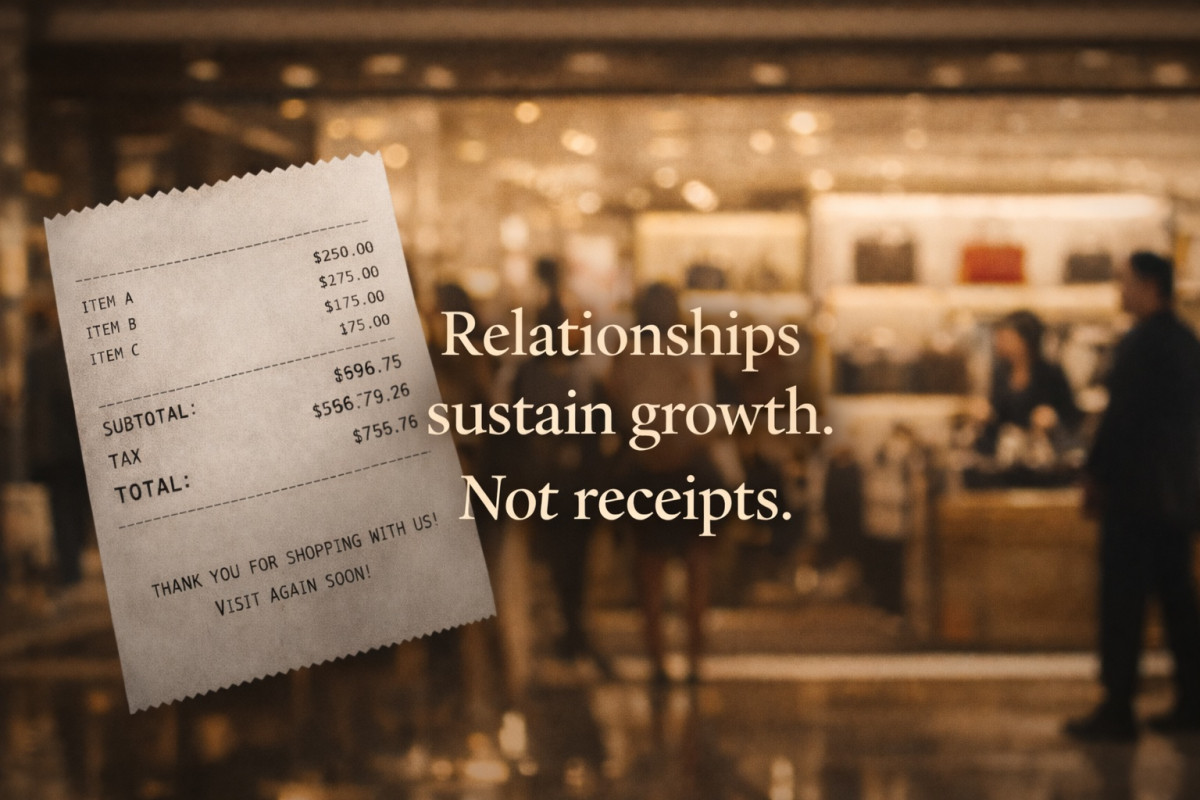
Retail still measures success in transactions. Consumers do not.
Too many brands continue to treat conversion as the ultimate indicator of performance. Footfall. Basket size. Uplift. These metrics matter. But when they become the objective rather than the outcome, strategy narrows.
A sale is not evidence of brand strength. It is evidence of a moment. The more important question is what that moment represents.
Too many brands continue to treat conversion as the ultimate indicator of performance.
Today’s shopper does not simply buy product. They engage with and reward brands who offer more than just items.
The brands they choose become part of their own narrative. Their social presence. Their values. Engagement is no longer limited to the act of purchase; it extends into a longer-term association which, done right, can be an investment in the brand’s future. Community, in practical terms, means repeat behaviour, cross touchpoint engagement and advocacy. These are measurable drivers of long term performance..
Brands that perform consistently understand this distinction. They do not view the relationship as something that culminates at the till. They treat the store as a stage; it is a place where the brand’s universe becomes tangible.
The transaction may happen there. But it is not the point; it is the receipt of participation.
When retail is engineered purely for conversion, the experience collapses into pressure. But when retail is engineered for immersion, sales follow as a consequence.
Recent campaigns from Moncler and Ralph Lauren, which I mentioned in last week’s blog, demonstrate this clearly. These campaigns built on the brand story, offering a new touchpoint for consumers, who could become part of the brand without making a purchase. They amplified a coherent brand narrative and extended it into retail space. The objective was not sentiment, but strategic consistency. That is what builds durable brand equity.
When retail is engineered purely for conversion, the experience collapses into pressure.
Look at Lululemon in China. Stores function as community spaces; hosting events, classes, and gatherings. The emphasis is not on immediate conversion. It is on integrating the brand into existing consumer behaviour patterns, rather than forcing conversion within store walls. Similarly, Miu Miu and Chanel extend their presence into art and cultural spaces. They create touchpoints that reinforce identity beyond retail walls. The store becomes one node within a larger ecosystem.
When the brand story is coherent, the store becomes an extension of it. But the store must remain a part of a journey. When the story stops at the door and the focus shifts abruptly to selling, brand coherence breaks. Everything that preceded the visit becomes transactional.
And transactional brands are easily replaced.
In travel retail, this distinction becomes even sharper. Airports compress time and attention, and with the high cost of each location, every square metre must justify its placement. No one can afford to be wasting their space. If a brand arrives in the airport with a purely sales-driven mindset, it blends into the noise – and that can be fatal.
The most effective airport stores offer a fresh touchpoint with the brand. They create a pause within the journey. A recognisable world in a transient environment. The product becomes a memento of that encounter; a physical marker of participation.
The most effective airport stores offer a fresh touchpoint with the brand. They create a pause within the journey.
If the space fails to deliver on the story, there is no second chance. The traveller moves on. Quite literally. In a terminal, the store is not the destination, it is the proof of the brand’s coherence.
A single transaction is not loyalty; nor is it community or long-term equity. The brands building durable performance today understand that retail is one chapter in a broader narrative. The store is a touchpoint. It is a convergence of story, space and consumer identity.
When that convergence is designed with discipline, sales follow.
When it is not, the transaction may still happen. But the relationship will not. And in a market saturated with choice, it is the relationship, not the receipt, that sustains growth.