
For years, travel retail convinced itself that growth was mainly a matter of passenger volume. More traffic meant more opportunity. More opportunity meant more sales. It was a reassuring equation, simple enough to repeat and comfortable enough not to question too much.
That equation no longer holds.
Recent research from ACI Asia Pacific & Middle East, developed with Arun and Steer, confirms that commercial revenues across many airports have already moved beyond 2019 levels, with sentiment on future performance remaining positive. On paper, that sounds like a healthy industry. In reality, the story underneath is more demanding.
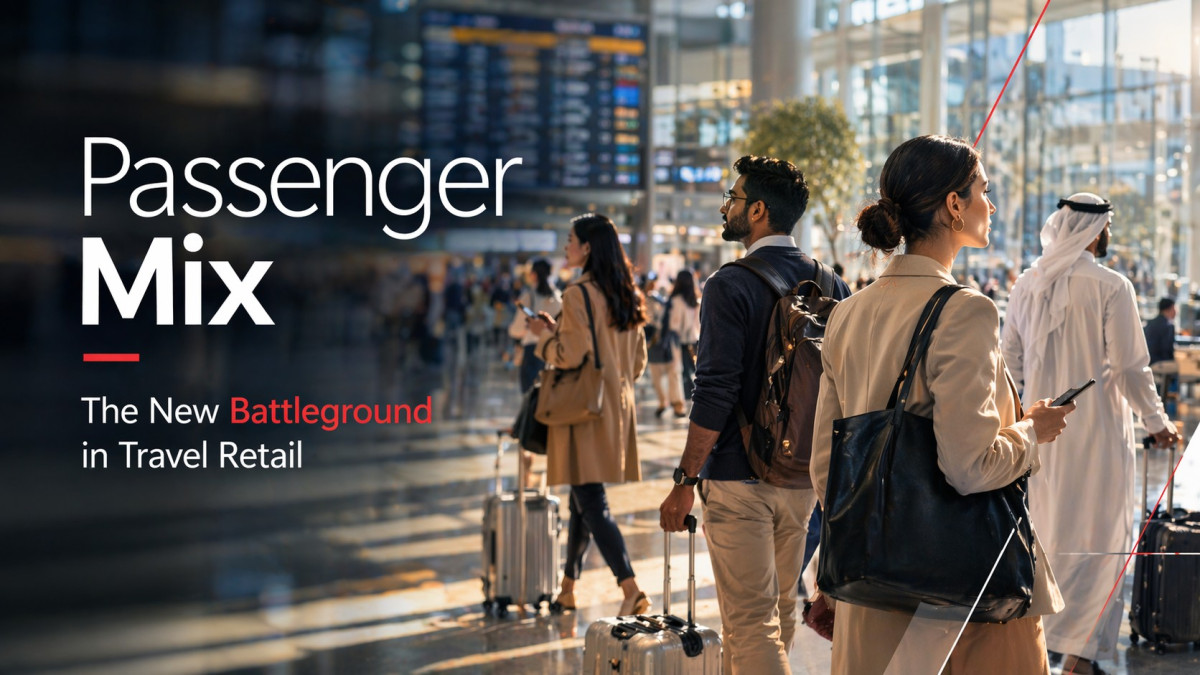
What matters today is not just how many passengers pass through an airport, but who they are, what they expect, how they shop, and how well the airport, operator and brand are equipped to respond. This is no longer a volume game. It is a passenger mix game.
What matters today is not just how many passengers pass through an airport, but who they are, and how well the airport, operator and brand are equipped to respond
That may sound obvious. In practice, the sector still behaves as if broad averages are enough. It still talks too often in general categories. It still assumes that a successful formula can simply be rolled out from one location to another with only minimal adjustment. It still mistakes familiarity for understanding.
That is where the problem starts.
The modern traveller is not one traveller. Passenger flows are more fragmented, more culturally diverse and more behaviourally complex than the industry often admits. Different nationalities, different service expectations, different spending triggers and different decision making patterns are now moving through the same terminal, often at the same time. Treating them as one audience is not just simplistic. It is commercially weak.
This becomes even clearer when looking at two of the most important growth segments today: Middle Eastern and Indian travellers.
Middle Eastern shoppers often expect a service environment that feels attentive, elevated and culturally aware. They do not simply buy products. They read the quality of the interaction around the product. Discretion, personal recognition and the right service tone are not details. They are part of the value equation.
Indian travellers are equally important, but for different reasons. They are increasingly confident, globally exposed and digitally fluent, especially in younger age groups. They are highly open to international brands and experiences, but they expect those experiences to feel current, connected and credible. Their reference points do not come only from the airport. They come from a wider world of digital content, entertainment, aspiration and social influence.
These are not nuances. They are material differences. And yet much of the sector still responds with broad assumptions, generic service models and retail environments that look international but do not always feel truly relevant to the people walking through them.
This is why passenger mix has become the real battleground.
Much of the sector still responds with broad assumptions, generic service models and retail environments that look international but do not always feel truly relevant to the people walking through them
Not because the industry suddenly discovered segmentation. It has talked about segmentation for years. The issue is that too often it has stopped at the language of segmentation without building the operational capability to act on it. Knowing that your passenger base is changing is one thing. Translating that into better assortment choices, stronger service rituals, more relevant communication and better trained frontline teams is something else entirely.
That is where many airports, operators and brands are still weaker than they should be.
The sector likes to talk about innovation, digitalisation and experience. Fine. But none of that means much if the reality on the shop floor remains generic. A digital touchpoint does not solve a poor interaction. A nice concept does not compensate for a service style that misses the customer in front of it. A broad luxury offer does not automatically become relevant just because the brands are strong.
Execution still decides everything.
If the passenger mix is changing, then the offer must change with it. The service approach must change with it. The training must change with it. Above all, the level of insight must improve. Not broad commentary. Not comfortable assumptions. Real understanding of who is travelling, what they expect and what actually happens when they engage with the retail environment.
That is the point many in travel retail still resist, because it is easier to discuss traffic than to confront execution.
Volume remains important, of course. But volume on its own is no longer enough to explain performance, and certainly not enough to secure future growth. The real commercial advantage now lies in understanding the passengers already in front of you better than your competitors do, and in translating that understanding into something concrete.
Volume on its own is no longer enough to explain performance, and certainly not enough to secure future growth
That is why passenger mix is no longer a background metric for commercial teams to mention in presentations. It is becoming one of the clearest indicators of whether a travel retail strategy is grounded in reality or still relying on old habits.
The question is no longer how many people walk through your doors.
It is whether your offer, your service and your execution are genuinely designed for the people who do.