
I recently came across a post on airport concession agreements that argued, in very direct terms, that the traditional model has quietly failed. The focus was on minimum guarantees, retail productivity and the fact that many contracts still seem to be renewed as if the market had not changed.
It was an interesting point of view. Also, in my opinion, too extreme.
Working every day with airports, operators and brands across different regions, I see a more complex reality. There are still airports that approach commercial negotiations with a very rigid financial mindset, focused mainly on guaranteed income, rental uplift and shareholder expectations. But there are also many others that, especially after Covid, have understood that the old relationship between MAG, royalties, traffic and retail productivity cannot be applied everywhere in the same mechanical way.
Still, the topic is worth discussing. Not because the minimum guarantee is dead, but because it needs to be treated with much more realism.
The traditional airport concession model was built around a principle that, in theory, remains valid. The airport makes valuable commercial space available and gives access to passenger flows. The operator or brand invests, operates and takes commercial risk. The minimum guarantee gives the airport a degree of income visibility, while the royalty allows it to benefit when the business performs above expectations.
The problem begins when the guarantee is no longer anchored to the real capacity of the location to generate sustainable sales. At that point, the MAG stops being a disciplined commercial commitment and starts becoming a financial fiction.
This distinction matters because the market has changed. Passenger numbers may recover, while spend per passenger remains under pressure. A terminal can be full and still produce weaker commercial productivity than expected. A location may look strong in terms of traffic, but less attractive once passenger mix, dwell time, purchasing behaviour, price perception and category relevance are properly considered.
According to ACI World, non aeronautical revenue per passenger reached US$7.57 in 2024, still below the US$8.61 recorded in 2019. The message is not that airport commercial revenues have collapsed. The message is that traffic recovery does not automatically restore the same level of revenue per traveller.
For concession agreements, this is the crucial point. If traffic and commercial productivity no longer move with the same consistency, then minimum guarantees cannot continue to be built as if they did.
A busy airport is not necessarily a more profitable retail environment. A traffic forecast is not the same as a sustainable commercial forecast.
This does not mean that airports should abandon minimum guarantees. Airports need predictability. They have their own investment obligations, financial constraints and long term development plans. It is unrealistic to expect them to carry all the downside risk of a commercial relationship.
But a minimum guarantee should protect the airport from unreasonable downside risk. It should not protect the contract from reality.
When the floor is set too high, the problem does not remain confined to the operator’s P&L. It eventually affects the entire commercial ecosystem. It can reduce investment capacity, create margin pressure, distort pricing decisions, weaken assortment choices and discourage the level of service and experience that passengers should receive. A concession can look attractive when signed and become unhealthy once operated.
This is where some airports still make a serious mistake.
They evaluate bids mainly through the guaranteed number. They compare the new proposal with the previous contract. They look for the strongest uplift. They reward the most aggressive financial offer, sometimes without challenging enough whether the underlying assumptions are commercially realistic.
This may satisfy the spreadsheet. It does not necessarily create long term value.
There is another distortion, and in some cases it is even more damaging. Some airports, consciously or not, allow themselves to be influenced by proposals from operators or brands that are clearly too aggressive. These proposals are often designed to win the location, not necessarily to operate it sustainably.
They may include high guarantees, optimistic sales projections, ambitious investment commitments and assumptions that look impressive during a tender process. But if the economics are unrealistic from the beginning, the outcome is usually predictable. The business struggles, investment is reduced, service suffers, renegotiation becomes inevitable, or the operator loses money for the duration of the contract.
When this happens, the problem is not only the bidder’s responsibility. The airport also has responsibility.
If an airport uses an unsustainable bid as the benchmark for the market, it distorts the whole value chain. It penalises more realistic players. It pushes future expectations away from commercial reality. It rewards short term aggressiveness over long term competence. And it creates a reference point that damages future negotiations, because the market is then measured against a number that should never have been accepted as realistic.
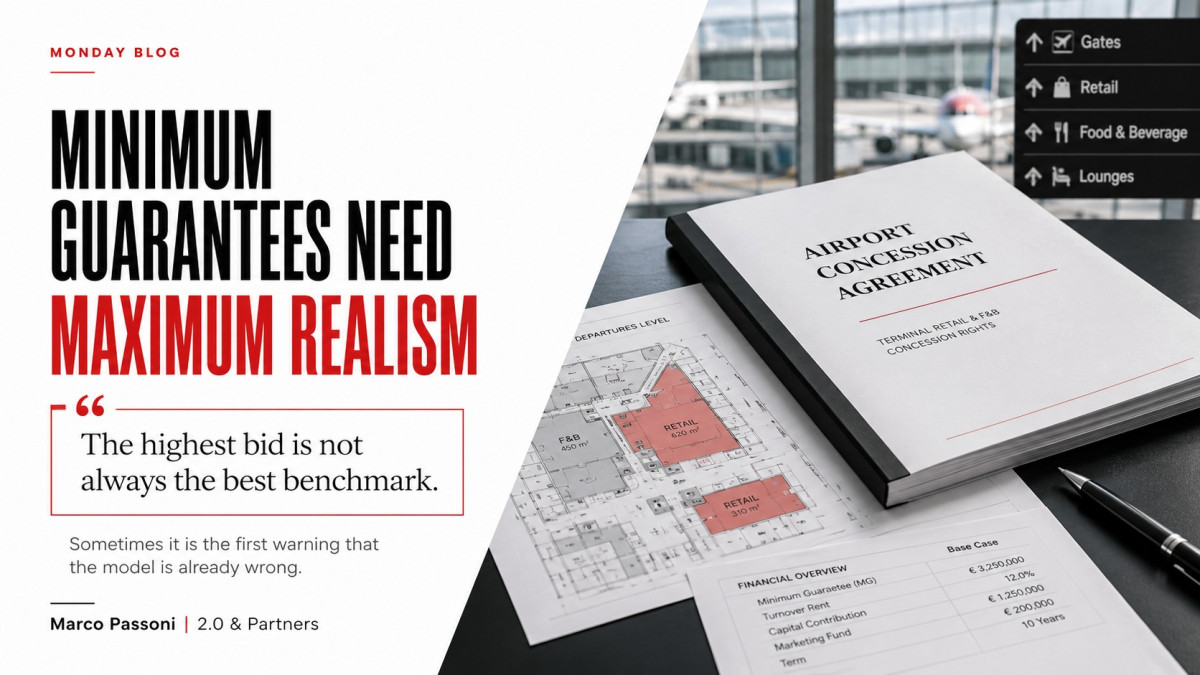
The highest bid is not always the best benchmark. Sometimes it is the first warning that the model is already wrong.
This is particularly relevant in today’s travel retail environment, where performance depends on far more than passenger volume. Nationality mix, route structure, destination profile, dwell time, purchasing power, competitive pricing, digital comparison, category relevance and geopolitical volatility all shape the real commercial opportunity.
A concession agreement that ignores these variables is not ambitious. It is incomplete.
After Covid, the industry did learn part of this lesson. Some airports introduced more flexible structures, temporary relief mechanisms, turnover based elements, revised MAG calculations or more pragmatic risk sharing solutions. This should be acknowledged. The industry is not uniformly blind. Many airport commercial teams have become more sophisticated and more aware that a model built for a different market cannot simply be copied into every new tender.
But progress is uneven.
Some airports have become more realistic. Others still treat concessions almost as financial auctions. Some operators have become more disciplined. Others still bid too aggressively to secure strategic space and then spend years trying to repair the economics. Some brands understand that unsustainable distribution damages positioning and profitability. Others still accept terms that may look good from a presence perspective but create long term commercial pressure.
This is why the debate should not become a simplistic airport versus operator argument.
The real question is whether the contract reflects the business reality of the location.
A sustainable concession agreement should start from a more honest reading of the opportunity. What is the real addressable traffic? How productive is the category in that terminal? What is the passenger mix? How volatile are the routes? What level of capex is required? What contract duration is needed to amortise the investment? What sales assumptions are realistic? What happens if traffic grows but spend per passenger does not?
These are not defensive questions. They are commercial questions.
A good concession agreement should allow the airport to earn properly, the operator to invest properly, the brand to perform properly and the passenger to receive a better offer. If one part of the chain is forced into an unsustainable position, the weakness eventually appears somewhere else.
Sometimes it appears through renegotiation. Sometimes through underinvestment. Sometimes through weaker service. Sometimes through reduced assortment relevance. Sometimes through pressure on pricing. Sometimes through a store that remains open, but no longer has the economic conditions to perform as it should.
This is why minimum guarantees need maximum realism.
Not because ambition should disappear from airport retail. Not because airports should accept weak offers. Not because operators and brands should be protected from risk. Risk is part of the business. But risk and fiction are not the same thing.
The next generation of concession agreements should not necessarily remove the MAG. It should make it more intelligent.
That may mean floors linked more closely to actual performance. It may mean stronger turnover based components. It may mean mechanisms that respond to material changes in passenger mix. It may mean clearer treatment of extraordinary disruptions. It may mean a more realistic relationship between capex, duration and expected productivity. It may also mean accepting that the best commercial structure is not always the one that produces the highest guaranteed income on day one.
The objective should not be to lower ambition.
The objective should be to separate ambition from illusion.
Travel retail needs strong airports, capable operators, relevant brands, confident investment and high quality concepts. But none of this can be built on numbers that everyone knows are unrealistic from the start.
A minimum guarantee should be a serious commercial commitment.
It should not be a denial of the conditions in which the business actually has to perform.
Source for ACI data: ACI World, 2024 non aeronautical revenue per passenger compared with 2019.