
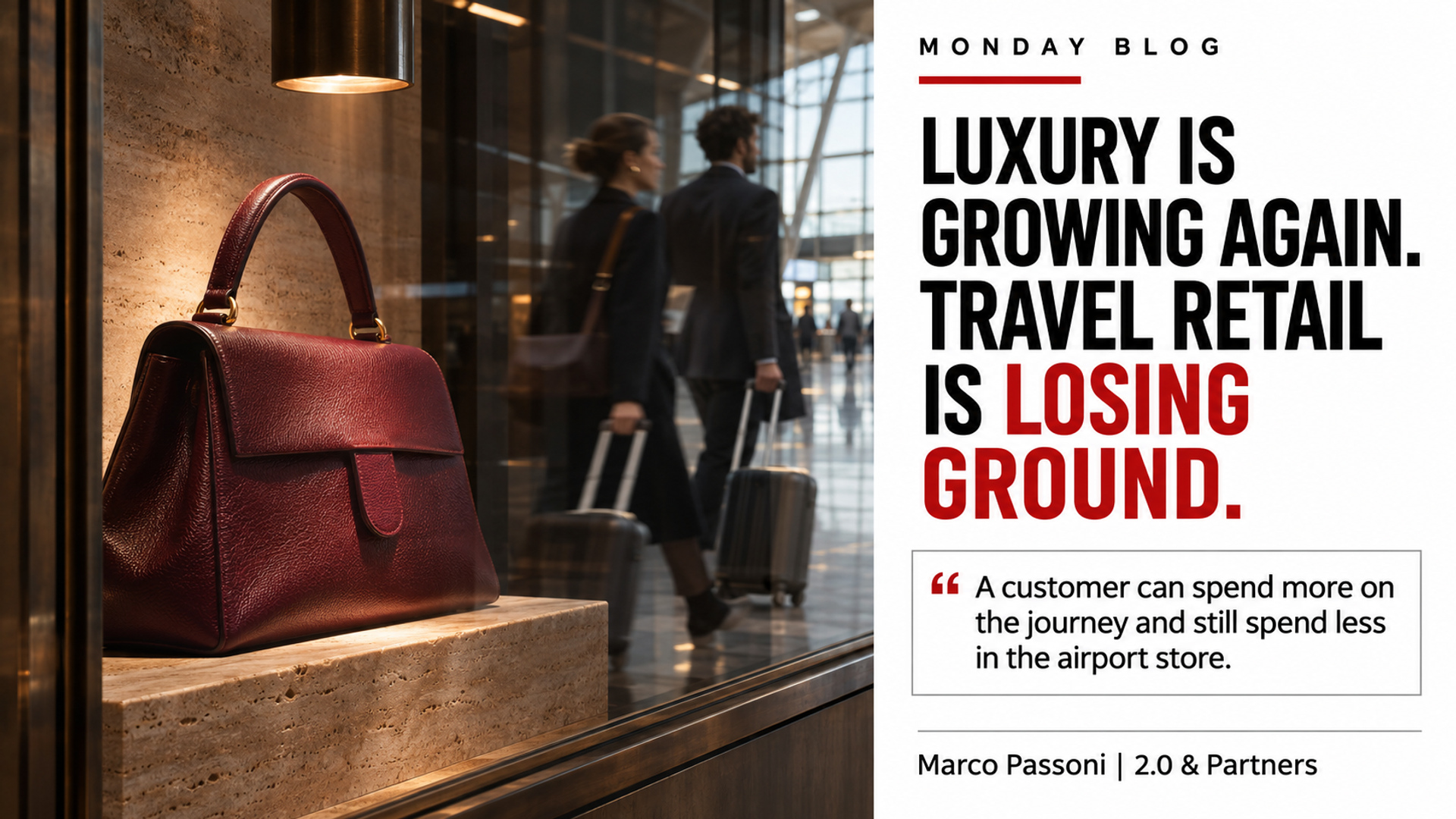
The latest Bain Luxury Worldwide Market Study, presented by Claudia D’Arpizio and Federica Levato, gives the industry some grounds for encouragement. Personal luxury goods are expected to return to growth in 2026, reaching approximately €367 billion. After two difficult years, that is welcome news. For anyone making decisions about airport retail, however, the channel figures deserve closer attention. Bain estimates a decline of between 4% and 6% for travel retail within that market.
Those figures concern personal luxury goods under Bain’s channel definitions. They do not describe every airport business, and individual locations will perform differently. They nevertheless expose a problem with treating a recovery in luxury spending as reassurance for airport stores. Growth elsewhere in the market can pass us by. A brand may recover through its domestic boutiques or online business while continuing to question the productivity of its airport network.
The study cannot tell us why a particular airport store is underperforming. Its figures reflect different markets, categories and operating conditions. It would be convenient to read them as confirmation of whichever industry problem we already consider most important. I would use them to challenge the assumptions behind our plans, starting with the idea that a recovering luxury customer will eventually resume buying from us in the same way.
Bain estimates that the number of personal luxury goods consumers has fallen from around 330 million in 2025 to 315 million in 2026. Revenue growth is therefore taking place alongside a smaller buying population. For travel retail, that matters. A stronger headline market does not necessarily mean a broader pool of passengers willing to buy luxury products. Nor can an increase in average transaction value tell us, on its own, whether we are attracting customers or relying more heavily on fewer purchases.
A customer can spend more on the journey and still spend less in the airport store.
Someone booking a better hotel or extending a holiday may have considerable spending power and very little intention of buying another bag. That passenger is commercially attractive, but the reasons for spending have changed. Treating the person as an underperforming luxury shopper misses the possibility that the trip is already delivering exactly what they wanted to buy.
This does not make experiences the enemy of products. The same customer can value both, and a purchase can become part of the memory of a journey. What deserves scrutiny is the occasion we are serving. A considered gift, an item needed for the destination and a purchase marking a personal milestone involve different decisions. An assortment organised around last year’s best sellers may capture some of those occasions and overlook others entirely.
In our work assessing airport opportunities for brands, I would want that conversation before assuming that an affluent passenger profile supports a particular offer. Nationality and destination remain important, but they leave questions unanswered. Is this a customer travelling frequently between familiar places, someone beginning a major holiday or someone returning home after already shopping at the destination? Those circumstances can change the relevance of the same product at the same price.
The comparison also extends beyond the airport. A customer may already have a trusted advisor in a city boutique, access to a wider assortment online or an appointment arranged at the destination. The airport store enters that existing relationship with the brand. Its convenient location can be valuable, but we need to understand what it adds. Availability, knowledgeable advice or the ability to resolve a specific request may justify the purchase there. The logo above the entrance cannot answer that question.
An airport store needs a reason to be chosen within the brand’s own network.
That requires decisions from the brand as well as the airport or retailer. If the location is expected to serve important clients, it needs appropriate access to products and information. If it is intended to recruit customers, the offer and service must make a first purchase credible. Expecting every store to fulfil both roles equally, with the same resources, deserves more challenge.
This has practical consequences for assortment. A strong category trend is useful evidence, but insufficient grounds for expanding a category in a particular terminal. The brand’s own relevance, the available price points and the ability to deliver the purchase all matter. Jewellery growth, for example, does not remove the need for specialist advice, appropriate security and confidence in the service available after departure. A smaller, well supported proposition may have a stronger case than a broader offer built around the market forecast.
Bain’s attention to longevity also deserves consideration. Longer, active lives can extend participation in luxury consumption, creating opportunities beyond the industry’s habitual focus on recruiting younger customers. The airport implication is to examine whom we may be overlooking. Age alone tells us little about someone’s appetite for discovery, digital confidence or willingness to spend. Experienced customers may have particularly clear expectations of product knowledge and service because they have bought from the brand for many years.
For those customers, recognition can be useful without requiring an elaborate airport experience. Where systems and consent allow, access to a previous purchase or an existing request can make a short conversation much more productive. Equally, staff need to know what they can realistically arrange before the passenger leaves. A promise that depends on stock, delivery or support elsewhere in the network should be confirmed before it becomes part of the sales conversation.
The study also considers how AI is changing discovery. For an airport business, the practical issue is whether accurate information about the location is available when the customer is making a decision. A passenger looking for a particular item should be able to establish that a relevant store exists, whether it is accessible on their journey and how to contact it. Technology can help bring a customer to the store; inaccurate information can waste the limited opportunity we have to serve them.
There will continue to be spontaneous purchases. We should make room for them without building the entire business case around the hope of intercepting someone with money to spend. Brands and operators need a clearer view of which customers choose the airport store, what they buy there and what prevents others from doing so. That evidence should influence the next assortment decision and the support given to the location.
I welcome the return to growth in personal luxury goods. I would still challenge an airport retail plan that uses that recovery as its principal reassurance. The customer has alternatives across the journey and within the brand’s own business. We need to be able to explain why the airport store deserves the purchase, and then give it the means to deliver.
Marco Passoni has spent more than three decades in the travel retail industry, holding senior leadership roles across distribution, retail and business development. His career included 12 years as CEO of a leading international Duty Free distribution company and a further eight years managing a retail business operating mono-brand fashion boutiques across several international airports.
Today, as Senior Executive Vice President and founding partner of 2.0 & Partners, he develops new business opportunities and services for brands, operators and airports across the global travel retail market. Through 2.0 & Partners, he works with some of the world’s most recognised luxury and premium brands, as well as leading international airports, helping them assess opportunities, strengthen their travel retail presence and navigate the distinctive commercial dynamics of the airport environment. A former elite sailor and World Champion, Marco continues to spend much of his time airside, observing the industry first hand and helping partners and clients respond to the challenges and opportunities of an evolving market.