
For anyone who works internationally with Italy, the middle of August comes with a familiar ritual, and sometimes a predictable nightmare.
Out-of-office messages multiply, suppliers become difficult to reach, decisions are postponed and perfectly ordinary requests suddenly acquire a delivery date somewhere towards the end of the month.
In Italy, none of this feels particularly unusual. We have grown up with August being different. Schools are closed, cities empty, families leave and many businesses have traditionally organised production and annual leave around the same period.
What is more difficult to understand, particularly when looking at Italy from an international perspective, is why so much of the business system still feels the need to slow down at exactly the same time.
This is not about questioning holidays. People need them, companies should encourage them and there is nothing admirable about confusing longer working hours with better performance.
The issue is how holidays are organised.
The economic environment in which the traditional August shutdown developed has changed completely. Italian businesses now sell into international markets, operate within global supply chains and work with customers, partners and investors whose calendars have very little to do with Ferragosto.
Most of the international markets Italian companies serve do not organise themselves around Ferragosto. London, Dubai, Singapore and New York continue to operate and digital commerce certainly does not pause for August.
Even within Italy, some of the sectors most exposed to international customers are working at their highest intensity. Airports, hotels, restaurants, logistics, tourism and retail cannot simply decide that August is inconvenient and ask customers to return in September.
Yet many of the organisations and suppliers supporting those businesses still behave as though the market can wait.
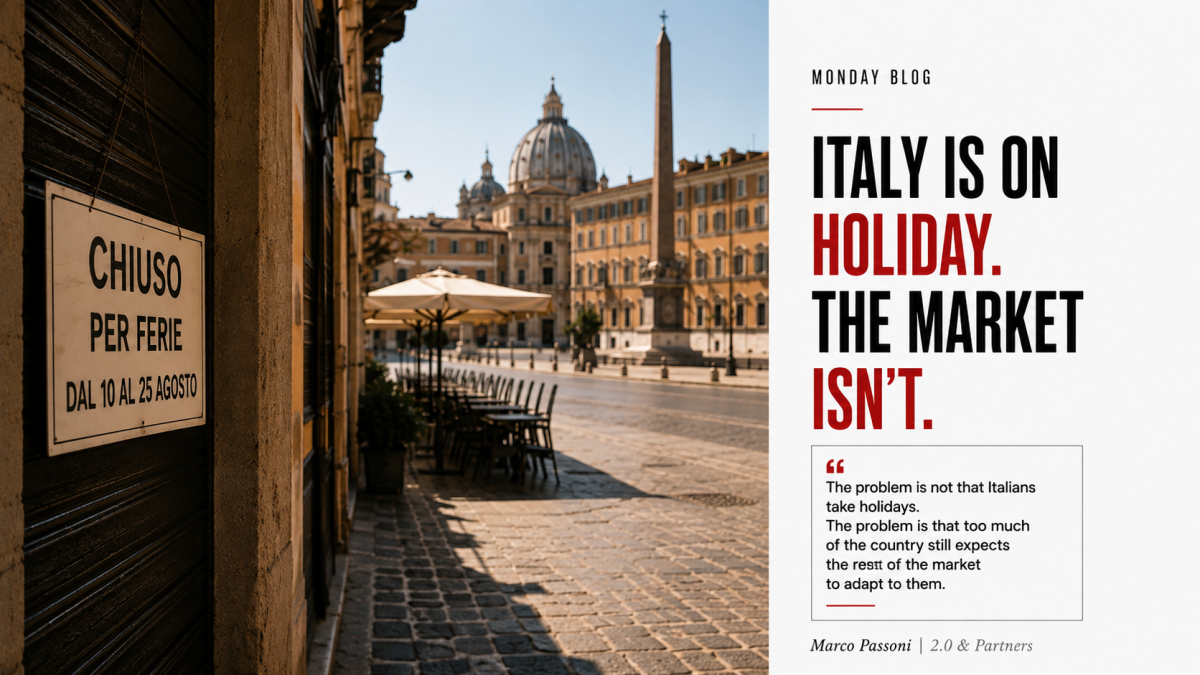
The problem is not that Italians take holidays. The problem is that too much of the country still expects the rest of the market to adapt to them.
From inside Italy, the system feels familiar and therefore relatively harmless. From outside, it can look surprisingly anachronistic.
There is something almost quaint about the idea that an internationally connected economy can collectively slow down because the domestic calendar says August. It belongs more naturally to a world of local customers, short supply chains and largely national business relationships than to the one in which Italian companies operate today.
The commercial consequences are obvious enough.
A quotation arrives late. An approval waits. A customer cannot find the person responsible for a decision. A supplier cannot confirm a delivery. Something relatively simple that could normally be resolved in a few hours waits two or three weeks.
No single episode is catastrophic. The problem is the accumulation.
Customers and business partners build their perception of companies through repeated experiences. Responsiveness, reliability and the ability to solve a problem when it occurs are part of service, even when they do not appear directly on an invoice.
If every August an international customer knows that dealing with Italy will become slower and more complicated, this eventually becomes part of the expectation.
And that brings us to the reputational issue, which I believe is more significant than we sometimes recognise.
Italy quite rightly promotes itself internationally as a sophisticated, creative, export-driven economy. We have world-class businesses in fashion, design, manufacturing, food, hospitality and many other sectors. Italian companies compete every day against organisations from countries where availability and speed of response are considered fundamental parts of the commercial proposition.
Against that background, the idea that large parts of the country effectively become unavailable for several weeks feels strangely out of step with the image we want to project.
The individual business may have perfectly legitimate reasons for reducing activity. Collectively, however, thousands of similar decisions create a much broader impression.
Italy is closed.
Or, perhaps more accurately, Italy is available again in September.
For anyone accustomed to working internationally, that assumption feels increasingly difficult to reconcile with the way business operates today. Not because taking August holidays is a problem, but because expecting customers and partners elsewhere to adapt to our national habits is becoming harder to justify.
Travel Retail provides a particularly clear example because the contrast is impossible to miss.
August is one of the busiest periods of the year for many airports. Passenger numbers rise, stores are full, restaurants operate continuously and frontline teams are under considerable pressure.
The commercial opportunity does not take a summer break.
A passenger at Heathrow, Rome, Dubai or Changi does not care whether the head office of a supplier is operating at reduced capacity. The store still needs product, maintenance, decisions, payments, logistics and support.
Anyone working in the sector knows how often relatively routine matters become unnecessarily complicated during August because someone further along the chain is unavailable.
This does not mean everybody needs to remain at their desk.
It means businesses need to be organised well enough that the absence of one person, or several people, does not become the absence of the company.
Many organisations already manage this perfectly well. Holidays are staggered. Responsibilities are transferred. Clients know whom to contact. Teams operate with reduced capacity while maintaining continuity where it matters.
Nobody expects August to look exactly like November.
But reduced capacity and effective disappearance are two very different things.
There is also a competitive dimension that should not be underestimated.
If two companies provide comparable products and service during most of the year, but one remains responsive during periods when the other becomes difficult to reach, eventually that difference will influence relationships.
Perhaps not immediately, and certainly not because of one unanswered email.
But customers remember who was available when something needed to be resolved. Reliability is rarely created by one dramatic gesture. It is built through a long series of small interactions.
International competition makes this increasingly relevant.
Italian companies are no longer competing only with the company down the road or another supplier in the same region. They are competing with businesses operating in markets where August is simply another working month.
An international customer receiving a response from one supplier today is unlikely to consider waiting until the end of August for another supplier particularly charming or culturally authentic.
They may simply move on.
The solution does not require a revolution in Italian working culture.
It requires organisation.
Take holidays. Take proper holidays. Disconnect and spend time with family.
But stagger them.
Maintain appropriate cover. Make sure clients have a functioning contact. Transfer responsibilities properly. Plan important decisions before people leave. Use technology where it helps and avoid making September the automatic destination for anything that arrives after the first week of August.
These are basic management practices.
The irony is that Italy is exceptionally good at serving international customers precisely during August in many parts of the economy. Hotels manage it. Airlines manage it. Airports manage it. Retailers manage it. Restaurants manage it.
The idea that other businesses cannot organise themselves in the same way is difficult to sustain.
Mostly, we continue doing it because we have always done it.
And habits become particularly difficult to challenge when everybody around us shares them.
When ‘closed for August’ becomes predictable, it stops being an internal organisational choice and starts becoming part of how Italy is perceived as a business partner.
That is what I find increasingly difficult to reconcile with the Italy we want to represent internationally.
We have every reason to defend our quality of life. We should probably defend it more, not less. But quality of life and quality of service are not mutually exclusive.
A modern business should be capable of protecting both.
Ferragosto can remain one of those very Italian traditions that we are right to enjoy.
What deserves reconsideration is the idea that an entire business system still needs to organise itself around it.
The market has moved on.
Perhaps our August habits should start doing the same.