
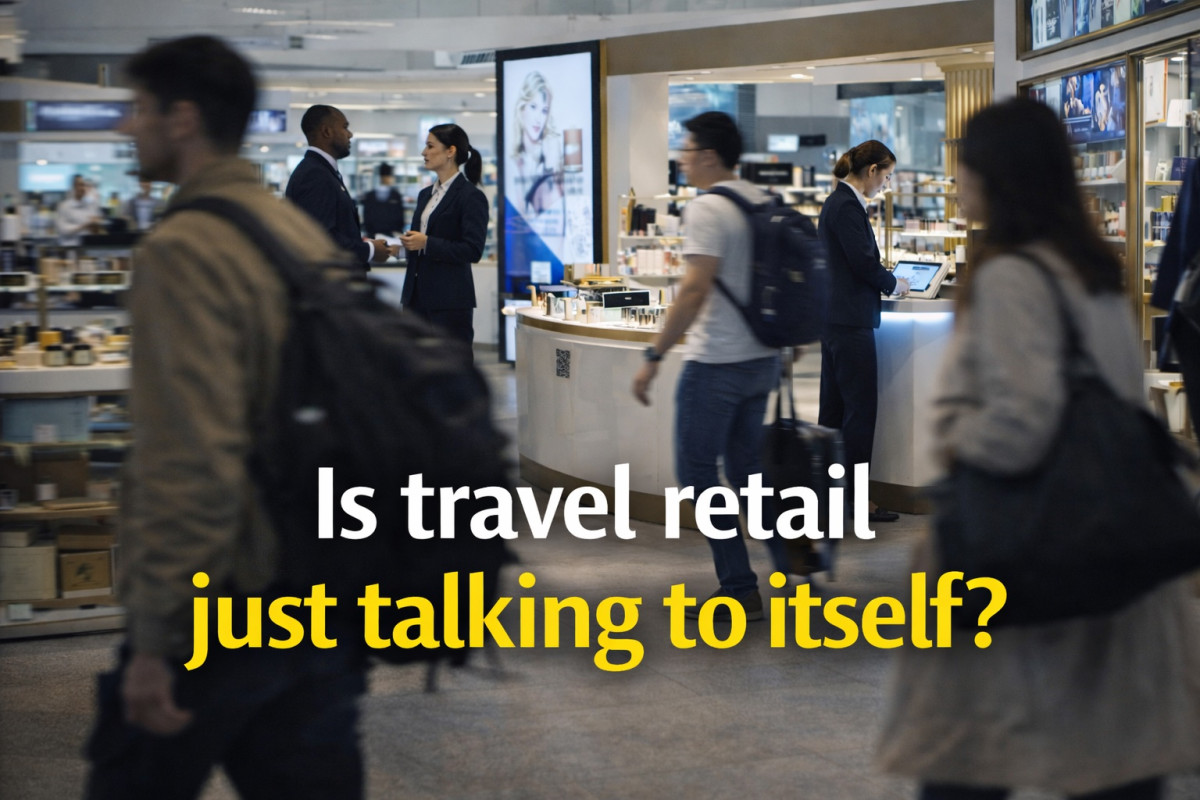
Travel retail spends a great deal of time discussing change. At conferences, panels, and strategy sessions the language is consistent. Evolution is needed. Innovation is critical. The traveller is changing.
Yet when those ideas reach the shop floor, the outcome often looks familiar. Too often, it is not new thinking or new execution, but a repetition of what already exists. The fact is that the industry is talking. But it is not always listening. Too often, what is presented as innovation is simply adaptation.
Digital screens become the default expression of “experience.” Add a photobooth, a piece of interactive content, and the assumption is that engagement has been created. But these are just superficial changes. They occupy space, but they do not enhance the shopper experience and they make little real difference on conversion. Doing something is not the same as making a difference.
Add a photobooth, a piece of interactive content, and the assumption is that engagement has been created. But these are just superficial changes.
The same pattern can be seen in product. “Exclusivity” is frequently positioned as a differentiator, yet in many cases these exclusives are not actually exclusive in any meaningful sense. They are a domestic product with new packaging or minor variation. These slight variations are dressed up with language that suggests something unique, but the reality for shoppers does not support it – and they can tell the difference.
Even at an infrastructure level, the pattern holds. New airports continue to follow established layouts and retail models. The flow, the zoning, the brand mix; all broadly aligned with what has come before. There is efficiency in this approach, but very little progression.
When the sector was growing rapidly, this was tolerated. Performance masked the lack of evolution. Passenger numbers were rising, spend was strong, and the model delivered. That is no longer the case.
Today, the underlying signals are more challenging. Passenger traffic has recovered and, in many markets, exceeded previous levels. Yet average spend per traveller is under pressure. Engagement is weaker and conversion is less predictable; this is not a demand problem, it is a relevance problem.
When the sector was growing rapidly, performance masked the lack of evolution. That is no longer the case.
The modern traveller is digitally connected, highly informed, and accustomed to seamless retail experiences outside the airport. They expect hybrid environments that combine retail, food and beverage, and discovery. They expect personalisation. They expect efficiency when they are in a hurry and immersion when they have time.
What they often encounter instead is a model that has not materially changed: Stores that look similar across geographies. Offers that feel interchangeable. Experiences that are designed more for visibility than for impact. This is not a conceptual gap. It is a commercial one. When the offer is not relevant to the traveller then conversion falls and spend becomes unreliable. This is damaging not just to individual airports, but to the whole market.
The gap is not only in design and proposition. It is also in execution. Training, in many cases, remains standardised. Built for scale rather than specificity. So much of training focuses on delivering a uniform experience, that it loses any sense of personalisation and individual excellence. Despite all the talk, most staff are trained to hit a common baseline, not to judge, assess and understand their shoppers in a live environment and then adapt in real time. Judgement is what frontline staff need, not a corporate manual.
At a structural level, the challenge is even more pronounced. There is a growing recognition that airports being developed today risk being outdated within a decade. The same can be said for many retail environments currently being designed and delivered. The pace of change in consumer behaviour is outstripping the pace of change in infrastructure and operating models. This is not a future risk, it is a present one.
The underlying issue is simple: Travel retail is highly effective at talking to itself.
Industry events bring together expertise, perspective, and ambition. They are essential. But too often the conversation remains internal. Ideas circulate within the sector, refined and repeated, without being sufficiently tested against the reality of the traveller experience.
The underlying issue is simple: Travel retail is highly effective at talking to itself.
The question is not whether the industry is discussing the right themes. The question is whether it is validating them in the right place. Because the only environment that matters is the shop floor.
What do travellers actually respond to? Where do they stop, and where do they pass by? What do they engage with, and what do they ignore? What do they buy, and just as importantly, what do they choose not to buy?
These signals exist in every airport, every day. They are immediate. They are measurable. And they are often underused. Building a stronger travel retail model does not start with another concept. It starts with observation. It starts with understanding who the travellers are in a specific location and then designing an offer that reflects their needs and behaviours. It requires training teams to respond in real time to real interactions, measuring performance and adjusting continuously. This is not theoretical work. It is operational discipline.
Travel retail does not need more conversation. It needs better listening. The customers have changed, but we have not. We promise big ideas and commend ourselves on excellence, but there is little evidence of it beneath the surface. While our travellers have evolved into a new world of distraction and expectation, our response has been some digital screens and fresh packaging. We can tell ourselves this is excellence, but that will not increase conversion. Only actual action can do that.