
A recent article by Daniel Langer in Jing Daily, “In the age of AI agents, luxury’s sea of sameness becomes a trap”, argues that shopping agents will expose how little distinguishes many luxury brands. When the purchasing journey can bypass the boutique, familiar claims about quality and heritage become easier to compare and harder to defend. It made me think about how we select the retail offer in airports, well beyond luxury.
Spend enough time travelling between airports and much of that offer becomes remarkably easy to anticipate. The architecture changes, the signage changes, and sometimes the environment improves considerably. What is available to buy often remains familiar. We may see a strong line-up of recognised names. A frequent traveller may see another version of the shopping they walked past last week.
Established brands earn their place. They bring demand, operational experience and the financial strength to support a demanding airport business. Passengers also appreciate finding a favourite brand before departure. I have no issue with that. The difficulty begins when familiarity becomes the main qualification for inclusion, and the retail strategy gradually becomes an exercise in reproducing what has already been approved somewhere else.
I understand the reasons. Airports need dependable income. Operators face guarantees, staffing costs, stock commitments and substantial investment. Brands compare an airport location with other uses of their capital. Every party has good reasons to favour something proven. A proposal that resembles an existing success is easier to forecast and defend internally. A different idea requires judgement, and somebody has to put their name behind it.
The difficulty is what happens when all those reasonable decisions are added together.
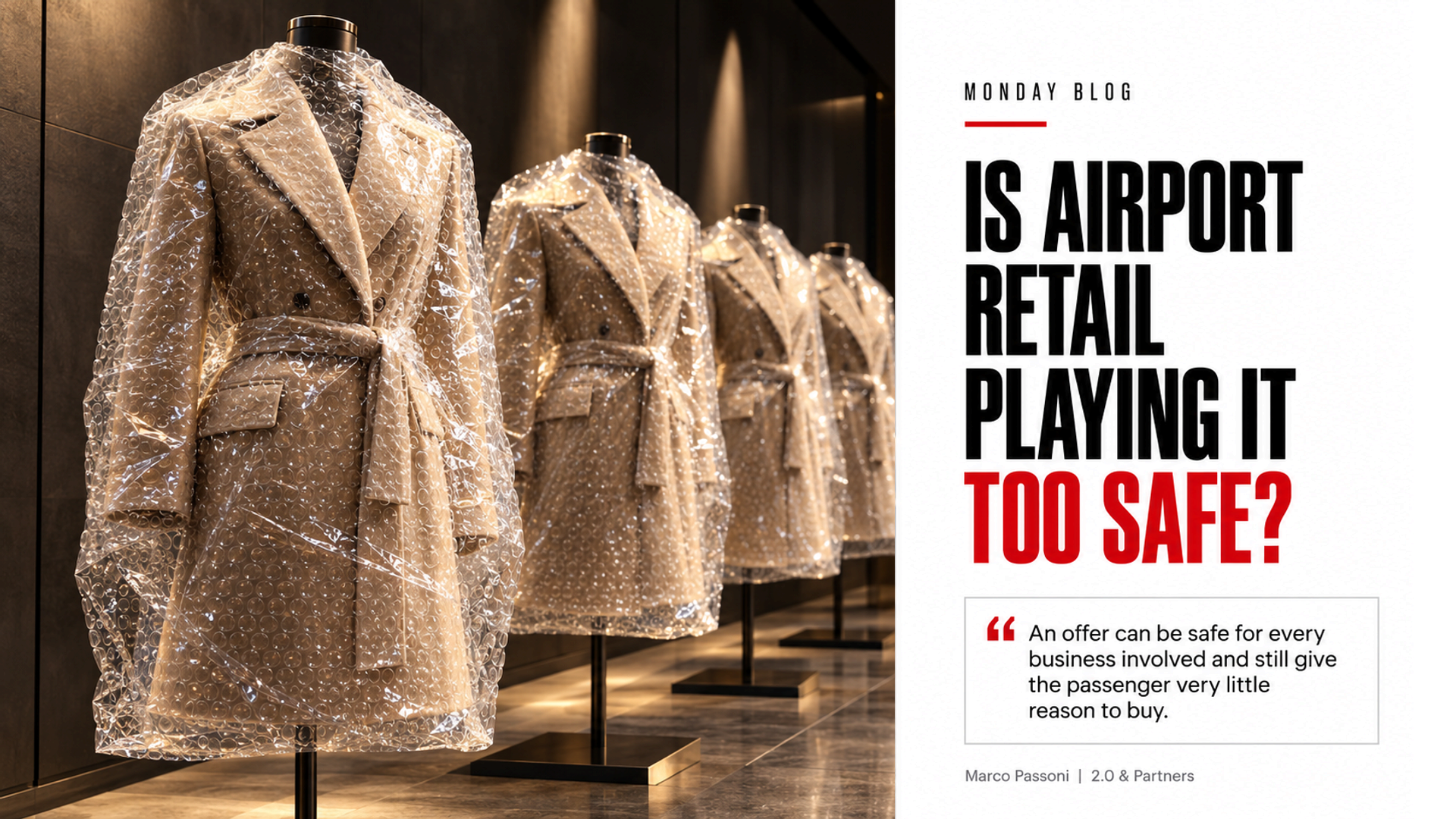
An offer can be safe for every business involved and still give the passenger very little reason to buy.
The risk has moved. We have reduced our exposure to an unfamiliar concept while accepting the possibility that the resulting offer will struggle to attract enough customers. That deserves at least as much attention as the uncertainty attached to trying something different.
Langer places considerable weight on the meaning a brand creates before the purchase. I would be careful about treating storytelling as the only answer. In Travel Retail, the passenger still needs sound reasons to buy here, now. A credible price advantage is part of that, alongside availability, service and an assortment worth considering. An attractive environment cannot make those reasons unnecessary, however impressive the names above the doors.
Adding more logos will not necessarily help. A terminal can contain many brands and still offer a narrow range of reasons to shop. Several units may target much the same customer, at similar price levels, with products readily available elsewhere. Each can look convincing in isolation. Together, they may leave sizeable parts of the passenger base with very little that interests them.
This is why the starting point matters. I want to understand who is travelling through a terminal, what they might buy and what alternatives they already have. The route network, purpose of travel and spending behaviour should influence the selection. A major international brand may be exactly right for one location. A specialist or regional business may add more in another. The same shortlist cannot answer every airport’s needs equally well.
Then we reach the tender. An established operator can bring years of airport trading data, a developed operating platform and the balance sheet to support a guarantee. A smaller specialist may have an excellent product and a loyal following, with little evidence of trading airside. Ask both for the same guarantees, investment and track record, and much of the choice has already been made before anyone gets very far into the merits of the offer.
Those requirements exist for good reasons. Airports are difficult places to operate, and an interesting product will not rescue weak stock management or an underfunded business. Those weaknesses need to be identified. But we should also be honest about what our selection process allows. If only businesses with an established airport presence can realistically qualify, we have made a decision about how much change we are prepared to accept.
There is room for a more considered approach. An airport could reserve a limited amount of space for concepts that deserve a proper commercial test. The operator would still need to demonstrate that it can deliver. The airport would need to agree an investment level and contractual exposure that make the test viable. Both would know how long it has to prove itself and what happens if it fails.
If the airport wants something different, the contract has to give it a realistic chance of working.
Depending on the opportunity, that could mean a smaller initial unit, staged investment or a defined period with more rent linked to actual sales. The terms should reflect what is being tested. A new concept should not need to achieve the productivity of an established airport business from its first month simply to survive.
The review then has to be serious. Sales, margin and productivity matter. So does understanding whether the concept brings in customers the existing offer was missing, adds spending or merely takes business from the next unit. A successful opening event tells us very little about that. I would want to see what happens once the launch attention has passed and the business has to earn its place through ordinary trading.
Brands and operators have responsibilities here too. Being different is no entitlement to space or favourable terms. Anyone asking an airport to consider a new idea needs to explain who will buy, why they will buy in that location and how the operation will work. They also need to be realistic about sales. An ambitious forecast written to satisfy a tender requirement is a poor foundation for a business that has yet to open.
Much of this comes down to whether the airport’s commercial ambition survives the leasing process. It is easy to welcome a more distinctive offer in a strategy presentation. The harder work is agreeing terms that allow a suitable operator to deliver it without asking either party to accept an unreasonable exposure. If that work is never done, the familiar names will keep being the only proposals that can get signed.
There will be plenty of occasions when the established choice is the right one. It should earn that decision through its relevance to the passengers and the business it can generate. Over a concession lasting several years, an offer that fails to interest enough travellers can become a very expensive expression of caution. That is a risk I would want on the table before the contract is signed, alongside all the others.
Marco Passoni has spent more than three decades in the travel retail industry, holding senior leadership roles across distribution, retail and business development. His career included 12 years as CEO of a leading international Duty Free distribution company and a further eight years managing a retail business operating mono-brand fashion boutiques across several international airports.
Today, as Senior Executive Vice President and founding partner of 2.0 & Partners, he develops new business opportunities and services for brands, operators and airports across the global travel retail market. Through 2.0 & Partners, he works with some of the world’s most recognised luxury and premium brands, as well as leading international airports, helping them assess opportunities, strengthen their travel retail presence and navigate the distinctive commercial dynamics of the airport environment. A former elite sailor and World Champion, Marco continues to spend much of his time airside, observing the industry first hand and helping partners and clients respond to the challenges and opportunities of an evolving market.