
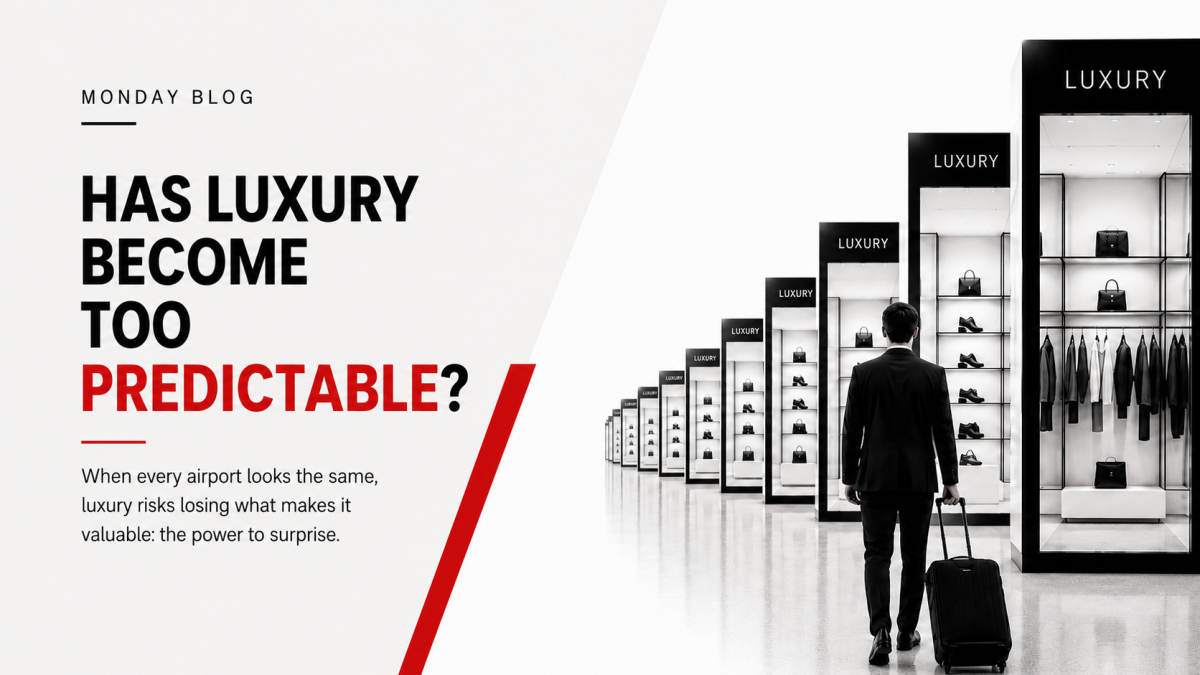
Luxury retail has rarely looked more accomplished. Flagship stores double as architectural statements, airport boutiques have grown more sophisticated, and brands continue to invest heavily in design, digital content, personalisation and service.
Yet one question is worth asking more seriously than it usually is: has luxury become too predictable?
A well travelled passenger can walk through London, Paris, Dubai, Singapore, Seoul and Sydney and encounter largely the same brands, the same collections, the same visual language and, increasingly, the same customer journey. Store size and architecture vary; the proposition rarely does.
This is not a flaw in itself. Consistency protects brand equity, guarantees a baseline of quality and tells the customer what to expect wherever they land. The issue starts when consistency leaves no room for the unexpected.
Luxury built its appeal on more than quality and status; it built it on discovery. A customer walked into a boutique expecting to find something they could not have anticipated. That expectation is harder to meet today. Shoppers now follow collections online, watch launches happen in real time and compare pricing and availability across markets before they ever reach an airport. By the time they arrive at the gate, they often already know the product, the price and the story behind it. Craftsmanship, visual merchandising and attentive service remain the baseline; they no longer make an encounter memorable on their own.
When every store delivers the same version of excellence, excellence stops feeling exceptional.
This matters more in an airport than almost anywhere else. A boutique has one narrow window to convince a passenger to stop rather than walk past, and if what is inside appears identical to what that passenger has already seen in another terminal or on their phone, the store gets admired, not entered.
Airports are right to compete for the leading names, because a strong roster of brands lifts the commercial standing of a terminal. But a list of prestigious logos is not, on its own, a retail experience. Line them up without differentiation and they blur into scenery: polished, correctly executed, entirely safe, and progressively interchangeable. The passenger recognises the brand, credits the store for its presentation and keeps walking, because nothing suggests there is a reason to stop.
The answer is not decoration. A destination motif on the shopfront or a locally themed window does not make a range relevant; it makes it dressed up.
Real differentiation has to sit inside the global brand framework, not outside it: a tighter assortment chosen for that specific airport, early access to a launch, a genuine collaboration, craftsmanship tied to the destination, or a service built around the realities of travel. Exclusivity has to earn its name. A colour variant or a repackaged SKU might generate a passing comment; it will not change how a passenger experiences the store. The test is simple: does this give someone a reason to walk into this particular store, rather than the one they passed in the terminal they flew from.
None of this requires spectacle. The industry tends to equate innovation with technology, entertainment or elaborate design, and those can help, but the more durable differentiation is usually smaller and more specific than that.
It can be a sales adviser who reads a customer quickly and surfaces something they would otherwise have walked past. It can be a sharper assortment, privileged access to a piece, or a service that removes friction from a journey the customer is already anxious about. A store earns its place in memory when walking into it produces something of value: discovery, useful advice, access or convenience. Without that, even an outstanding environment becomes another attractive space on the way to the gate.
Delivering that requires the three parties who shape a store to work as one, not in sequence. Brands hold identity, product and the customer experience. Retailers understand passenger behaviour and the operational realities of an airport. Airports control location, visibility and the flow that brings a passenger to the door in the first place. Differentiation survives only when all three treat it as a shared priority, not a request one party makes of the others.
Consistency is not the target here, relevance is. Customers still need to recognise the brand and trust that the standard will hold wherever they encounter it, and that will not change. What has to change is the assumption that recognition alone still does the commercial work it once did. That means using passenger data properly, building assortments around who is actually flying through that airport that week, and giving store teams the latitude to make a genuinely personal recommendation rather than a scripted one. It also means judging a concept not only on how faithfully it follows the global guidelines, but on whether it gives a traveller an actual reason to stop.
The next competitive advantage in luxury travel retail will not come from being present in more airports, but from making each presence feel less interchangeable.
Luxury has mastered the discipline of controlling its image everywhere at once. That discipline is not the problem, and no one is suggesting brands loosen it. What it needs is enough space, deliberately built in, for something a passenger did not expect to find. The boutiques that matter in ten years will still be unmistakably global. They just will not all be the same store.