
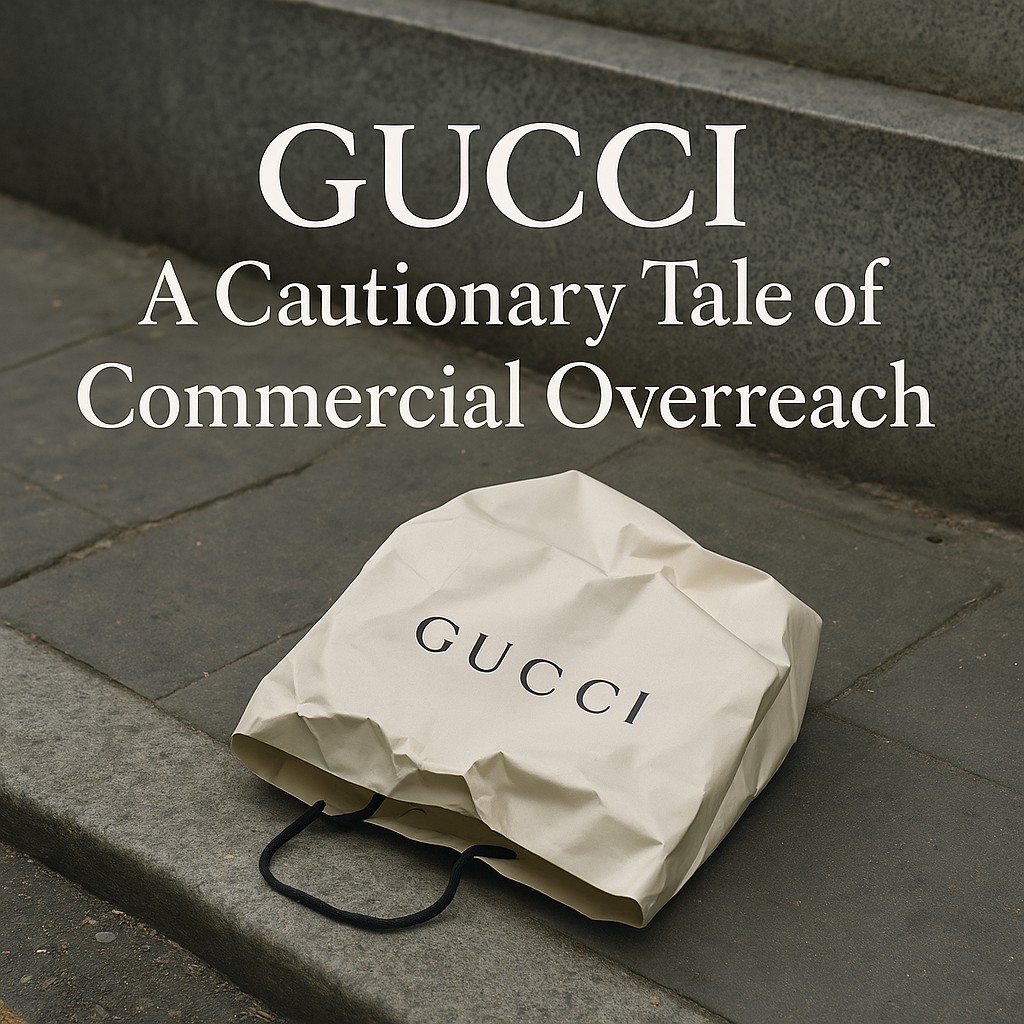
In recent days, a certain tone in the public commentary surrounding Gucci’s current challenges has not gone unnoticed. It is somewhat disappointing to observe how quickly some voices, even within the industry, shift from admiration to criticism with a tone of misplaced triumphalism. Difficulties should inspire thoughtful analysis, not superficial celebration. The resilience of a brand is demonstrated not by the absence of challenges, but by the way it chooses to respond and rebuild.
Gucci posted a 25% drop in comparable sales in the first quarter of 2025, significantly impacting Kering’s overall performance, with group revenues down 14%. This result is not an isolated incident but rather the continuation of a downward trend that began in early 2023, with Gucci reporting consecutive quarterly declines: sales fell by 18% in Q1 2024, 19% in Q2, 25% in Q3, and 24% in Q4. These figures highlight a persistent and deepening challenge for the brand. While many have pointed fingers at the brand’s changing creative direction and narrative inconsistency, the structural issues, in my opinion, lie elsewhere. Gucci is facing the consequences of a long-standing commercial imbalance, rooted in strategic decisions that are now proving difficult to reverse.
During the post-2015 boom years, Gucci pursued an aggressive expansion through an extensive wholesale network, seeking rapid market penetration. While this strategy brought volume and visibility, it also compromised the brand’s control over the customer experience and its perceived value. The outcome was brand overexposure, a dilution of exclusivity, and an image that leaned more towards premium than true luxury.
During the post-2015 boom years, Gucci pursued an aggressive expansion through an extensive wholesale network, seeking rapid market penetration…the outcome was brand overexposure, a dilution of exclusivity, and an image that leaned more towards premium than true luxury.
At the same time, Gucci implemented aggressive sell-in policies, pushing merchandise into the market rather than securing genuine sell-through. This approach led to excess inventory, markdowns, image erosion, and friction within the distribution chain. The data speaks for itself: Kering had to allocate over 1.5 billion euros to cover unsold stock, an increase from the previous year.
When attempting to course-correct—by cutting wholesale ties, focusing on directly operated stores, and relaunching with a new creative direction—the brand encountered two major hurdles. First, the damage to brand equity had already been done. Second, the customer base had grown accustomed to easier access to the brand. In short, its positioning had become muddled, and reclaiming a luxury stature now requires time, consistency, and above all, bold strategic choices.
Gucci’s positioning had become muddled, and reclaiming a luxury stature now requires time, consistency, and above all, bold strategic choices
In contrast, case studies such as Dior demonstrate the effectiveness of a coherent and disciplined strategy: minimal reliance on wholesale, full control of proprietary channels, and careful product and brand storytelling. Unsurprisingly, LVMH is currently outperforming in a challenging market, while Kering is facing the consequences of a growth-at-all-costs model.
Gucci’s crisis cannot be blamed on one single factor, but it is clear that many of its struggles stem from commercial missteps rather than creative failings. A true recovery will demand a fundamental redefinition of the business model—not just a new stylistic vision, but a renewed culture of selectivity, channel control, and respect for perceived brand value.
In a market increasingly driven by authenticity, consistency, and direct engagement, luxury cannot afford to be omnipresent and universally accessible. Gucci must now prove it can return to being desirable rather than merely available.