
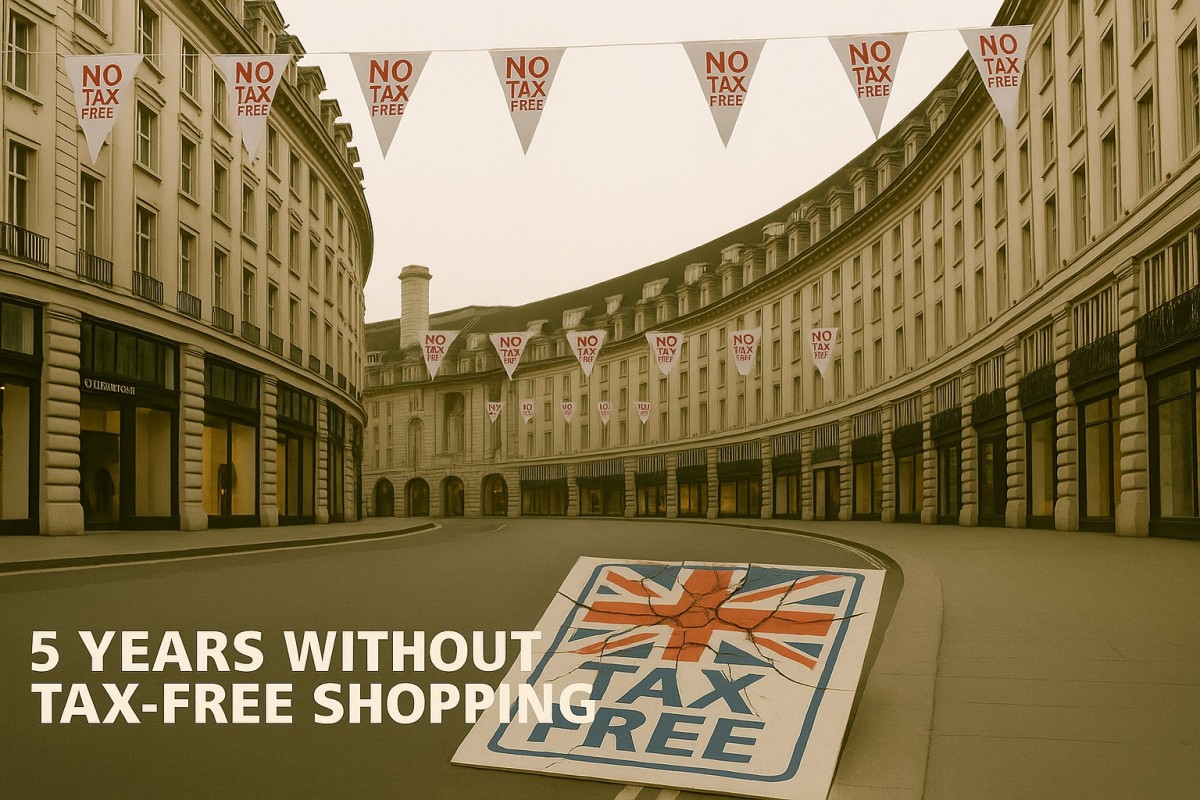
London remains one of the world’s major luxury capitals, but for the past five years it has deprived itself of one of the key tools to attract international tourist spending: tax-free shopping for non-EU visitors. This is a deliberate political decision, introduced in 2021 after Brexit, which has had concrete effects on purchasing flows, on the competitiveness of the system, and on the city’s perception as a destination for high-end retail. I have already written about this several times, but the data that emerges today makes the situation even more clear and hard to ignore.
While the number of tourists in London is growing again, their actual spending is down. In the first half of 2024, tourist-related sales in the West End are estimated to have dropped by 12 %, with over £220 million lost compared to the pre-Covid period. More broadly, international visitor spending in the UK remains 28 % below 2019 levels, while in cities like Paris and Madrid it has grown by double digits. Meanwhile, British citizens’ tax-free shopping spend in Europe rose from £147 million to £742 million between 2021 and 2024, with a further 16 % increase in 2025. The message is clear: affluent consumers choose destinations where their spending is encouraged and rewarded.
International visitor spending in the UK remains 28 % below 2019 levels, while in cities like Paris and Madrid it has grown by double digits
This trend is confirmed by several industry players. Liberty London, the iconic department store, has seen a sharp drop in its Asian and Middle Eastern clientele, who now prefer to shop in Paris or Dubai where they can claim back VAT. Fortnum & Mason has intensified international activities to offset the domestic shortfall. Burberry has raised concerns about the distortion caused by current UK policy, noting the competitive gap it creates with other European markets. And this is not limited to luxury fashion. The entire premium supply chain, from beauty brands to spirits producers and design labels, is suffering from the erosion of value generated by international big spenders.
So far, that’s the market’s view. But the government, which is not stupid, continues to stand by its position. According to HM Treasury, reinstating tax-free shopping would be a regressive measure, benefitting a narrow segment of wealthy buyers and causing a net loss to public finances. The argument is technical: VAT refunds are seen as a tax break for a minority, costly to administer and difficult to monitor, with little collective return.
The argument is technical: VAT refunds are seen as a tax break for a minority, costly to administer and difficult to monitor, with little collective return.
Yet several independent studies offer a very different perspective. Oxford Economics estimates that a well-designed tax-free regime would boost GDP by over £10 billion and support around 70,000 new jobs. The Association of International Retail suggests reintroducing tax-free shopping could directly generate £3.7 billion in additional annual tourist spending. On top of this comes the reputational benefit of keeping the UK positioned as a global luxury shopping destination.
To date, none of these arguments have convinced the government to reverse course. But the market does not wait. Other countries are acting, attracting flows, building loyalty, investing in hospitality and retail experience. London, meanwhile, continues to welcome tourists who admire the windows but make their purchases elsewhere. The risk is that the city becomes an elegant stage with little real commerce behind the curtain.
Maybe it’s time to move beyond the ideological debate between fiscal cost and public return. The real issue is not how much it would cost to reinstate tax-free shopping, but how much it is already costing us not to. Losing London’s position as the top global destination for luxury retail may turn out to be far more expensive in the long run, in real economic terms, in jobs, and in global visibility. And no positive balance sheet will be able to make up for that.