
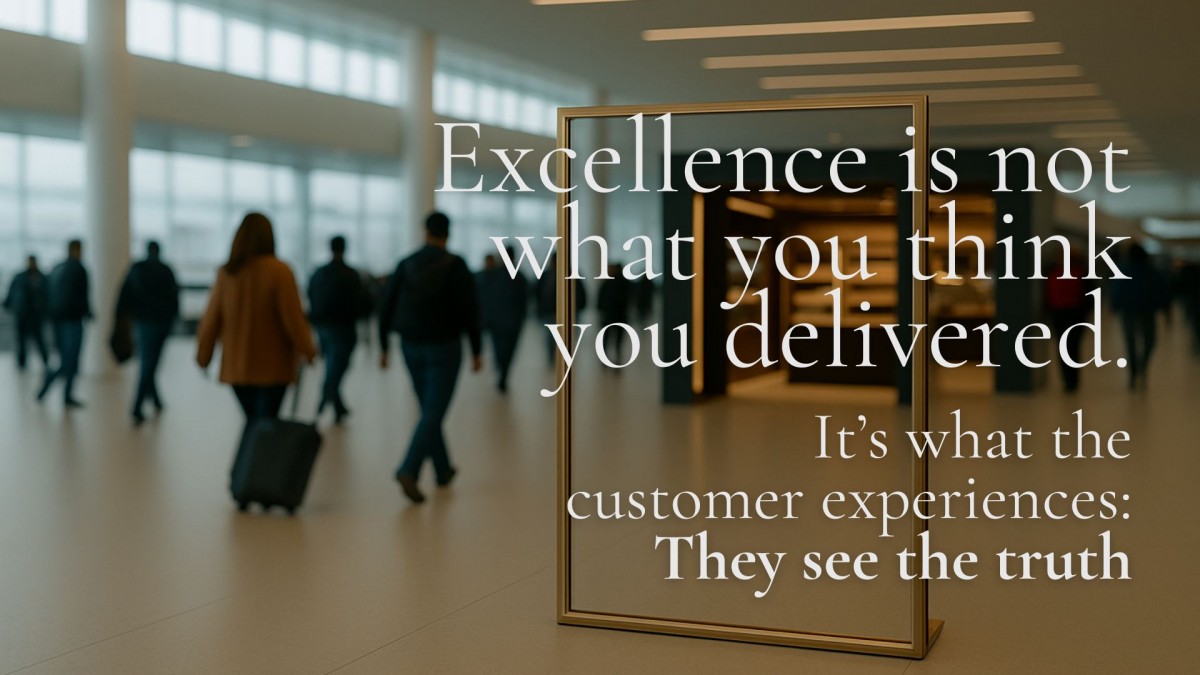
Excellence is one of those words that we hear a lot in travel retail; it is used by every brand and retailer, but few stop to ask: What does it actually mean? And more importantly, how is it achieved?
The reality is that excellence rarely comes from routine. It does not grow out of repeating the same processes, even if they once delivered results. This has been clearly demonstrated by the shifts in the market today; the old processes are not delivering, as spend drops compared to passenger recovery. No, real excellence comes from disruption. From challenge. From seeing the familiar in unfamiliar ways. That is why an outside perspective is not a luxury, it is a necessity.
Excellence rarely comes from routine. It does not grow out of repeating the same processes, even if they once delivered results.
Most travel retail businesses already have strong internal mechanisms in place: mystery shopping, analysis, training programmes. But these systems are shaped by the business itself. They measure staff performance against an internal framework: the ability to follow brand guidelines, to deliver the scripted experience, to tick the right boxes. In other words, they measure whether employees are doing what the handbook says they should.
This is precisely why controller and controlled should never be the same entity or sit under the same payroll. When the assessor depends on the organisation they are evaluating, objectivity is inevitably compromised. True excellence can only be revealed when evaluation is independent, impartial, and free from the influence of internal agendas.
But travellers don’t read the employee handbook. They don’t know what the brand intended to deliver, they only know what they see, feel, and experience in front of them. And that is what shapes their view of the interaction and, ultimately, of the brand itself.
Travellers don’t read the employee handbook. They don’t know what the brand intended to deliver, they only know what they see, feel, and experience in front of them
A shopper does not care whether the right number of talking points were hit in a conversation. They care whether they felt listened to, understood, and valued. They don’t analyse whether a display matches the corporate brief, they notice whether it made them stop, look, and want to engage.
This gap between internal intention and external perception is where excellence is either won or lost. And it is why a fresh perspective is so powerful.
An independent, customer-first lens exposes truths that internal teams cannot always see. It asks different questions. It looks beyond whether the script was followed, and asks whether the shopper walked away with a sense of delight, curiosity, or loyalty. It recognises that in travel retail, where travellers are often stressed, time-poor, and distracted, what matters most is not perfection against a manual, but connection in a moment.
True excellence can only be revealed when evaluation is independent, impartial, and free from the influence of internal agendas.
At 2.0 & Partners, this is the foundation of our Strategic Mystery Shopping programme, in fact, it is central to our whole ideal. This is evident in our Academy training courses. Designed by independent experts, they do not measure staff against an internal checklist, they measure the journey through the eyes of the traveller. Because at the end of the day, that is the only perspective that really matters.
Excellence is not about what you think you delivered. It is about what your customer actually experienced. And sometimes, the only way to see that clearly is to step outside yourself and let a new pair of eyes hold up the mirror.