
October is Dyslexia Awareness Month, and over the years I have written more than once about my own experience of being dyslexic. The first time, I wrote mainly about growing up without knowing there was a name for what made so many apparently simple things difficult for me. I remembered being considered different, sometimes stupid, and constantly having to develop my own strategies to deal with situations that seemed perfectly normal to everybody else. I also wrote about one episode at school that has stayed with me for decades, when I misread “someone” as “Simone” while reading aloud and was laughed at by my classmates for months afterwards.
Later, I came back to the subject from a very different perspective. By then I had understood much more clearly how dyslexia had influenced the way I think and, particularly, the way I work. Seeing the bigger picture, identifying patterns, approaching problems from unusual angles, connecting things that may initially appear unrelated. In retail and luxury, I genuinely believe many of these characteristics have been an advantage throughout my career.
Today I would probably go further. For the type of work I do, I consider dyslexia something close to a superpower. But I have become increasingly uncomfortable with the way that word can sometimes be used.
The progress in dyslexia awareness has been enormously positive. We have moved a long way from seeing dyslexia simply as an inability to read or spell properly. There is now much greater recognition that a dyslexic brain processes information differently and that this difference can bring valuable strengths. That matters. A child growing up today has a much better chance of hearing that being dyslexic does not mean being less intelligent. An adult receiving a diagnosis may finally understand why certain things have always required disproportionate effort. Employers are becoming more aware that different ways of thinking can add real value to organisations. These are significant achievements.
But there is a danger in making the story too attractive.
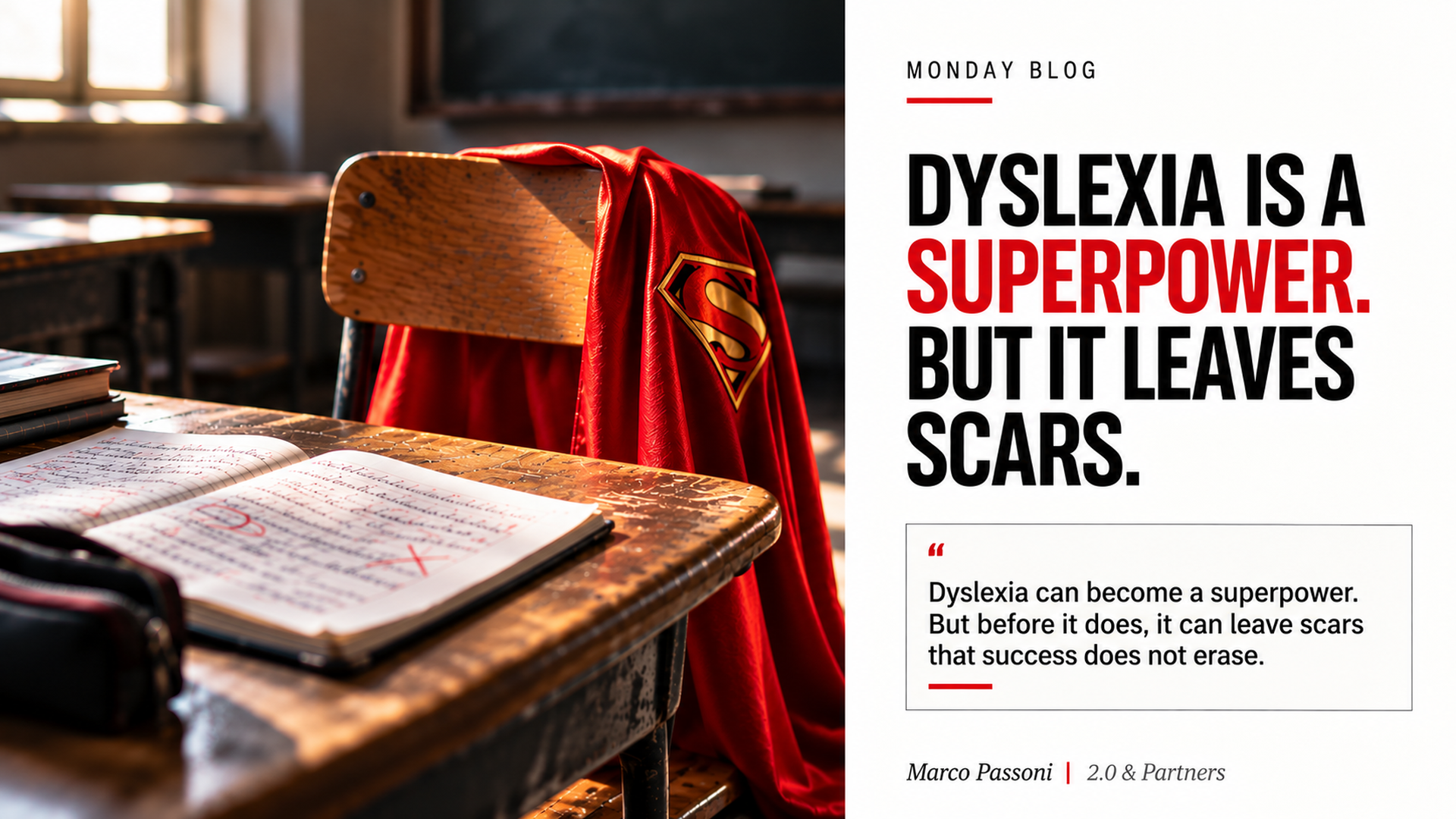
Dyslexia can become a superpower. But before it does, it can leave scars that success does not erase.
I know what dyslexia has given me. I also know what it cost me before I understood it. When I was young, nobody explained that my brain simply worked differently. There was no alternative framework through which to interpret what was happening. If everybody else can apparently do something easily and you cannot, the conclusion a child reaches is rarely that the system may not suit the way their brain processes information. The much more obvious conclusion is that something is wrong with them.
So you start running. You work harder to keep up. You invent ways of avoiding situations that expose you. You become extremely good at disguising what you find difficult. You learn to anticipate embarrassment before it arrives. Sometimes you become resilient. Sometimes you become competitive. Sometimes you become obsessive about getting things right. And sometimes these very behaviours later contribute to success. But that does not mean they came for free.
I still hate reading aloud. I still know the feeling of looking at something I have written and wondering whether I have missed something obvious. I still check certain things far more times than should reasonably be necessary. Some of that has undoubtedly contributed to the determination and perfectionism that have accompanied me throughout my career. But I would be lying if I pretended all of it was simply a gift.
This is the part of the dyslexia conversation that I think we need to protect as awareness evolves. Celebrating difference is important. Romanticising it is something else. A superpower is a very appealing description when you are an adult who has learnt how to use the way your brain works to your advantage. It probably feels rather different to the 10-year-old who is convinced they are the least intelligent person in the classroom. Or the teenager who spends twice as long studying only to receive a worse result. Or the adult who has developed an extraordinary collection of coping mechanisms without ever understanding why they need them.
Recognition changes everything because it changes the explanation. Suddenly the difficulty is no longer evidence of limited ability. It is evidence that a particular task is being processed differently. That distinction can be liberating. But recognition cannot completely erase what happened before it. The confidence lost along the way does not automatically return. The fear of being exposed does not necessarily disappear. The habits built over decades remain. And some wounds become so deeply incorporated into our personalities that it becomes difficult to distinguish the scar from the strength that eventually grew around it.
Perhaps that is why I find the current conversation around dyslexic thinking both encouraging and slightly uncomfortable. I want young dyslexic people to know that their brains may eventually give them extraordinary advantages. I certainly wish somebody had told me that. But I also want the adults around them to understand that telling a struggling child they have a superpower is not enough. They still need recognition. They still need the right support. They still need different ways of learning and being assessed where appropriate. And, above all, they need to avoid spending years believing that difficulty means inadequacy.
The objective should not be to make dyslexic people better at surviving systems designed around somebody else's way of thinking. It should be to recognise their capabilities early enough that they do not have to spend half their lives proving to themselves that they have them.
Awareness should celebrate what dyslexic minds can do without hiding what many of them had to endure before discovering it.
I would not give up the advantages dyslexia has given me. At this stage of my life, I would not even want to think differently. The ability to look at a problem and see something unexpected has served me extraordinarily well, in business, in sport and probably in many other areas of my life. But if I could change one thing, it would not be the dyslexia. It would be the years it took to understand it.
Because the real progress will not come when every dyslexic child is told that they have a superpower. It will come when they no longer need to be wounded before learning how to use it.
Marco Passoni has spent more than three decades in the travel retail industry, holding senior leadership roles across distribution, retail and business development. His career included 12 years as CEO of a leading international Duty Free distribution company and a further eight years managing a retail business operating mono-brand fashion boutiques across several international airports.
Today, as Senior Executive Vice President and founding partner of 2.0 & Partners, he develops new business opportunities and services for brands, operators and airports across the global travel retail market. Through 2.0 & Partners, he works with some of the world’s most recognised luxury and premium brands, as well as leading international airports, helping them assess opportunities, strengthen their travel retail presence and navigate the distinctive commercial dynamics of the airport environment. A former elite sailor and World Champion, Marco continues to spend much of his time airside, observing the industry first hand and helping partners and clients respond to the challenges and opportunities of an evolving market.