
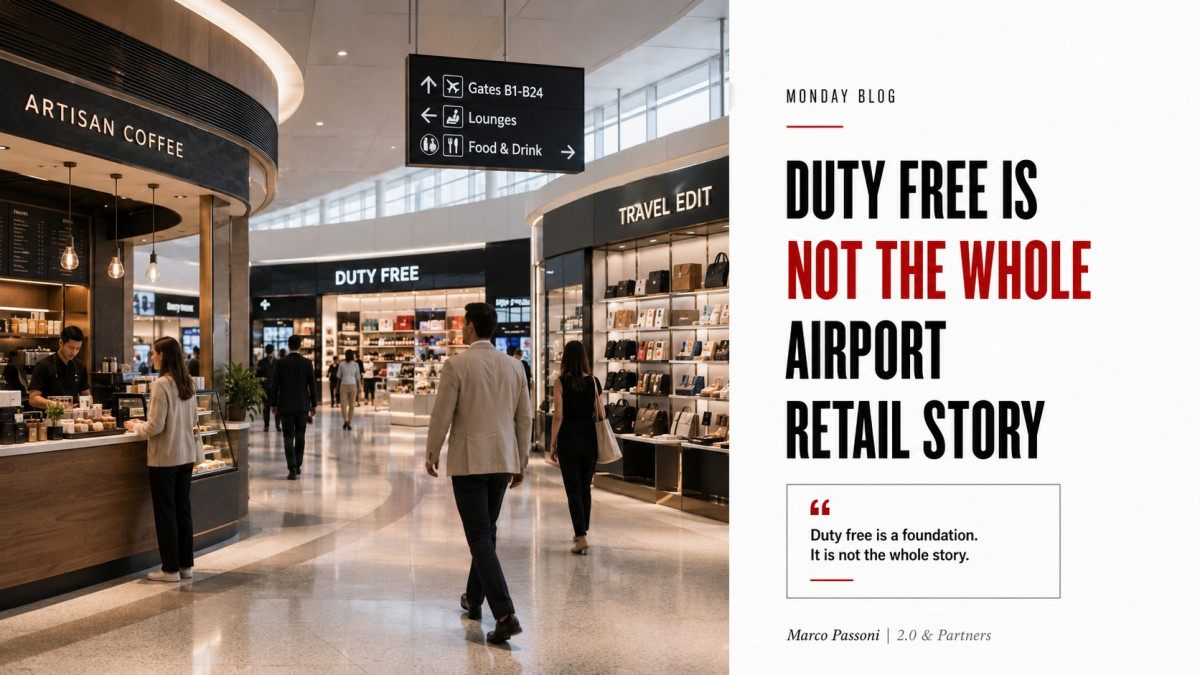
There is still a tendency in our industry to discuss airport retail as if it were almost entirely synonymous with core duty free.
Beauty, liquor, tobacco and confectionery remain essential categories. They have built much of the travel retail model, they continue to generate significant volumes, and any serious conversation about the future of the channel has to include them.
But they are no longer enough to describe the full commercial reality of the airport.
Airport retail today is a much broader ecosystem. Luxury fashion, lifestyle, F&B, gourmet, hospitality, services, pop-ups, brand activations, local concepts, premium passenger services and placemaking are increasingly part of how passengers experience the terminal as a commercial environment.
This does not reduce the importance of duty free.
It simply means that duty free is not the whole airport retail story.
The distinction matters because the industry often uses a narrow lens to analyse a much wider opportunity. When the conversation is focused almost exclusively on the traditional core categories, we risk missing part of the transformation already taking place in airports. The passenger does not experience the terminal in category silos. The passenger experiences a journey made of movement, waiting time, stress, discovery, food, service, retail, brand exposure, local identity and convenience.
That journey is commercial in many different ways.
A passenger may buy fragrance, whisky or confectionery. But the same passenger may also stop for coffee, enter a luxury boutique, discover a local gourmet concept, use a lounge, interact with a pop-up, buy a gift, visit a pharmacy, collect a pre-ordered item, or simply decide whether the airport feels like a place worth spending time and money.
All of this belongs to the airport commercial story.
This is why I am always cautious when large forecasts about duty free growth are presented without a very clear perimeter. Are we talking only about airport duty free? Are we including travel retail more broadly? Are downtown duty free, border stores, cruise, offshore duty free or Hainan part of the number? The figure may be interesting, but without clarity on the scope, it should be interpreted carefully.
A recent TRBusiness / m1nd-set article on the potential for duty free to reach USD 113 billion by 2031 offered useful data points in this respect. International departures are forecast to reach 2.414 billion in 2026, equal to 122% of 2019 levels. In other words, the traffic base is clearly back. But the same discussion also points to a more complex commercial picture: non-aeronautical revenue share has fallen from 40.2% in 2019 to 36.7% in 2023, while retail concessions represent around 20% of non-aeronautical income, compared with 27% in 2019.
For me, this is where the real discussion should begin.
The issue is not whether passenger traffic is recovering. It is. The issue is whether airport retail is converting that traffic with the same effectiveness, relevance and profitability.
Traffic is an opportunity. It is not a result.
This may sound obvious, but I am not sure the industry always behaves as if it were. Too many discussions still start from the assumption that more passengers will naturally produce more sales. In some cases, that may happen. But in many airports, the relationship between traffic and commercial productivity has become less automatic.
The passenger is back. But not always with the same mindset.
Travellers are more informed. They compare prices more easily. They are exposed to digital channels before they arrive at the airport. They may already know what they want, or what they do not want. They may have less dwell time, different priorities, or a weaker perception of duty free value than in the past.
This does not make duty free less important.
It makes execution more important.
It also makes the wider airport retail proposition more important.
The future of airport commercial performance cannot be built only around passenger growth. It has to be built around traffic capture, conversion, spend per passenger, staff-assisted selling, quality of offer, price perception and customer experience. It also has to be built around a better understanding of the different reasons why a passenger may choose to stop, enter, engage and spend.
For some passengers, the reason may still be price. For others, it may be convenience, gifting, discovery, exclusivity, local relevance, food, comfort, service or simply a better use of time before boarding.
A strong airport commercial strategy should not reduce all these motivations to one category or one model.
This is where the difference between duty free and airport retail becomes important.
Duty free is a foundation. Airport retail is the broader environment in which that foundation now has to coexist with many other forms of commercial value.
Airports are no longer simply places where passengers buy before flying. They are commercial environments where brands, services, food, hospitality, experience and place identity all compete for attention and relevance.
This does not mean that every airport should become a shopping mall.
That would be the wrong conclusion.
Airports have their own logic. The passenger journey is not a downtown retail journey. Time, stress, boarding, security, family travel, connections and luggage all influence behaviour. The commercial environment has to respect that reality, not ignore it.
But it does mean that airport retail should be understood as an ecosystem, not only as a duty free transaction.
The concept of hybrid retail is interesting in this context, but it also needs to be handled with care. For beauty, wine and spirits, confectionery, coffee, gourmet, gifting and lifestyle, hybrid formats can create new reasons to stop, engage and spend. Combining product, tasting, service, education, gifting or F&B can make sense when it is relevant to the category and clear to the customer.
But luxury is different.
In luxury, the answer cannot simply be to make everything hybrid, experiential or more entertaining.
Luxury requires brand control, the right location, a strong façade, excellent staff, coherent storytelling, the right product and consistency with the brand’s DNA. Experience matters, but not every experience creates luxury value. A poorly conceived activation can dilute a brand as easily as a good one can strengthen it.
This is an important point for airports.
Innovation should not become noise.
A stronger airport retail environment is not built by adding random experiences, more screens, more pop-ups or more commercial messages. It is built by understanding which categories need speed, which need discovery, which need service, which need emotional engagement and which need strict brand coherence.
The same applies to operators. The future is not only about managing square metres or category contracts. It is about curating a commercial environment where different formats can coexist without confusing the passenger or weakening the offer.
Traditional duty free, specialty retail, luxury boutiques, F&B, services and activations should not behave like disconnected pieces. They should contribute to a more coherent airport commercial journey.
For brands, the question is also becoming more complex. Travel retail cannot be evaluated only as a channel for incremental sales. In many categories, it is also a platform for visibility, image, client acquisition, product discovery and international relevance. But that value only exists if the airport environment allows the brand to express itself properly.
This is why I believe the industry needs a broader commercial vocabulary.
We should continue to analyse core duty free categories with discipline and depth. But we should not allow them to become the only framework through which we understand airport retail. The future opportunity will not be unlocked only by selling more of the same products to more passengers. It will depend on how well airports and operators understand different passenger missions, different moments of the journey and different forms of commercial relevance.
Duty free remains one of the foundations of airport retail.
But the airport commercial story is now wider, more complex and more demanding.
And the industry should read it that way.