
Walk through almost any major city today and one of the most visible changes in the retail landscape is the growth of premium performance and athleisure brands.
On has expanded rapidly from its running origins into footwear, apparel and lifestyle, opening stores in many of the world’s most important retail locations. London alone now has four On stores, and the company has reached around 60 directly operated stores globally.
Alo has followed a different route but with a similar result, building a premium lifestyle proposition around yoga, wellness and fashion and accelerating its international expansion across Europe and Asia.
These are no longer niche sports brands.
They occupy premium locations, invest heavily in store design and experience, collaborate with fashion and cultural partners and attract exactly the kind of internationally mobile, relatively affluent consumer that airports spend considerable effort trying to understand.
Yet their presence in Travel Retail remains remarkably limited.
There are exceptions. Lululemon operates at Heathrow Terminal 5, as well as airside stores at Hong Kong International Airport Terminal 1 and Singapore Changi Terminal 3. On has gone further at Jewel Changi, where its 9,300 sq ft two-level flagship sits within one of the world’s most successful airport ecosystems, although technically outside the airside Travel Retail environment.
But compared with the extraordinary expansion these brands are experiencing in domestic markets, their airport footprint remains small.
I think this represents a missed opportunity.
For decades, airport retail has understandably built its premium proposition around established categories: luxury fashion, leather goods, watches and jewellery, beauty, wines and spirits. These categories remain fundamental and will continue to be.
But the premium consumer has evolved.
Spending on wellness, fitness, performance, travel comfort and premium casualwear has become an increasingly important part of the lifestyle of many affluent consumers. The distinction between what people wear to exercise, to travel, at weekends and sometimes even to work has become much less clear.
And nowhere is this more visible than in an airport.
Look at passengers walking through Heathrow, Changi, Dubai or JFK. Premium sneakers, technical outerwear, leggings, hoodies, performance trousers and sophisticated travel clothing are already part of the uniform of contemporary international travel.
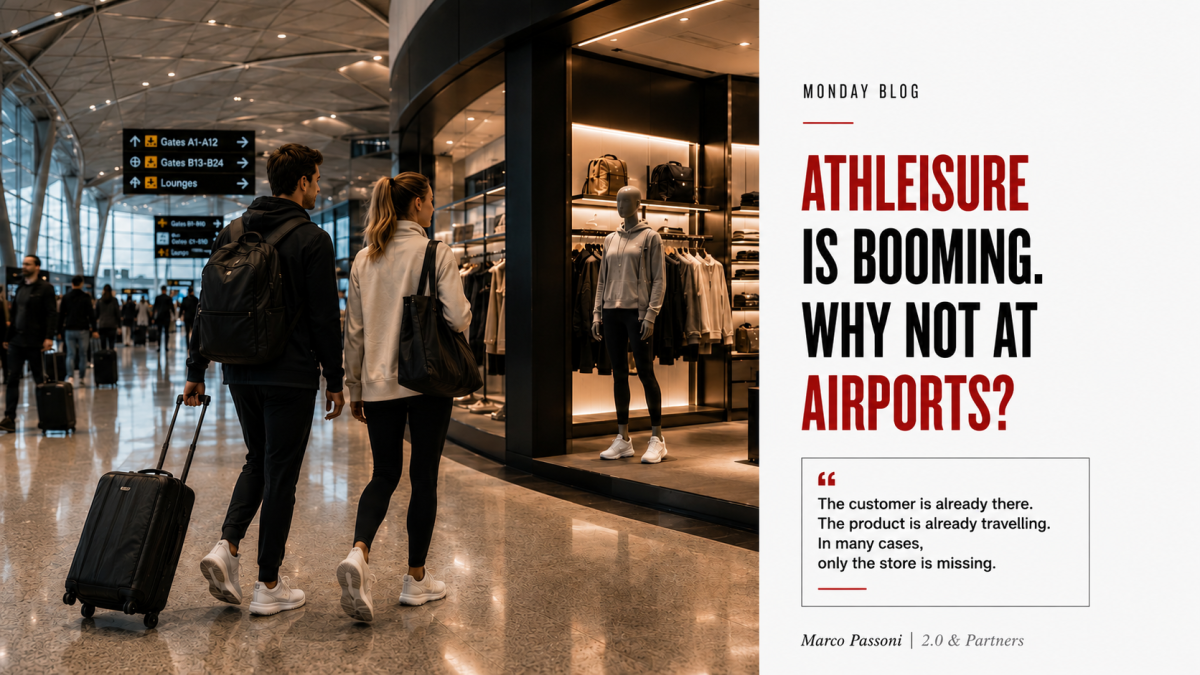
The customer is already there. The product is already travelling. In many cases, only the store is missing.
The irony is that some of the brands expanding fastest on the high street are also among those naturally best suited to the airport environment, yet Travel Retail has been relatively slow to bring them into the mix.
There are good commercial reasons to look at this category more seriously.
The first is relevance.
A pair of On shoes or premium athleisure clothing has an immediate relationship with travel. Comfort, movement and versatility are not abstract brand concepts in an airport; they are directly connected with what the passenger is doing at that moment.
The second is accessibility.
These brands sit in an interesting space between mainstream sportswear and traditional luxury. Their price points are premium enough to support attractive productivity but still accessible to a considerably broader customer base than a €3,000 handbag.
That matters at a time when the aspirational luxury customer has become more selective and many airport retailers are searching for categories capable of attracting passengers beyond the traditional luxury audience.
The third is international awareness.
Brands such as Lululemon, On and Alo have built communities that travel extremely well across markets. Their customers recognise them in London, New York, Singapore, Dubai or Seoul. That recognition reduces one of the traditional barriers for new airport concepts: the need to explain what the brand represents before asking the passenger to enter the store.
There is also an important demographic dimension.
Airports increasingly need propositions capable of engaging Millennials and Gen Z without artificially trying to make traditional categories appear younger. Premium performance and lifestyle brands already have that relationship.
They do not need to manufacture relevance to these consumers. They already possess it.
This does not mean that every airport should suddenly dedicate large spaces to athleisure, or that another wave of identical stores should simply replace one form of category repetition with another.
Airport commercial strategy should never begin with a brand list.
It should begin with the passenger profile, the route network, dwell time, spending behaviour and the competitive environment of the individual airport.
At some locations, a full standalone store may make sense. At others, a curated multi-brand performance or wellness concept could be stronger. Shop-in-shops, temporary activations and airport-exclusive capsules could also provide ways of testing demand before committing significant space.
There is another reason why the timing may be interesting.
Domestic retail expansion normally comes first. Brands establish awareness, build their distribution network and demonstrate productivity before landlords and Travel Retail operators become comfortable allocating airport space.
That is understandable.
But waiting until every brand has become completely established also carries a cost. By then, the airport is no longer introducing something customers are excited to discover. It is simply replicating what they already see everywhere else.
The strongest airport retail environments have historically been those able to anticipate changes in consumer behaviour rather than merely reproduce the high street several years later.
On is particularly interesting in this respect. Its Jewel Changi flagship demonstrates that a performance brand can create a sophisticated, design-led retail environment entirely consistent with a premium airport ecosystem. It sells running, training, tennis, trail and lifestyle products under one roof, turning what was once primarily a technical footwear proposition into a much broader retail platform.
Alo is moving in an equally interesting direction. Its international strategy increasingly connects apparel with wellness, community, experience and cultural relevance rather than treating the store simply as a place to sell leggings.
Those concepts should be particularly interesting to airports trying to become destinations rather than collections of transactional stores.
There are operational questions, of course. Size availability can complicate inventory. Footwear and apparel require fitting rooms and more stockholding than some traditional airport categories. Returns and exchanges need careful management. Not every passenger wants to carry another pair of shoes through the terminal.
None of these challenges is unusual or insurmountable.
The more important question is whether the potential productivity and relevance justify solving them.
Airport brand mix should not be defined by what the premium customer used to buy; it should reflect what today’s premium customer actually values, wears and wants to discover.
This is where I believe the athleisure phenomenon becomes interesting for Travel Retail.
The opportunity is not simply to add sportswear to an airport.
It is to recognise that the definition of premium lifestyle has broadened significantly, while airport category planning has sometimes remained remarkably traditional.
The domestic market is already providing the evidence. On, Alo, Lululemon and others are investing heavily in physical retail because customers still want to experience these brands in stores. They are simply building a different type of premium retail proposition.
Travel Retail should be watching closely.
Better still, in the right airports, it should probably stop watching and start testing.