

I read about the recent opening of yet another multibrand store at Hamburg Airport Nothing particularly remarkable in itself—it’s no secret I’ve never been fond of this kind of format, which too often dilutes rather than elevates brand identity—but once again what catches the eye, and not in a good way, is the presence of Armani Exchange. Another bland, standardised wall, tucked away in an indistinct corner, devoid of impact or meaning. A logo pasted on a surface, with no context, no intent, no storytelling. Just another generic presence, lost in the noise.
And that image—banal, cold, forgettable—tells a real story about the current state of a brand that once stood above the rest.
Because Armani was never just a brand. It was a language. A code. A design revolution that redefined elegance for an entire generation. It was the very embodiment of timeless refinement, restraint, harmony and authority. Armani didn’t follow trends—it set them. But today, looking at the brand’s presence in retail, one struggles to detect any trace of vision. Worse: one struggles to perceive any direction at all.
Over time, the label has multiplied into an ever-expanding galaxy of sub-brands and derivatives: Giorgio Armani, Emporio, Exchange, EA7, Casa, Beauty, Restaurants, Hotels, Flowers, even Confectionery. A sprawling, saturated, and at times incoherent archipelago. Each label with its own purpose, price point and audience—yet none that speaks with clarity or conviction. The overlaps are such that even insiders would struggle to define the boundaries between Emporio and Exchange. There is no clear story. No experience. No identity.
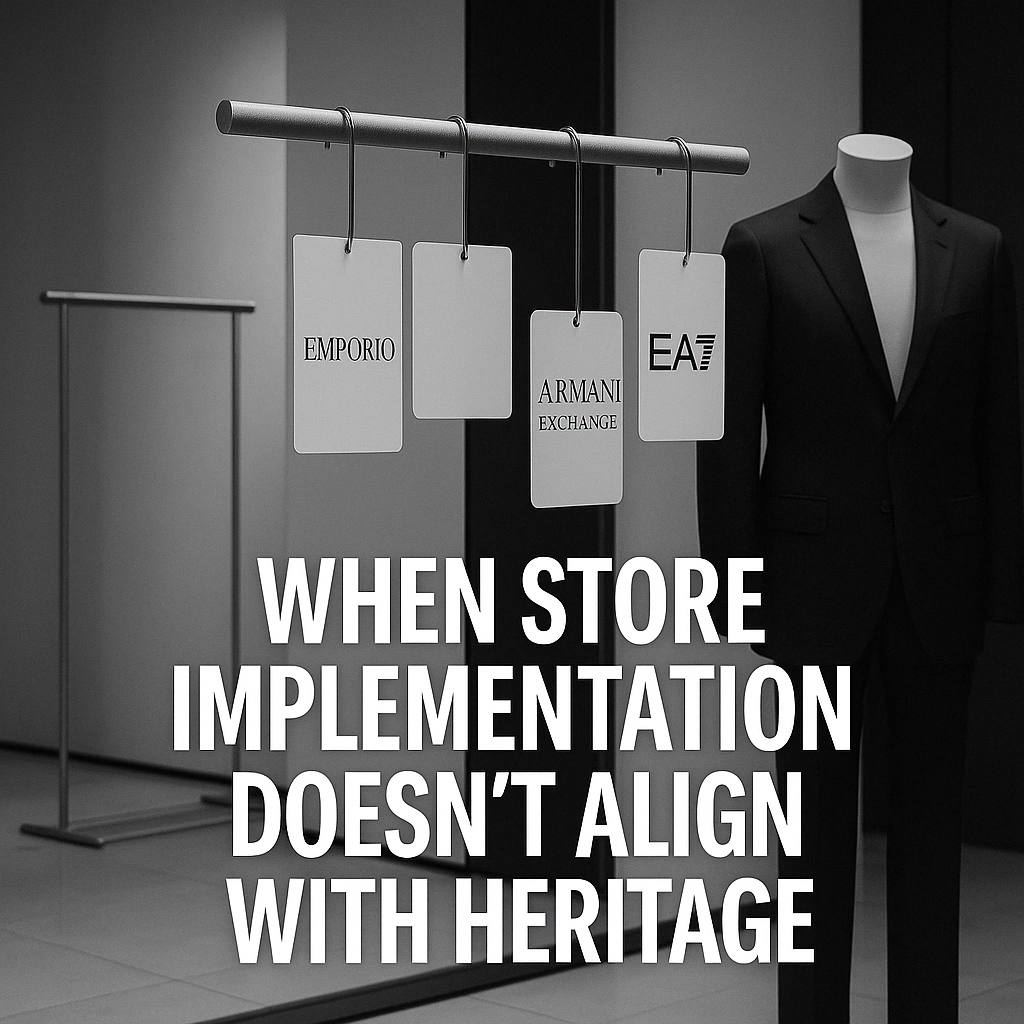
And so, retail becomes a mirror of this fragmentation. Armani stores pop up in every possible context: luxury boutiques, outlets, mall corners, airport multibrands, department stores, e-commerce platforms. Surfaces are filled, locations are ticked off, flags are planted. But without curatorial strategy, without a logic of selection. Expansion turns into dilution. Presence into noise.
This is miles away from what today’s luxury consumer seeks: scarcity, coherence, storytelling, differentiation, exclusivity. The strongest global players have learned this. Chanel refuses e-commerce to preserve the physical experience. Hermès cultivates anticipation. Bottega Veneta communicates without logos. Balenciaga treats visual positioning as a religion.
Armani, instead, seems to be chasing every market segment, every price point, every possible channel. Everything for everyone, everywhere. The result? A brand that, by trying to speak to all, ends up saying nothing.
And yet, the label still stands. But not because of its recent retail strategies. It endures thanks to the vast symbolic capital built over forty years by a single man: Giorgio Armani. A legacy of aesthetic authority and vision. An immense reserve of credibility. But even the most substantial heritage is finite. If not protected, it is consumed.
The result is a brand that, by trying to speak to all, ends up saying nothing.
In today’s fashion and luxury landscape, protecting brand identity is a strategic priority. It’s no longer about presence, but about precision. About subtraction, not addition. About curation, not expansion.
Real luxury is knowing how to say no. Turning down a quick win to protect long-term meaning. Refusing easy exposure to safeguard the integrity of one’s voice. Choosing where *not* to be is what gives meaning to where you *are*.
Armani today appears to follow a logic that is tactical, opportunistic, and ultimately short-sighted. A scattergun approach that risks emptying one of Italy’s most iconic brands of its depth and stature. Every poorly thought-out space, every soulless corner, every arbitrary extension isn’t just a tactical mistake—it’s a step towards irrelevance.
Those who truly loved the brand—those who witnessed its rise as a symbol, a statement, a language—can only look on with dismay. Because heritage is not forever. It’s not a guarantee. It’s credit. And once spent recklessly, it vanishes.
It is time, for Armani, to regain its centre. To rewrite its rules—starting with one simple question: who do we want to be today? Because if the answer is “everything for everyone”, then true elegance—the kind that endures, inspires, and defines—is already lost.