
I had planned to use this Monday Blog to share my takeaways from TFWA Cannes.
I have changed my mind.
In the days immediately following the exhibition, LinkedIn is inevitably full of Cannes recaps, photographs, announcements and conclusions. Some are useful, many are understandably similar, and I would rather let the week settle before adding another set of takeaways to an already crowded conversation.
There was, however, one development in Cannes that I do not think should wait.
One of the developments presented in Cannes was a new approach to retail execution monitoring, using travellers to carry out short observational checks in airport stores and feed the results into a comparative platform.
There is nothing inherently wrong with that model.
In fact, for certain questions it makes very good sense.
If I want to know whether a bestseller is available, whether a promotion has been implemented correctly, whether a display follows the agreed guidelines, whether a store is open or whether staff are physically present, a frequent and scalable observational check can be extremely useful.
Traditional retail has used crowdsourced models successfully for years for precisely this type of execution monitoring.
The issue begins when we use the same language for very different forms of measurement and, as a consequence, start to assume that they provide the same kind of insight.
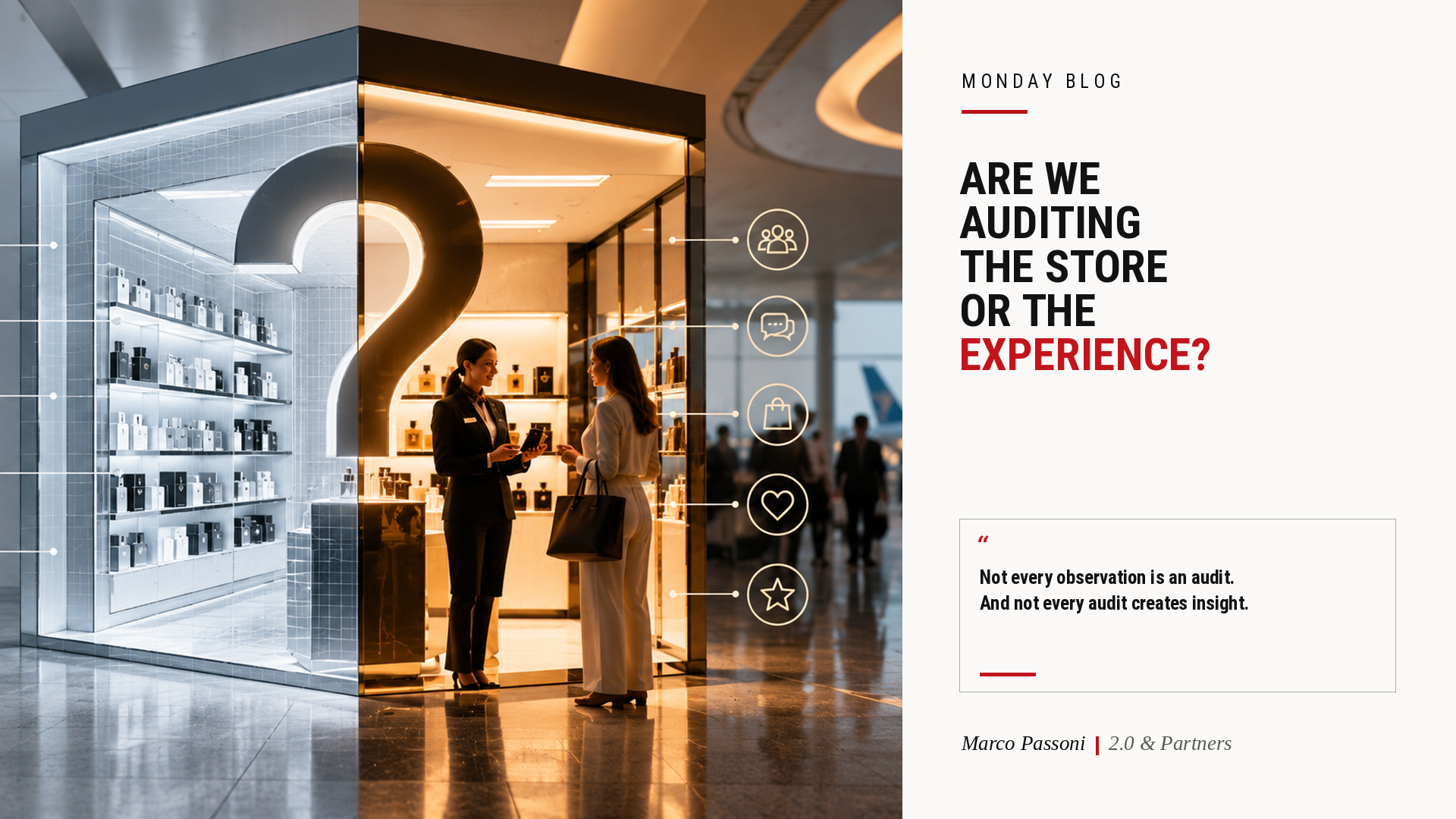
Not every observation is an audit. And not every audit creates insight.
There is a fundamental difference between checking what is visible and understanding what is happening.
A traveller can tell us whether a member of staff was present.
A professional retail auditor should be able to tell us what happened when that member of staff interacted with the guest.
Was there an appropriate approach? Did the salesperson understand who was in front of them? Was there genuine engagement? Was the product knowledge sufficient? Was storytelling relevant rather than scripted? Were selling skills used naturally? Was there cross selling? Were objections understood and managed? Was the interaction personalised? Was cultural sensitivity appropriate? Was there an attempt to close the sale? How did the interaction end?
Those questions are not about the condition of the store.
They are about behaviour.
And behaviour is considerably harder to observe, interpret and evaluate than whether a bottle is in the correct position on a shelf.
This is where methodology matters.
Imagine a supermarket. If I want to know whether a particular bottle is available, correctly priced and displayed in the right place, I do not need a highly specialised retail professional. A well designed observational check will do the job efficiently.
But if I want to understand why a luxury boutique, a duty free store or an F&B outlet is receiving substantial traffic without converting enough of it into engagement and sales, I am asking a completely different question.
The answer might involve the initial approach, staffing, product knowledge, language, confidence, selling technique, the relevance of the assortment, the passenger mix, the moment of the day, operational constraints or simply the ability of the person on the floor to read the guest standing in front of them.
Travel Retail makes this even more complicated because performance never happens in isolation.
The same interaction can produce very different results in different terminals, with different operators, passenger profiles, dwell times, traffic patterns and operational conditions. Someone evaluating the interaction therefore needs enough context and professional understanding to distinguish an event from a cause, a symptom from a problem and presence from performance.
That distinction matters for another reason.
Customer experience measurement in Travel Retail is still developing as a management discipline.
Many airports, operators and brands remain understandably cautious about the return generated by these investments. CX does not always produce an immediate line on a P&L, and the people advocating investment in measurement, training and frontline development frequently have to explain internally why the expenditure is worthwhile.
That means the industry is still building credibility around the subject.
And this is precisely why confusing different tools could become dangerous.
The commercial reality is that budgets are not unlimited. An airport, operator or brand investing in something presented broadly as a retail audit may reasonably ask why it should then invest again in Strategic Mystery Shopping.
From a methodological perspective, the two services can be entirely complementary. One can monitor execution standards. The other can analyse the customer interaction.
From the buyer’s perspective, however, they can easily look like two versions of the same thing.
That creates a risk of substitution where there should be differentiation.
There is also a more subtle risk.
If stock availability, promotional compliance, visual merchandising, staff presence and the quality of the entire customer interaction are placed inside the same broad audit framework, management can begin to treat them as information of comparable diagnostic value.
They are not.
Knowing that a promotion was displayed incorrectly may lead to a clear operational action.
Knowing that a member of staff was present tells us almost nothing about whether they were capable of converting a guest.
And if an organisation buys an audit expecting meaningful insight into customer experience but receives information that cannot explain why the experience succeeded or failed, it may not conclude that it selected the wrong methodology.
It may simply conclude that auditing or mystery shopping does not tell management anything particularly useful.
That would be a problem for the entire category.
Travel Retail can hardly afford that confusion at the moment.
We continue to debate conversion, engagement, inconsistent service, poor frontline execution and the growing difficulty of giving physical retail a compelling advantage over digital alternatives.
Those problems will not be solved by knowing more about the shelf alone.
The shelf matters. Availability matters. Merchandising matters. Promotions matter. Operational execution matters.
But when the question is customer experience, at some point we have to measure the customer experience.
If Travel Retail wants to improve customer experience, it has to measure the entire selling ceremony, not simply the condition of the shelf.
That does not mean a more complex methodology is automatically a better one.
Quite the opposite.
The methodology should be proportionate to the question.
If the question is whether the display is compliant, use the fastest and most efficient tool capable of answering it reliably.
If the question is why the guest did not engage, why the interaction failed, why an opportunity to cross sell was missed or why traffic is not becoming conversion, use a methodology capable of understanding behaviour.
Scalability is valuable. Frequency is valuable. Cost efficiency is valuable.
But cheap, scalable and easy to measure are not substitutes for relevant, diagnostic and actionable.
The responsibility therefore sits with everyone operating in this space to be much clearer about what is being measured, why it is being measured, how it is being measured and, most importantly, what management decision the information is supposed to support.
The principle is actually quite simple.
Use the right tool for the right question and the right methodology for the decision you need to make.
Before buying another audit platform, mystery shopping programme, execution tool or customer experience measurement solution, airports, operators and brands should perhaps start with one question.
What exactly are we trying to measure?
Marco Passoni has spent more than three decades in the travel retail industry, holding senior leadership roles across distribution, retail and business development. His career included 12 years as CEO of a leading international Duty Free distribution company and a further eight years managing a retail business operating mono-brand fashion boutiques across several international airports.
Today, as Senior Executive Vice President and founding partner of 2.0 & Partners, he develops new business opportunities and services for brands, operators and airports across the global travel retail market. Through 2.0 & Partners, he works with some of the world’s most recognised luxury and premium brands, as well as leading international airports, helping them assess opportunities, strengthen their travel retail presence and navigate the distinctive commercial dynamics of the airport environment. A former elite sailor and World Champion, Marco continues to spend much of his time airside, observing the industry first hand and helping partners and clients respond to the challenges and opportunities of an evolving market.