
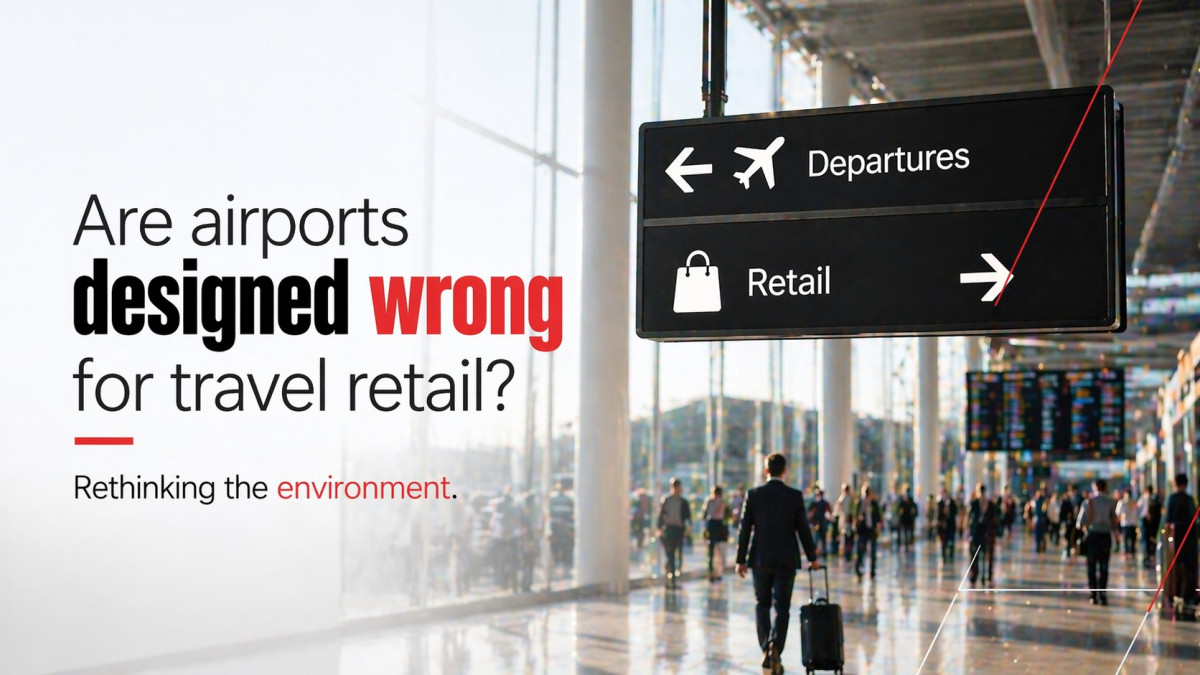
Modern airports are not built for travel retail. That, I am afraid, is a fact. We as an industry focus on key ideas such as experience, digital, price and personalisation. They are important, but if the foundations we are building on are wrong, then we will always struggle.
This begs a simple question: Are airports themselves designed to support the way people now shop?
Recent data from m1nd-set, presented at the APTRA India Conference, highlights a contradiction that should give the industry pause. Indian travellers are among the most time-rich passengers in the market. In theory, this should make them highly valuable retail customers. In practice, many are not engaging. The reason is simple. They only interact with what sits directly on their path.
This reinforces a truth the industry has always known, but not always acted on with enough discipline: location is not a detail in travel retail. It is the strategy.
When you look at the reality of delivering retail space in airports, the disconnect is often clear. Retail is still too frequently treated as an addition — something layered onto an existing terminal design — rather than something embedded into the flow of the passenger journey from the outset. It is something we see constantly first-hand at 2.0 & Partners and I can tell you, that approach no longer works.
Location is not a detail in travel retail. It is the strategy.
The modern traveller moves differently. They expect efficiency. They expect clarity. They expect spaces that allow them to transition seamlessly between needs such as eating, working, browsing and discovering, without friction.
When retail sits out of the way, disconnected from that flow, it becomes optional. And optional space quickly becomes empty space. Worse still, long, empty corridors leading to sparse gate areas are actively taking away from both the experience and the opportunity.
What we create in those moments is not opportunity, but dead time.
More concerning is the fact that many new airports are still being designed with these outdated assumptions built in. We are, in effect, constructing environments that are already misaligned with the behaviours of the travellers who will use them.
There is no reason for this to be the case. There are people who can advise on the habits of shoppers and travellers in a retail space. Those people are the retailers and brands themselves. This closer collaboration is no longer optional when it comes to development.
More concerning is the fact that many new airports are still being designed with outdated assumptions built in.
Retailers and brands must be involved far earlier in the design and planning process. They understand exactly how shoppers behave. The know what drives engagement, and they can see how environments can either encourage or suppress interaction. This is knowledge and insight which must be embedded from the outset. Asking experts to deliver excellence in a space which is wrong presents problems – when that space has been designed for that specific purpose, that is madness.
Domestic retail has already moved in this direction. Traditional mall formats are being reworked into more fluid, accessible spaces which are designed both for efficiency and for exploration, depending on the shopper’s mindset.
Travel retail cannot afford to lag behind that evolution.
Because there is a simple reality we cannot ignore: travellers do not come to the airport to shop. They come to catch a flight. Everything else must fit around that priority; seamlessly, intuitively, and without effort. If it does not, the traveller will default to the easiest alternative. And increasingly, that alternative sits in their hand.
Travellers do not need to shop at airports. It is up to us to inspire them to do so and that process begins with the creation of the space itself. Today, not only is that space not supporting retail, it is – in some cases – actively working against it.