
In recent years, travel retail has continued to grow in terms of flows, visibility and investment. But beneath the surface, deep, structural problems are accumulating. Problems that everyone knows about, but no one addresses publicly.
This is not a temporary crisis. It is a gradual detachment from the reality of today’s traveller, who is more informed, more demanding and more aware.
Travel retail is historically a closed market, with high barriers to entry and a level of competition that is often more formal than real. And it is precisely in this kind of environment that the culture of the status quo tends to thrive. Positions are protected, existing models are preserved, and evolution is postponed. Those already inside defend their ground. Those on the outside rarely break through. The result is an ecosystem that barely moves, rarely challenges itself and inevitably struggles to innovate.
That is why a shift is needed. And it is needed now.
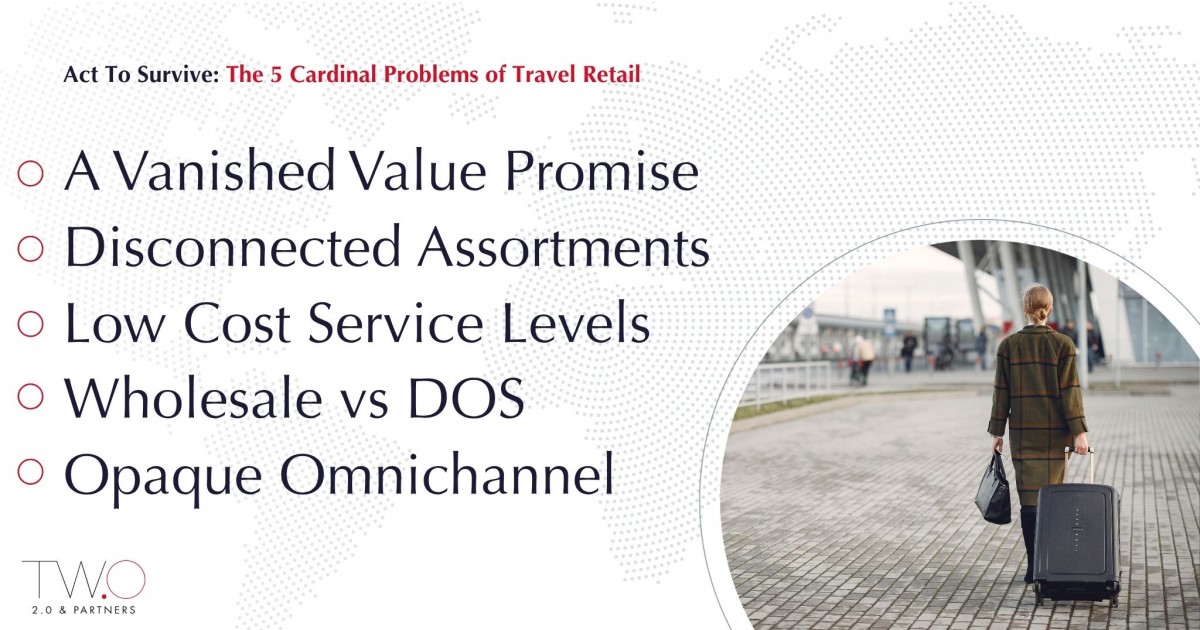
1. A vanished value promise
Duty free was born from a clear promise: to offer travellers a compelling value proposition. Today, that promise no longer exists. Prices are not competitive, and travellers know it. They have learned to compare, to verify, to decide in advance, and the online market, which has grown exponentially over the past 10 to 15 years, offers them endless alternatives.
Yet travel retail acts as if passengers are still living in the past. No dynamic pricing, no transparency, no willingness to engage in honest comparison. The result is obvious: Passenger traffic grows, but conversion rates fall. Because shoppers are no longer willing to buy on faith. They want to know if it’s worth it. And too often, the answer is no.
2. Low cost service in a supposedly premium context
Service is the face of travel retail. It is the voice that welcomes, the look that guides, the gesture that solves. But today, in the vast majority of cases, it is the weakest link in the entire experience.
Frontline staff in retail, F&B, assistance and security are often left unsupported, poorly trained and without a real understanding of their role. This is not always improvisation. More often, it is approximation, brought about by rushed, superficial, and standardised training. The situation worsened after Covid. Many experienced professionals were laid off. New staff were hired hastily, without onboarding, without knowledge transfer, without building any culture. The result is a workforce holding the stage but lacking ownership or authority.
In F&B, the paradox is even more striking. Formats have evolved. Elegant interiors, curated designs, gourmet ambitions. But behind the façade are the same operators, the same logistics chains, the same quantitative mindset. It is not uncommon to sit down in a bistro promising a premium experience and end up with a sandwich indistinguishable from the grab and go outlet across the hall. Only the packaging has changed. Customers notice. And they feel deceived.
3. Too much wholesale, too little DOS
Travel retail still operates on a model of delegated operations. Brands, even those with strong identities, surrender direct control and hand over execution to the same usual operators in a wholesale setup. This applies to retail but is especially true in F&B.
The result is a weak, impersonal, standardised presence. Brands provide the guidelines but then lose control over everything else. Staff selection, stock management, display consistency, service standards. The outlet becomes a showcase, not a true brand extension.
Direct Operation (DOS), where feasible, is not about margins. It is about positioning, consistency and accountability. Today’s customers can tell when a brand is truly present and when it is just lending its name. In today’s competitive environment, that authenticity makes the difference between a memorable experience and a forgettable one.
4. Outdated and opaque omnichannel approach
Modern travellers are digital, informed, and used to planning ahead. The customer journey no longer begins at the airport. It starts before. Yet travel retail still insists on living only within the physical terminal.
Omnichannel services remain rare. Pre ordering, click and collect, advance payment, post trip delivery. But what is completely lacking is informational transparency. No integrated system allows customers to check prices in advance, compare offers or make considered decisions. In 2025, this is no longer a nice to have. It is a baseline expectation.
Travellers no longer want to discover whether something is a good deal once they are at the gate. They want to know before. And if they cannot, they simply will not buy.
5. Out of control assortments
The core categories of duty free are bloated with unnecessary SKUs, driven by outdated commercial practices like listing fees, which grant shelf space regardless of product value. The result is a repetitive, chaotic, uninspired offer; travellers face shelves that all look the same, filled with items that fail to stand out or connect.
What is needed is a leaner, more curated, customer driven approach. We need fewer products, but more relevance, with no duplication and a clear logic, not over saturation. There must be a focus on newness, rotation and products that align with traveller profiles. An assortment must have direction. It must make sense. It is not about offering everything. It is about offering what matters.
The 5 moves to survive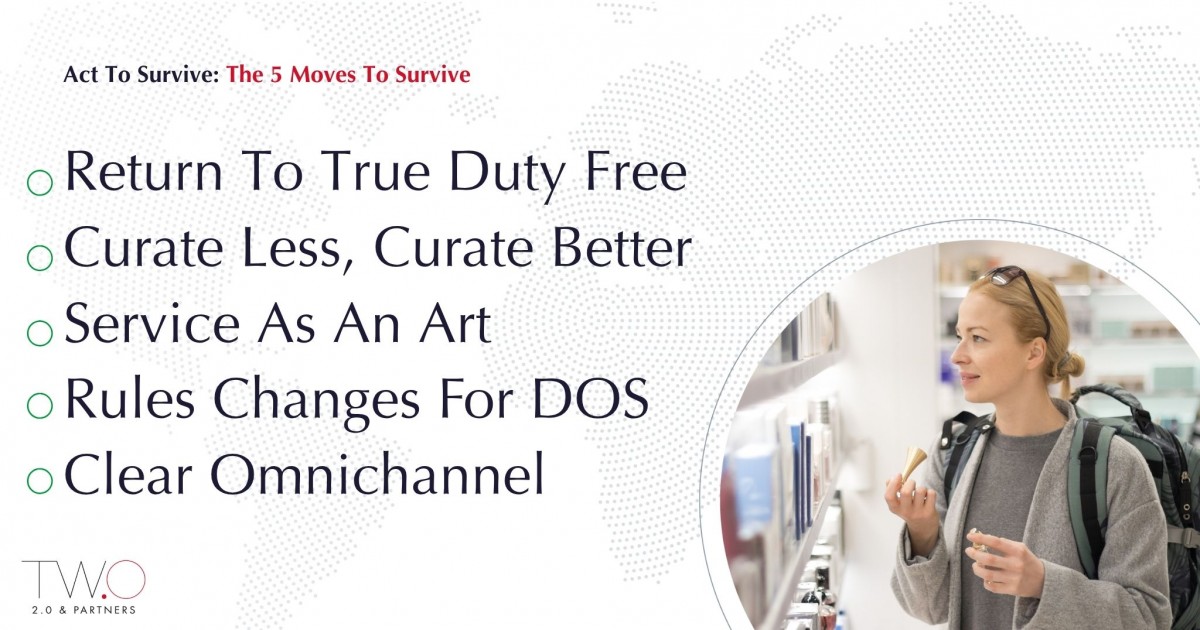
1. RSP must return to being true duty free
The original strength of travel retail was its clarity: prices that clearly beat the domestic market. That was the foundation of its value proposition. Today, that foundation has crumbled. Travellers no longer perceive a benefit, because the benefit no longer exists.
The problem is not margin chasing. The problem is that an unsustainable cost structure has erased the very advantage the customer was promised, and when that promise disappears, so does credibility.
If duty free is to mean anything, the RSP must follow one rule: domestic price minus 20%.
Full stop. No marketing spin.
That difference must be real, measurable and transparent. Only then can the channel regain credibility, rebuild trust, and convert traffic into real business, for the benefit of all stakeholders.
2. Serving is a skill and an art
Technical skills can be taught. But great service is more than technique. It is a mindset, a culture, a responsibility. Frontline staff must know what to do, of course. But they must also understand why they do it.
Building skill requires solid training programmes. But conveying the art of service requires working on attitude and sensitivity. Pride in the role, joy in serving, understanding one’s place in the bigger picture. This takes time, consistency and cultural investment. Not a name tag and a two hour briefing.
3. Promoting DOS requires rule changes
Brands cannot operate directly if the system is structurally against it. Retail offers more room to manoeuvre, but in F&B, the current model makes DOS economically unviable.
Large operators enjoy economies of scale, particularly in staffing, that a standalone brand cannot replicate.
To encourage direct operation, dedicated conditions must be introduced. Rebalanced rents, financial incentives, selection processes that do not penalise those who seek authenticity and control. Otherwise, it will always be easier to hand over the keys and hope for the best. And in that scenario, real experiences will never be born.
4. Omnichannel must serve a clear function
Enough theory. Today’s systems must allow customers to:
- Check prices and availability before arriving
- Access online exclusive offers
- Order or pay in advance and collect on site
- Receive accurate, verified information
It must be intuitive, mobile first and integrated with the real travel journey. Check in, emails, screens, airport comms. It does not need to be impressive. It needs to be simple. And it must convert ahead of time.
5. Curate less, curate better
Core categories are cluttered with products no one asked for, included only because they paid to be there. Listing fees have turned assortments into commercial lists instead of strategic customer offers. This logic must change. The assortment must become a tool for relevance.
What is needed:
- Fewer SKUs.
- No duplications.
- Offers aligned with travellers and their needs.
- Space for new, timely, resonant products.
It is not about endless choice. It is about choosing what truly matters.
The time for excuses is over
Travel retail has everything it needs to thrive again. Unparalleled visibility. A captive audience. An international, affluent customer base. What is missing is not opportunity; it is the will to evolve.
The problems are clear, and the solutions exist. Now it is a matter of priorities: Those who act will regain relevance. Those who wait will lose ground.
Because in today’s market, standing still is the fastest way to disappear.