
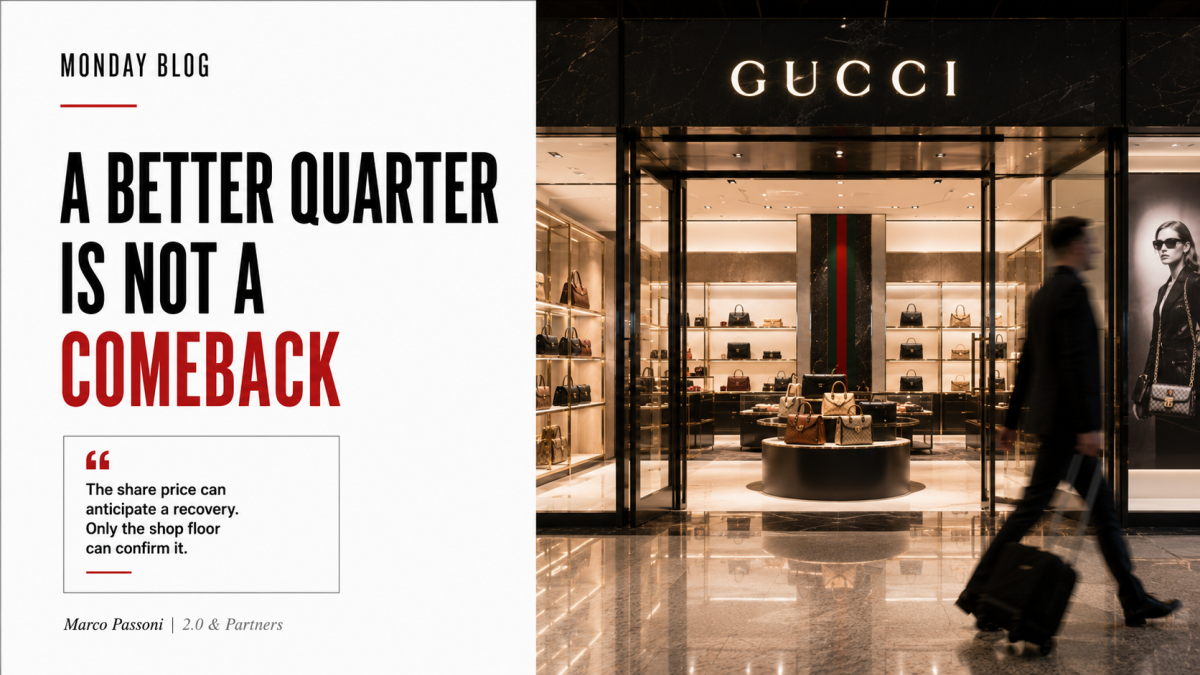
Gucci’s latest results are encouraging, and the market reacted quickly. Financial markets do not wait for a recovery to be completed; they try to anticipate it.
Gucci’s second-quarter revenue declined by 2% on a comparable basis, a significant improvement from the 8% fall recorded in the first quarter. New handbag lines gained traction, North America delivered stronger demand and Kering’s share price rose sharply following the announcement.
These are encouraging developments.
But encouragement and recovery are not the same thing.
Gucci generated €10.5 billion in revenue in 2022. By 2025, that figure had fallen to approximately €6 billion. The latest quarter was still the brand’s twelfth consecutive period of declining sales. One better result can indicate that the direction is changing, but it cannot yet demonstrate that the destination has been reached.
From an investor’s perspective, an inflection point may be sufficient to justify optimism. From a retail perspective, the threshold must be higher.
A turnaround is not when the decline becomes smaller; it is when customers begin choosing the brand again, repeatedly and at full value.
That change cannot be measured through revenue alone.
The real evidence sits deeper inside the retail operation. Are more customers entering stores with genuine purchase intent? Is conversion improving? Are new collections generating full-price sales after the initial launch period? Is growth spreading beyond a few successful products? Are existing clients returning, and are new clients entering the brand? Are client advisors converting renewed attention into stronger transactions and longer-term relationships?
These are the indicators that distinguish a temporary improvement from a sustainable recovery.
Gucci’s directly operated stores generated €1.275 billion in the second quarter, with comparable sales down 2%. This represented a seven-percentage-point improvement compared with the first quarter. The new Borsetto and Paparazzo lines contributed to the momentum, while North America remained the principal growth driver. Western Europe and Asia-Pacific showed early signs of improvement, although Mainland China remained challenging.
There is therefore substance behind the better result.
At the same time, a retail operator must interpret the numbers carefully.
Kering closed a net 84 stores during the first half of 2026 as part of a wider network optimisation programme. Gucci also improved its recurring operating margin to 17%, supported by cost discipline. Both actions are commercially sensible and necessary. A smaller, more productive network can strengthen the business, while tighter cost control can protect the resources required for future investment.
But store closures can improve average productivity by removing weaker locations. Cost reductions can improve margins before customer demand has fully recovered. A small number of successful products can also provide a strong quarterly boost without yet restoring the broader relevance of the brand.
The next test is therefore breadth.
The improvement must extend across products, regions, customer segments and store formats. It must be visible not only among very important clients, but also among the core and aspirational customers that once played a major role in Gucci’s scale. It must survive beyond campaign launches and initial product excitement. Most importantly, it must become consistent enough to be reproduced by different stores and different teams.
This is particularly relevant in Travel Retail.
Airport boutiques operate in an environment where visibility is expensive, passenger traffic is available but attention is limited. A recovering brand should not simply benefit from being noticed more frequently. It should generate a stronger stop rate, more meaningful customer engagement, better conversion, higher transaction value and a healthier mix of returning and newly recruited clients.
The airport shop floor can therefore provide an unusually clear test of brand momentum. Travellers have limited time, multiple competing stimuli and little patience for propositions that feel confused or irrelevant. Creative attention may bring them closer to the store, but product relevance, service and execution determine whether they enter and buy.
The share price can anticipate a recovery, but only the shop floor can confirm it.
Gucci deserves credit for the progress achieved during the second quarter. The decline has slowed materially, new products are attracting customers, margins have improved and the wider Kering organisation is showing greater financial and operational discipline.
But the strongest turnaround stories are not built on a single quarter, a stock-market reaction or a renewed communication narrative.
They are built when improved desirability becomes repeatable retail performance.
For Gucci, the next few quarters will reveal whether the business is merely declining more slowly or whether customers are genuinely returning to the brand.
That is the difference between stabilisation and recovery.
And in retail, it is the only difference that ultimately matters.