
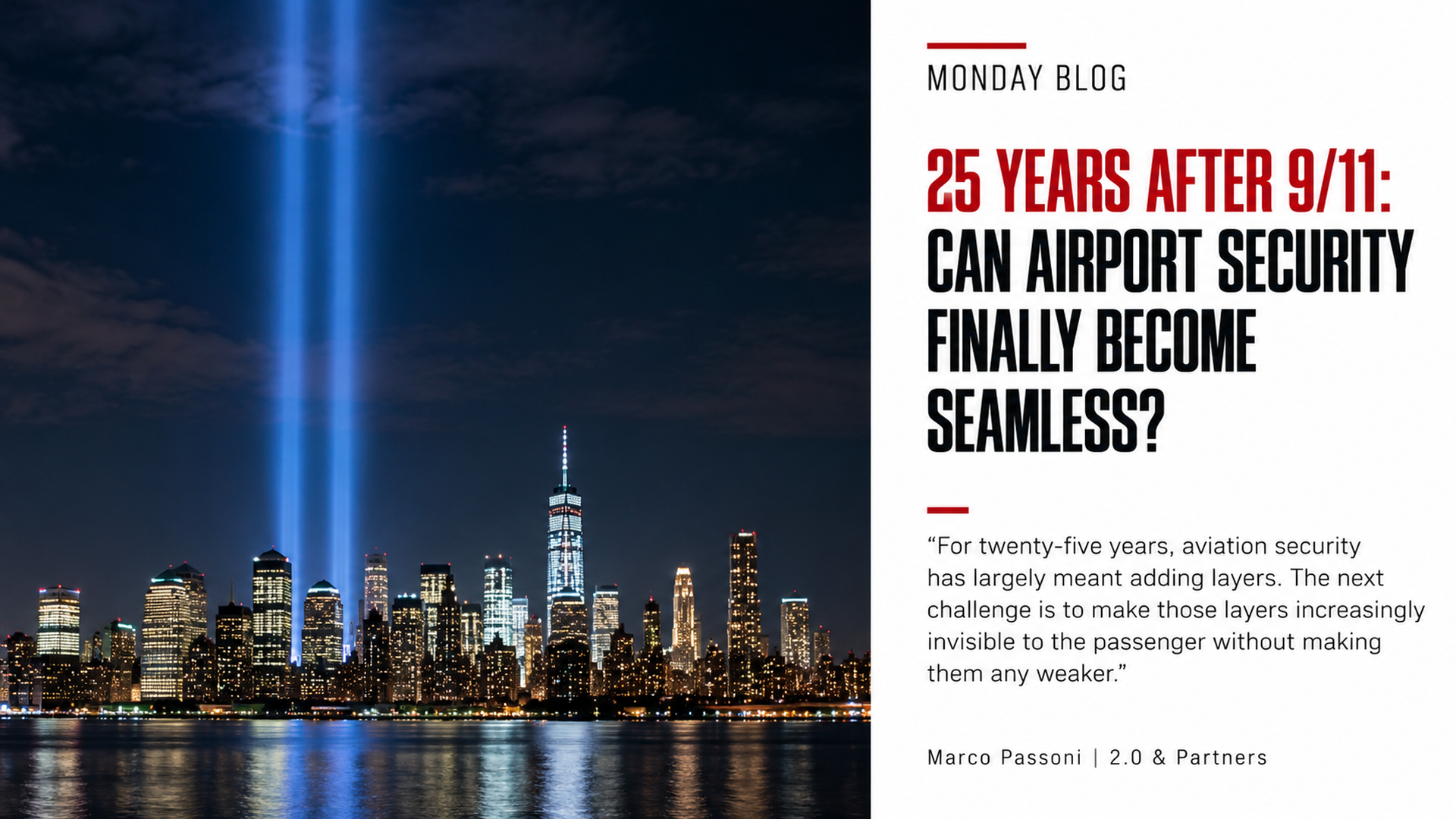
Last Friday marked the 25th anniversary of the attacks of 11 September 2001, and for many of us the anniversary inevitably brought back the images, the voices and the stories of that terrible day. Among them, the final calls made from the hijacked aircraft and the Twin Towers remain some of the most powerful reminders of the human tragedy behind an event that would go on to change the world in so many ways.
It is difficult to think of another single event that changed the way we travel so profoundly. Aviation was one of the areas transformed most visibly. In the years that followed, airport security was rebuilt around a very different perception of risk, with new procedures, new technology and progressively more layers between arriving at an airport and boarding an aircraft.
My perspective here is necessarily narrower. I work in Travel Retail, and what interests me is how those changes reshaped the passenger journey, how they affected the commercial environment around it, and why, twenty-five years later, we may now be entering another important phase of that evolution.
Before 9/11, aviation security obviously existed. What changed afterwards was its scale, consistency and underlying philosophy. In the United States, the creation of the Transportation Security Administration brought screening under federal control, while the new system required 100% checked-baggage screening, reinforced cockpit doors and a major expansion of the Federal Air Marshal Service.
And the process did not stop there. Later threats added further requirements. Shoes, liquids, electronics, body scanning, explosive trace detection and increasingly sophisticated baggage screening all became part of a passenger routine that would have been difficult to imagine in 2001.
Each measure had a reason. Taken together, however, they also changed the psychology and the choreography of travelling.
We learnt to arrive earlier. We learnt to prepare for security before reaching the belt. We learnt which items had to come out of the bag, what could be carried through and what could not. At many airports, the security checkpoint became one of the defining moments of the journey: necessary, increasingly sophisticated, but also capable of being unpredictable and stressful.
Travel Retail had to adapt around that reality. Security does not sit outside the commercial journey. It helps determine when that journey really begins.
For an airport retailer, the difference between a passenger who reaches airside calmly with ninety minutes ahead and one who reaches it after an unexpectedly long security queue with thirty minutes left is not simply sixty minutes of theoretical dwell time. They are two different customers, with different priorities and a very different willingness to browse, engage, eat, drink or buy.
The impact of security regulation has also been particularly visible in categories such as beauty and liquor. Restrictions on liquids changed what passengers could carry, how airport purchases had to be packaged and, particularly for transfer passengers, how carefully purchases had to be managed through subsequent checkpoints. Even today, rules can vary between airports as new screening technology is introduced. In the UK, for example, official guidance explicitly tells travellers to check the rules of the individual airport because some now permit larger liquid containers while others retain the traditional 100ml limit.
For much of the last twenty-five years, the answer to an evolving threat environment was understandably to add capability and add controls. What is interesting today is that the direction of travel is beginning to look different.
The objective is no longer simply to make security more sophisticated. It is increasingly to make sophisticated security easier for the passenger to navigate.
New-generation cabin-baggage screening systems can analyse baggage in far greater detail and, where deployed under the appropriate rules, reduce the need to remove items from hand luggage. The UK government, for example, describes the latest scanners as both more accurate in detecting prohibited items and capable of making screening simpler and faster for passengers.
At the same time, digital identity and biometrics are addressing another recurring source of friction: repeatedly proving who we are and whether we are entitled to travel. IATA's One ID vision is based on passengers arriving at the airport “Ready to Fly”, with relevant documents checked in advance and biometric identification allowing them to move through participating airport touchpoints without repeatedly presenting physical documents. In April this year, IATA said a series of international proofs of concept had demonstrated that this type of contactless, biometric-enabled journey is already technically achievable.
None of this means security is disappearing, nor should it. It means that twenty-five years of additional security capability are increasingly being combined with a different design objective: remove unnecessary friction without removing protection.
For twenty-five years, aviation security has largely meant adding layers. The next challenge is to make those layers increasingly invisible to the passenger without making them any weaker.
The commercial opportunity is sometimes reduced to a very simple equation: faster security gives passengers more dwell time, therefore they have more time to shop. There is truth in that, but I think it misses the more important point.
Time in an airport is not all of equal commercial value. Ten minutes spent worrying about whether you will make the gate is not the same as ten minutes spent relaxed in the commercial area. A passenger checking the departure board every thirty seconds behaves differently from one who feels in control of the journey.
That is why I would look at seamless security not only as a capacity or processing issue, but as part of the customer experience that precedes retail.
The commercial value of seamless security is not simply the time it gives back to the traveller, but the quality of the traveller it gives back to the airport.
Less friction can mean more than additional minutes. It can mean less stress, greater confidence in the time available and a passenger more receptive to what comes next.
That does not automatically produce a sale. Retail still has to do its job. The proposition needs to be relevant, the location needs to work, the assortment needs to make sense and the frontline still has to convert the opportunity. Faster security cannot rescue a weak commercial offer, but it can create better conditions in which a strong one can perform.
For airports, this also exposes a familiar problem. We often discuss the passenger journey as a collection of separate processes: check-in, security, border control, retail, food and beverage, lounges and boarding. The passenger does not experience it that way. It is one journey, and friction created in one part inevitably affects the experience of the next.
That is why investment in seamless processing should matter to commercial teams as much as it matters to operations. The value created by a better security process does not end when the passenger collects the bag from the tray.
Twenty-five years after 9/11, aviation security is incomparably more sophisticated than it was in 2001. That is an extraordinary achievement, built over decades of technology, intelligence, regulation and operational learning.
Perhaps the next achievement will be less visible. If security can continue becoming stronger while feeling simpler, faster and less intrusive, we will not be returning to the way people travelled before 9/11, nor should we.
We will be doing something much more difficult: preserving what twenty-five years of security development have taught us while giving passengers back some of the simplicity that was lost along the way.
For those of us working in Travel Retail, that is not a peripheral change to the journey. It could materially change the customer who arrives in front of us.
Marco Passoni has spent more than three decades in the travel retail industry, holding senior leadership roles across distribution, retail and business development. His career included 12 years as CEO of a leading international Duty Free distribution company and a further eight years managing a retail business operating fashion mono brand stores across several international airports.
Today, as Senior Executive Vice President and founding partner of 2.0 & Partners, he leads the development of innovative services and new business opportunities for brands, operators and airports across the global travel retail market. A former elite sailor and World Champion, Marco continues to spend much of his time airside, observing the industry first hand and helping partners and clients navigate the distinctive challenges and opportunities of this constantly evolving market.